 Amanze Chinonye
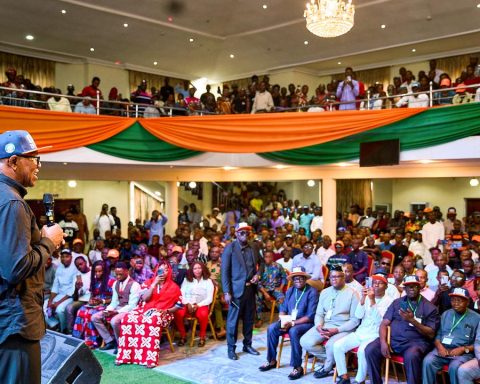
Former Anambra State governor and Labour Party presidential candidate, Peter Obi, has criticised the Federal Government over the reported expenditure of $9 million on foreign lobbyists in the United States, describing it as a stark example of misplaced priorities that continue to undermine Nigeria’s development.
Obi’s remarks come against the backdrop of renewed diplomatic pressure on Nigeria from Washington and heightened international scrutiny of the country’s security and human rights record.
In November 2025, the United States, under President Donald Trump, redesignated Nigeria as a Country of Particular Concern over persistent killings linked to religious violence, particularly in parts of northern Nigeria.
Join our WhatsApp ChannelThe decision followed sustained advocacy by U.S.-based rights and evangelical groups accusing Nigerian authorities of failing to protect vulnerable communities.
The designation raised fears of possible diplomatic and security consequences. Days later, U.S. Africa Command confirmed an airstrike on Islamic State-linked militants in north-western Nigeria, reinforcing Washington’s increasingly hardline posture.
It was within this context that filings under the U.S. Foreign Agents Registration Act (FARA), dated December 18, 2025, disclosed that the Nigerian government had engaged Washington-based firm DCI Group under a six-month contract reportedly worth $4.5 million, with a renewal option that could raise the total to $9 million. The firm was mandated to help Nigeria engage U.S. policymakers and counter allegations of religious persecution.
READ ALSO : Nigeria Engages Republican-Linked Firm in $9m Washington Lobbying Push
The disclosure triggered sharp domestic backlash, with critics questioning why Nigeria, which already maintains a diplomatic mission in Washington, would spend millions of dollars on foreign lobbyists while critical sectors at home remain underfunded.
In a statement on Friday, Obi said the spending reflected a broader culture of “waste, corruption, propaganda and lies,” arguing that such decisions have contributed to Nigeria’s long-standing development failures. He linked the issue directly to the country’s performance on the Human Development Index (HDI), noting that Nigeria has remained in the low HDI category for about 35 years, from 1990 to 2025.
He contrasted Nigeria’s trajectory with that of countries such as China and Indonesia, which were once in similar development brackets but have since advanced to medium and high HDI levels through what he described as deliberate policy choices and disciplined leadership.
Obi said Nigeria is failing across all three core HDI indicators health, education and per capita income despite having the resources to do better. Focusing on the health sector, he noted that Nigeria currently records the lowest life expectancy globally and ranks among the top two countries for maternal mortality, making childbirth “one of the most dangerous experiences” for Nigerian women.
To underscore his argument, Obi converted the $9 million lobbying expenditure to about ₦14 billion and compared it with the 2024 capital budget allocations for federal teaching hospitals. He cited ₦2.67 billion for University College Hospital, Ibadan; ₦2.46 billion for Ahmadu Bello University Teaching Hospital, Zaria; ₦2.8 billion for University of Nigeria Teaching Hospital, Enugu; ₦2.43 billion for University of Benin Teaching Hospital, Benin City; ₦1.16 billion for University of Ilorin Teaching Hospital, Ilorin; and ₦2.37 billion for University of Maiduguri Teaching Hospital, Maiduguri totalling roughly ₦13.9 billion.
According to Obi, the same funds spent on foreign lobbyists could have fully covered the capital budget of at least one major teaching hospital in each geopolitical zone, enabling the purchase of essential medical equipment, strengthening healthcare delivery and potentially saving thousands of lives.
He argued that Nigeria’s global image would be better improved by functional hospitals, rising life expectancy and reduced maternal deaths than by what he described as attempts to “manage perception abroad while governance collapses at home.”
“The funds are available,” Obi said, “what is lacking are prioritisation, discipline and effective leadership.”
The Federal Government has not denied the existence of the lobbying contract but has maintained that Nigeria’s security crisis affects both Christians and Muslims, rejecting claims of systematic religious persecution.
Nevertheless, the $9 million lobbying deal has become a flashpoint in a wider national debate about governance priorities, accountability and whether scarce public resources should be spent on image management or on fixing Nigeria’s deep-rooted structural problems.
Obi concluded by reiterating his long-standing message that “a New Nigeria is Possible,” insisting that meaningful change will only come when public resources are consistently directed toward improving the welfare and dignity of Nigerians.

Amanze Chinonye is a Staff Correspondent at Prime Business Africa, a rising star in the literary world, weaving captivating stories that transport readers to the vibrant landscapes of Nigeria and the rest of Africa. With a unique voice that blends with the newspaper's tradition and style, Chinonye's writing is a masterful exploration of the human condition, delving into themes of identity, culture, and social justice. Through her words, Chinonye paints vivid portraits of everyday African life, from the bustling markets of Nigeria's Lagos to the quiet villages of South Africa's countryside . With a keen eye for detail and a deep understanding of the complexities of Nigerian society, Chinonye's writing is both a testament to the country's rich cultural heritage and a powerful call to action for a brighter future. As a writer, Chinonye is a true storyteller, using her dexterity to educate, inspire, and uplift readers around the world.
- Amanze Chinonye
- Amanze Chinonye
- Amanze Chinonye
- Amanze Chinonye
- Amanze Chinonye
- Amanze Chinonye
- Amanze Chinonye
- Amanze Chinonye
- Amanze Chinonye
- Amanze Chinonye
- Amanze Chinonye
- Amanze Chinonye
- Amanze Chinonye
- Amanze Chinonye
- Amanze Chinonye
- Amanze Chinonye
- Amanze Chinonye
- Amanze Chinonye
- Amanze Chinonye
- Amanze Chinonye
- Amanze Chinonye
- Amanze Chinonye
- Amanze Chinonye
- Amanze Chinonye
- Amanze Chinonye
- Amanze Chinonye
- Amanze Chinonye
- Amanze Chinonye
- Amanze Chinonye
- Amanze Chinonye
- Amanze Chinonye
- Amanze Chinonye
- Amanze Chinonye
- Amanze Chinonye
- Amanze Chinonye
- Amanze Chinonye
- Amanze Chinonye
- Amanze Chinonye
- Amanze Chinonye
- Amanze Chinonye
- Amanze Chinonye
- Amanze Chinonye
- Amanze Chinonye
- Amanze Chinonye
- Amanze Chinonye
- Amanze Chinonye
- Amanze Chinonye
- Amanze Chinonye
- Amanze Chinonye
- Amanze Chinonye
- Amanze Chinonye
- Amanze Chinonye
- Amanze Chinonye
- Amanze Chinonye
- Amanze Chinonye
- Amanze Chinonye
- Amanze Chinonye
- Amanze Chinonye
- Amanze Chinonye
- Amanze Chinonye
- Amanze Chinonye
- Amanze Chinonye
- Amanze Chinonye
- Amanze Chinonye
- Amanze Chinonye
- Amanze Chinonye
- Amanze Chinonye
- Amanze Chinonye
- Amanze Chinonye
- Amanze Chinonye
- Amanze Chinonye
- Amanze Chinonye
- Amanze Chinonye
- Amanze Chinonye
- Amanze Chinonye
- Amanze Chinonye
- Amanze Chinonye
- Amanze Chinonye
- Amanze Chinonye
- Amanze Chinonye
- Amanze Chinonye
- Amanze Chinonye
- Amanze Chinonye
- Amanze Chinonye
- Amanze Chinonye
- Amanze Chinonye
- Amanze Chinonye
- Amanze Chinonye
- Amanze Chinonye
- Amanze Chinonye
- Amanze Chinonye
- Amanze Chinonye
- Amanze Chinonye
- Amanze Chinonye
- Amanze Chinonye
- Amanze Chinonye
- Amanze Chinonye
- Amanze Chinonye
- Amanze Chinonye
- Amanze Chinonye
- Amanze Chinonye
- Amanze Chinonye
- Amanze Chinonye
- Amanze Chinonye
- Amanze Chinonye
- Amanze Chinonye
- Amanze Chinonye
- Amanze Chinonye
- Amanze Chinonye
- Amanze Chinonye
- Amanze Chinonye
- Amanze Chinonye
- Amanze Chinonye
- Amanze Chinonye
- Amanze Chinonye
- Amanze Chinonye
- Amanze Chinonye
- Amanze Chinonye
- Amanze Chinonye
- Amanze Chinonye
- Amanze Chinonye
- Amanze Chinonye
- Amanze Chinonye
- Amanze Chinonye
- Amanze Chinonye
- Amanze Chinonye
- Amanze Chinonye
- Amanze Chinonye
- Amanze Chinonye
- Amanze Chinonye
- Amanze Chinonye
- Amanze Chinonye
- Amanze Chinonye
- Amanze Chinonye
- Amanze Chinonye
- Amanze Chinonye
- Amanze Chinonye
- Amanze Chinonye
- Amanze Chinonye
- Amanze Chinonye
- Amanze Chinonye