 Amanze Chinonye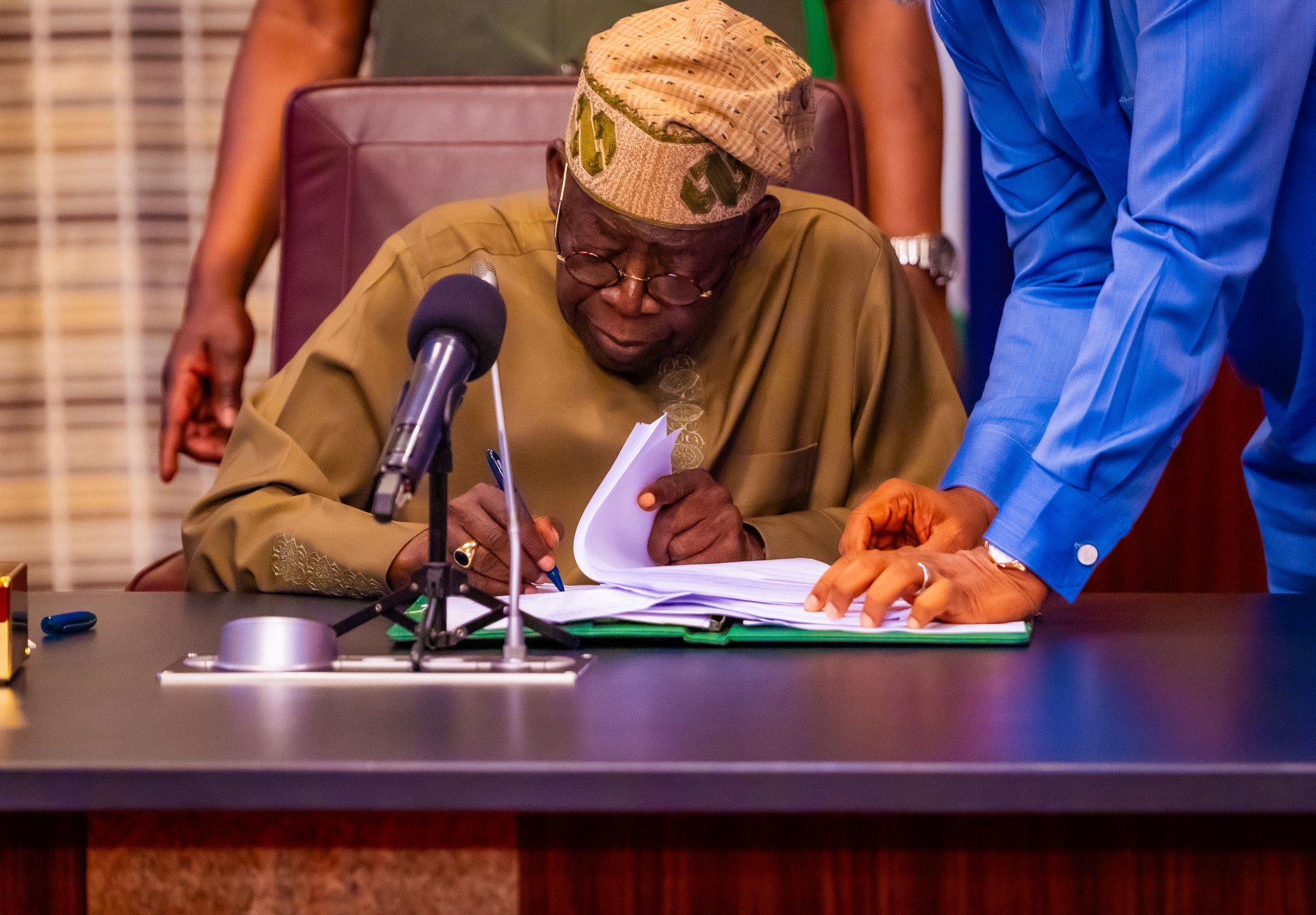
President Tinubu has signed into law the Electoral Act 2026, a sweeping repeal and re-enactment of the 2022 legislation that will regulate Nigeria’s 2027 general elections, following weeks of intense parliamentary exchanges over the role of technology in result transmission, Prime Business Africa reports.
The President signed the bill at the State House Abuja, in the presence of Senate President Godswill Akpabio, Speaker of the House of Representatives Tajudeen Abbas, and Chief of Staff Femi Gbajabiamila, among other senior officials.
The new statute replaces the Electoral Act 2022 and introduces fresh provisions governing the collation and transmission of results, the deployment of digital tools, and fallback options where technological systems fail.
Join our WhatsApp ChannelTinubu Backs Caution on Technology
Addressing concerns surrounding electronic transmission, Tinubu stressed that elections remain fundamentally people-driven processes, not computer-controlled exercises.
“You are not going to be talking to the computer for final results; you will be talking to human beings who will announce them,” the President said, underscoring that votes are cast, counted, and recorded manually at polling units.
He warned against vulnerabilities associated with digital systems, noting the need to guard against “glitches, interference and unnecessary hacking,” especially in an era of expanding cyber threats.
Tinubu also questioned Nigeria’s broadband strength and technical preparedness to sustain nationwide real-time transmission, arguing that infrastructure gaps must be considered in shaping electoral policy.
While defending technological innovation, he maintained that arithmetic entries transmitted electronically originate from manually collated Form EC8A results.
The President urged citizens to maintain trust in democratic institutions, saying robust debate over electoral processes is healthy for nation-building and stability.
READ ALSO : Senate Passes New Electoral Act After Row Over Electronic Results Clause
Nigerian Senate Reduces Notice Period for 2027 Elections
Flashpoints in the Senate
The legislation’s passage at the National Assembly was anything but routine. In the Senate, deliberations grew tense over Clause 60, which addresses procedures when electronic transmission fails.
Senator Enyinnaya Abaribe (ADC, Abia South) pushed for a formal division on the clause, seeking to eliminate a proviso that permits manual transmission in cases of network disruption.
Deputy Senate President Barau Jibrin countered that the matter had already been ruled upon, citing Senate rules against revisiting settled issues a position that sparked heated exchanges on the floor.
Senate Leader Opeyemi Bamidele defended the motion for rescission that reopened consideration of earlier decisions, arguing that previous positions had effectively lapsed.
When the chamber proceeded to a vote, 55 senators supported retaining the proviso allowing manual transmission as a safeguard, while 15 opposed it. The ruling was sustained by Senate President Akpabio after the count.
The session, at one point, descended into consultations and was briefly moved behind closed doors before proceedings resumed.
Discord in the Green Chamber
The debate spilled into the House of Representatives, where lawmakers contested a motion to rescind earlier approval of compulsory real-time electronic transmission of results.
Speaker Abbas ruled in favour of the motion after a voice vote, despite audible objections from opposition members who claimed the “nays” were louder. The disagreement prompted protests on the floor and led to an executive session.
The House had previously adopted mandatory real-time transmission to the Independent National Electoral Commission’s result portal in December 2025, a position later aligned with the Senate’s revised stance permitting manual alternatives where necessary.
Framework for 2027
With presidential assent secured, the Electoral Act 2026 becomes the operational blueprint for the 2027 polls. It codifies both electronic transmission and manual fallback mechanisms, reflecting a compromise between technological ambition and infrastructural realities.
The controversy surrounding the amendments highlights lingering divisions over how best to balance transparency, efficiency and resilience in Nigeria’s electoral system.
As preparations gradually shift toward the next general elections, attention is expected to focus on implementation by the electoral commission and the country’s capacity to deliver credible polls under the revised framework.

Amanze Chinonye is a Staff Correspondent at Prime Business Africa, a rising star in the literary world, weaving captivating stories that transport readers to the vibrant landscapes of Nigeria and the rest of Africa. With a unique voice that blends with the newspaper's tradition and style, Chinonye's writing is a masterful exploration of the human condition, delving into themes of identity, culture, and social justice. Through her words, Chinonye paints vivid portraits of everyday African life, from the bustling markets of Nigeria's Lagos to the quiet villages of South Africa's countryside . With a keen eye for detail and a deep understanding of the complexities of Nigerian society, Chinonye's writing is both a testament to the country's rich cultural heritage and a powerful call to action for a brighter future. As a writer, Chinonye is a true storyteller, using her dexterity to educate, inspire, and uplift readers around the world.
- Amanze Chinonye
- Amanze Chinonye
- Amanze Chinonye
- Amanze Chinonye
- Amanze Chinonye
- Amanze Chinonye
- Amanze Chinonye
- Amanze Chinonye
- Amanze Chinonye
- Amanze Chinonye
- Amanze Chinonye
- Amanze Chinonye
- Amanze Chinonye
- Amanze Chinonye
- Amanze Chinonye
- Amanze Chinonye
- Amanze Chinonye
- Amanze Chinonye
- Amanze Chinonye
- Amanze Chinonye
- Amanze Chinonye
- Amanze Chinonye
- Amanze Chinonye
- Amanze Chinonye
- Amanze Chinonye
- Amanze Chinonye
- Amanze Chinonye
- Amanze Chinonye
- Amanze Chinonye
- Amanze Chinonye
- Amanze Chinonye
- Amanze Chinonye
- Amanze Chinonye
- Amanze Chinonye
- Amanze Chinonye
- Amanze Chinonye
- Amanze Chinonye
- Amanze Chinonye
- Amanze Chinonye
- Amanze Chinonye
- Amanze Chinonye
- Amanze Chinonye
- Amanze Chinonye
- Amanze Chinonye
- Amanze Chinonye
- Amanze Chinonye
- Amanze Chinonye
- Amanze Chinonye
- Amanze Chinonye
- Amanze Chinonye
- Amanze Chinonye
- Amanze Chinonye
- Amanze Chinonye
- Amanze Chinonye
- Amanze Chinonye
- Amanze Chinonye
- Amanze Chinonye
- Amanze Chinonye
- Amanze Chinonye
- Amanze Chinonye
- Amanze Chinonye
- Amanze Chinonye
- Amanze Chinonye
- Amanze Chinonye
- Amanze Chinonye
- Amanze Chinonye
- Amanze Chinonye
- Amanze Chinonye
- Amanze Chinonye
- Amanze Chinonye
- Amanze Chinonye
- Amanze Chinonye
- Amanze Chinonye
- Amanze Chinonye
- Amanze Chinonye
- Amanze Chinonye
- Amanze Chinonye
- Amanze Chinonye
- Amanze Chinonye
- Amanze Chinonye
- Amanze Chinonye
- Amanze Chinonye
- Amanze Chinonye
- Amanze Chinonye
- Amanze Chinonye
- Amanze Chinonye
- Amanze Chinonye
- Amanze Chinonye
- Amanze Chinonye
- Amanze Chinonye
- Amanze Chinonye
- Amanze Chinonye
- Amanze Chinonye
- Amanze Chinonye
- Amanze Chinonye
- Amanze Chinonye
- Amanze Chinonye
- Amanze Chinonye
- Amanze Chinonye
- Amanze Chinonye
- Amanze Chinonye
- Amanze Chinonye
- Amanze Chinonye
- Amanze Chinonye
- Amanze Chinonye
- Amanze Chinonye
- Amanze Chinonye
- Amanze Chinonye
- Amanze Chinonye
- Amanze Chinonye
- Amanze Chinonye
- Amanze Chinonye
- Amanze Chinonye
- Amanze Chinonye
- Amanze Chinonye
- Amanze Chinonye
- Amanze Chinonye
- Amanze Chinonye
- Amanze Chinonye
- Amanze Chinonye
- Amanze Chinonye
- Amanze Chinonye
- Amanze Chinonye
- Amanze Chinonye