 Prosper Okoye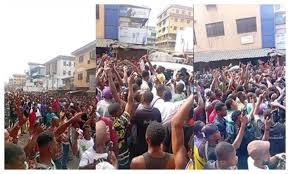
Young apprentices known as umu-boi staged a protest at Onitsha Main Market on Tuesday, following the closure of the market by the Anambra State Government.
The demonstration has raised concerns about a potential confrontation between youths and security forces in a region with a history of violent clashes.
The market, one of the largest in the Southeast, was shut on Monday by Governor Chukwuma Soludo, who said the measure was necessary to end the long-standing “sit-at-home” observance enforced by groups linked to the Indigenous People of Biafra (IPOB).
Join our WhatsApp ChannelSoludo described the ritual as a drain on the state’s economy and warned traders that defiance could result in the destruction of their businesses.
Despite the government directive, traders had planned to reopen the market on Tuesday. But when they arrived, they were met with a heavy security presence, including military personnel and anti-riot police, enforcing a one-week closure. Most shop owners opted to leave, citing the presence of armed forces.
“The apprentices don’t own shops, but each time the market closes, they don’t earn daily pay,” said one trader, who asked not to be named. “Their training stops, and they fear for their future.”
Unlike the shop owners, the umu-boi — young men and women serving under the traditional apprenticeship system — staged a spontaneous protest after their employers left. Videos shared on social media showed the youths chanting and demonstrating, raising fears of escalation given the region’s recent history of violent responses to IPOB-linked protests.
In a protest video circulating on social media, the youths were seen chanting solidarity songs for Nnamdi Kanu, leader of the proscribed IPOB group, who is currently in prison.
Marcel Mbamelo, publisher of Prime Business Africa, warned in an op-ed following the governor’s announcement of the market closure that the move could spark unrest. ‘The government’s heavy-handed approach risks turning what should be a temporary enforcement measure into a full-scale protest,’ he wrote. ‘History has shown that market closures in the Southeast, especially when enforced with armed security, have often provoked confrontation and, in some cases, tragic loss of life,’ he noted.
Legal experts and academics have echoed these concerns. Nnamdi Okonkwo, a lecturer at the University of Nigeria, Enugu Campus, called for direct engagement between government officials, market leaders, and youth representatives. “Once blood is shed, control is lost — not just on the streets but in public trust and regional stability,” he said.
Observers noted that while the umu-boi are not formally acting under IPOB directives, the optics of a youth-led protest against a backdrop of armed security risk misinterpretation and overreaction.
“It carries the risk of panic and fatal mistakes,” a legal practitioner at Upper Iweka told reporters.
Soludo Shuts Onitsha Main Market for One Week Over Sit-at-Home Defiance
Sit-at-Home, Markets, and the Politics of Economic Punishment in Anambra
Anambra 2025: History And Upset May Repeat
For now, the market remains closed, and tensions simmer. How the Anambra State Government responds in the coming days will be crucial in determining whether the protest escalates into a wider security crisis.

Prosper Okoye is a Correspondent and Research Writer at Prime Business Africa, a Nigerian journalist with experience in development reporting, public affairs, and policy-focused storytelling across Africa
- Prosper Okoye
- Prosper Okoye
- Prosper Okoye
- Prosper Okoye
- Prosper Okoye
- Prosper Okoye
- Prosper Okoye
- Prosper Okoye
- Prosper Okoye
- Prosper Okoye
- Prosper Okoye
- Prosper Okoye
- Prosper Okoye
- Prosper Okoye
- Prosper Okoye
- Prosper Okoye
- Prosper Okoye
- Prosper Okoye
- Prosper Okoye
- Prosper Okoye
- Prosper Okoye
- Prosper Okoye
- Prosper Okoye
- Prosper Okoye
- Prosper Okoye
- Prosper Okoye
- Prosper Okoye
- Prosper Okoye
- Prosper Okoye
- Prosper Okoye
- Prosper Okoye
- Prosper Okoye
- Prosper Okoye
- Prosper Okoye
- Prosper Okoye
- Prosper Okoye
- Prosper Okoye
- Prosper Okoye
- Prosper Okoye
- Prosper Okoye
- Prosper Okoye
- Prosper Okoye
- Prosper Okoye
- Prosper Okoye
- Prosper Okoye
- Prosper Okoye
- Prosper Okoye
- Prosper Okoye
- Prosper Okoye
- Prosper Okoye
- Prosper Okoye
- Prosper Okoye
- Prosper Okoye
- Prosper Okoye
- Prosper Okoye
- Prosper Okoye
- Prosper Okoye
- Prosper Okoye
- Prosper Okoye
- Prosper Okoye
- Prosper Okoye
- Prosper Okoye
- Prosper Okoye
- Prosper Okoye
- Prosper Okoye
- Prosper Okoye
- Prosper Okoye
- Prosper Okoye
- Prosper Okoye
- Prosper Okoye
- Prosper Okoye
- Prosper Okoye
- Prosper Okoye
- Prosper Okoye
- Prosper Okoye
- Prosper Okoye
- Prosper Okoye
- Prosper Okoye
- Prosper Okoye
- Prosper Okoye
- Prosper Okoye
- Prosper Okoye
- Prosper Okoye
- Prosper Okoye
- Prosper Okoye
- Prosper Okoye
- Prosper Okoye
- Prosper Okoye
- Prosper Okoye
- Prosper Okoye
- Prosper Okoye
- Prosper Okoye
- Prosper Okoye
- Prosper Okoye
- Prosper Okoye