 Prosper Okoye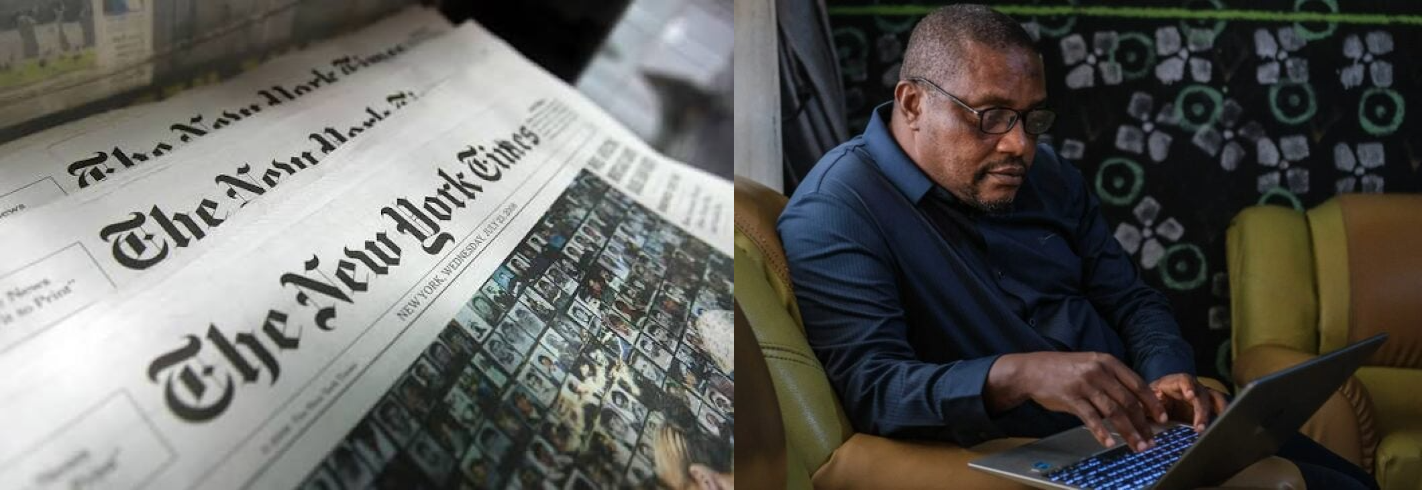
Rights group accuses US newspaper of misrepresentation, distortion and endangering its leadership
“At no point during our interaction with the New York Times did we say or imply many of the things now attributed to us. What has been published is a gross misrepresentation of our position and a dangerous distortion of our work,” the International Society for Civil Liberties and Rule of Law (Intersociety) has said.
The International Society for Civil Liberties and Rule of Law (Intersociety) has accused the New York Times of what it described as “deliberate falsehoods, misquotations and injurious framing” in a report published on Sunday, January 18, 2026, following an interview conducted with the organisation more than a month earlier.
Join our WhatsApp ChannelIn a lengthy statement issued in Onitsha, eastern Nigeria, on Monday, January 19, 2026, the rights group said the report, authored by the newspaper’s West Africa bureau chief, Ruth Maclean, falsely attributed statements to its leadership and misleadingly linked the interview to United States airstrikes carried out days later in northern Nigeria.
Background to the Interview
According to Intersociety, the interview in question took place on December 16, 2025, when Maclean visited its leader, criminologist Emeka Umeagbalasi, at his residence in Onitsha.
The organisation said Maclean was accompanied by a female photographer from Kwara State and Mr Dave Eleke of ThisDay newspaper, Awka, whom it described as a long-time associate of its leadership.
The visit, it said, was approved by Intersociety’s board and coincided with the organisation’s off-office pre-Christmas period. The interview reportedly lasted over three hours and was followed by a one-hour photographic session at a local market.
Intersociety also rejected what it termed attempts to ridicule or diminish its leader’s background, stressing that Mr Umeagbalasi is a trained criminologist with undergraduate and postgraduate degrees in Criminology and Security Studies as well as Peace Studies and Conflict Resolution, in addition to running a legitimate business in Onitsha.
‘We Were Shocked and Disappointed’
Intersociety said it was “shocked and totally disappointed” by the content of the New York Times report, arguing that several claims attributed to its leadership were never made during the interview.
It insisted that its documentation of attacks on Christians and churches in Nigeria since 2009 was conducted in line with international best practices under United Nations and African Union frameworks, and was unrelated to United States domestic politics or partisan debates.
“Our work has nothing to do with Republicans, Democrats, or American political culture wars,” the organisation said, adding that religious freedom remained a universal right applying to all faiths.
The group reiterated its long-standing figures, claiming that since 2009 an estimated 125,000 Christians and 60,000 Muslims had been killed outside the protection of religious freedom in Nigeria, alongside approximately 19,100 attacks on churches.
Objection to Link with US Airstrikes
A central grievance raised by Intersociety was the report’s headline and framing, which it said linked the December interview to US airstrikes carried out in Sokoto State on December 25, 2025—nine days after the interview.
The organisation said it could not understand why its interview was associated with the military operation, which Nigerian authorities and the United States government publicly acknowledged and celebrated as a joint action.
Intersociety warned that such framing could expose its leadership and offices to danger.
“We hereby place the world on notice,” the statement said, “that we hold the New York Times and its West African bureau chief vicariously liable should anything untoward happen to our leader, his family, or our offices.”
Disputed Claims and Alleged Misquotations
Intersociety went on to list specific areas where it said the New York Times report “grossly misrepresented” its position.
It rejected the use of first-person singular pronouns in the report, insisting that its leader spoke on behalf of the organisation and not as an individual.
The group also denied claims that its board chair admitted to not verifying data, stating instead that its data collection methods—both primary and secondary—were explained in detail during the interview.
It further disputed assertions that its findings relied mainly on Nigerian media, Christian groups or internet searches, saying it has conducted extensive field research across multiple regions, including southern Kaduna, Taraba, the South-East and South-South, with recent investigations in Enugu State.
Intersociety said it made clear to the New York Times that it operates as a human rights monitoring organisation rather than a media outlet, and that its volunteer researchers gather data directly where possible while relying on credible third-party reports when access is limited.
The group argued that such an approach aligns with international human rights documentation standards and allows it to cover a wider geographical spread than many other monitoring bodies.
Contested Reporting on Boko Haram Victims
The organisation strongly disputed claims attributed to it regarding Boko Haram victims, insisting that, particularly between 2009 and 2017, Christians constituted a majority of those killed.
It cited figures from the Church of Brethren in Nigeria, which reported that 8,600 of its members were killed between 2014 and 2020, with more than 300 church districts destroyed.
Intersociety also referenced the 2014 Chibok abductions, stating that more than 200 of the girls abducted were members of the same church.
Kebbi Abductions and Religious Identity
Addressing reporting on the abduction of schoolgirls in Kebbi State, Intersociety said it never claimed that “many” of the victims were Christians, but rather expressed suspicion that some Christian students could have been involved, given the nature of the school and the demographic composition of the area.
It said this view was supported by proceedings of the UK Parliament on religious freedom in June 2025, which highlighted attacks on Christian communities in the same locality.
Denial of Incitement Claims
The group also rejected claims that it described Fulani people as animals or suggested their confinement to a single state.
According to Intersociety, its position was that if the government’s cattle ranching policy lacked extremist intent, Niger State—Nigeria’s largest and agriculturally fertile state—could be developed into a central, modern livestock hub.
Sokoto Residents Report Militant Movement After US Airstrikes on Lakurawa Camps
Nigeria Police Refuse to Disclose Details of US Air Strikes in Sokoto
How Nigerian Trader’s Data Sparked US Air Strikes in Sokoto
Figures on Church Attacks
Intersociety clarified that it reported 19,100 churches attacked or destroyed since 2009, not “close to 20,000” as stated in the New York Times report. It added that its reference to an estimated 100,000 churches nationwide was contextual, not comparative.
Leadership and Contacts
Intersociety is led by Emeka Umeagbalasi, a criminologist and US State Department International Visitor Leadership Programme fellow. Other senior officials include human rights lawyers Chidinma Evangeline Udegbunam and Obiajunu Joy Igboeli, alongside Samuel Kamanyaoku, head of field data collection.
The organisation said it welcomed informed criticism of its work but insisted that misrepresentation and false attribution undermined both journalistic integrity and human rights advocacy.
Prosper Okoye is a Correspondent and Research Writer at Prime Business Africa, a Nigerian journalist with experience in development reporting, public affairs, and policy-focused storytelling across Africa