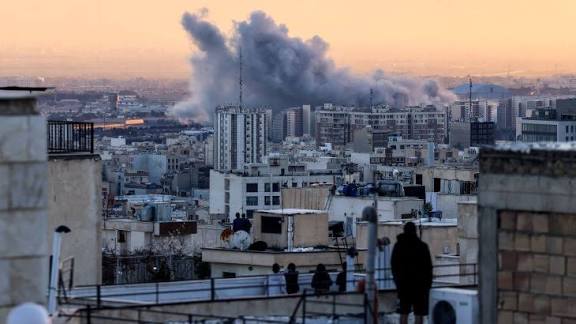
In the early hours of February 28, 2026, the Iranian capital awoke to coordinated airstrikes that marked one of the most consequential escalations in the region in years.
The operations—codenamed Roaring Lion and Epic Fury—unfolded with precision, targeting a web of political, military, and symbolic sites across Tehran. According to Iranian authorities, the death toll had reportedly reached around 1,000 as of Wednesday.
Following the initial strikes, it became clear that this was not a single attack but a sustained and layered campaign aimed at the very core of Iran’s state structure. From leadership compounds to public spaces, the operations demonstrated both reach and intent.
Join our WhatsApp ChannelFirst US Soldiers Killed in Iran Conflict Identified
Six American soldiers became the first confirmed US fatalities in the conflict with Iran. They died when an “unmanned aircraft system” evaded air defences to strike a command centre in Port Shuaiba, Kuwait, on Sunday.
US Central Command initially reported three deaths, but the toll later doubled after one soldier succumbed to injuries and two more bodies were recovered from the rubble.
Iran Power Centres Under Fire
The Pasteur district, long regarded as the administrative heartbeat of Tehran, bore the brunt of the initial assault. Missiles struck near the residence of Supreme Leader Ali Khamenei, as well as the Sa’dabad Complex and offices tied to the national security apparatus. The clustering of these targets pointed to a deliberate attempt to disrupt command and governance at the highest level.
Nearby, the presidential offices linked to Masoud Pezeshkian were also hit, though details of casualties remained unclear. In the absence of confirmed figures, uncertainty itself became part of the unfolding narrative—fuelled by restricted information flows and the scale of destruction.
Elsewhere in the capital, strikes extended into University Street, the Jomhouri district and the northern Seyed Khandan area. These locations, blending civilian life with institutional presence, underscored how the line between strategic and populated zones had effectively collapsed.
Civilian Spaces Caught in the Crossfire
Among the most devastating incidents was a strike on Minab School, where reports indicated 148 people were killed. The attack stood out not only for its toll but for what it represented: the intrusion of conflict into spaces assumed to be insulated from direct military targeting.
A day later, the scope widened further. Landmarks such as Azadi Stadium, Azadi Square and Milad Tower—symbols of civic identity and national pride—were hit. While no casualties were confirmed at these sites, their inclusion suggested a broader psychological dimension to the campaign.
Explosions near hospitals and the Peace Building of the Iranian Red Crescent Society reinforced concerns about proximity to humanitarian infrastructure. Even without reported deaths, the message was unmistakable: few places were beyond reach.
Security Apparatus Dismantled
On March 1, attention turned sharply toward Iran’s internal security framework. The Thar-Allah Headquarters, a key node in maintaining domestic control, was struck in what Israeli forces described as the destruction of a central command structure.
State media infrastructure was also targeted, with the national radio and television headquarters coming under attack. Though details remained scarce, the strike highlighted the role of information control as a parallel battleground.
Beyond the Capital
The campaign did not end in Tehran. On the same day as the initial strikes, cities including Qom, Kermanshah, Isfahan and Karaj were hit. While casualty figures were not immediately available, the geographic spread suggested a coordinated effort to stretch defensive capacities and amplify pressure nationwide.
Regional Reverberations
The conflict’s impact quickly spilled beyond Iran’s borders. In Iraq, strikes hit positions linked to the Popular Mobilisation Forces, with casualties reported among fighters in Jurf al-Sakhar. In Lebanon, areas associated with Hezbollah came under attack, though details were limited.
Meanwhile, Iran’s retaliatory actions reached deep into the Gulf. In the United Arab Emirates, missiles and drones triggered fires, injuries and isolated fatalities, including damage in high-profile areas such as Palm Jumeirah and near the Burj Khalifa.
Neighbouring states including Jordan and Saudi Arabia reported interceptions of missiles and drones, with varying degrees of damage but relatively limited casualties. Military installations across the region—from air bases to naval facilities—were placed on high alert as the confrontation widened.
Decapitation Strikes
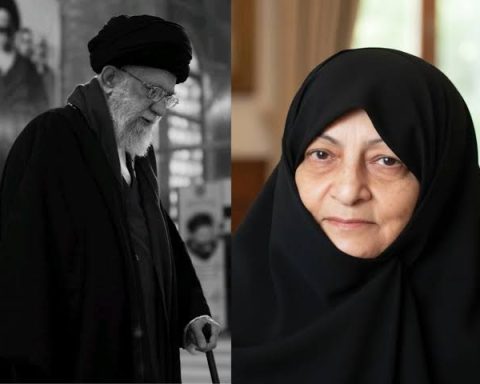
Perhaps the most far-reaching dimension of the campaign was the apparent targeting of Iran’s leadership. Among those reported killed were Iran’s Supreme Leader, Ali Khamenei, and his senior adviser, Ali Shamkhani, alongside a range of senior military and intelligence figures embedded within the country’s defence architecture.
The deaths cut across multiple layers of command—from the armed forces to defence research institutions—pointing to a strategy aimed at dismantling both operational capacity and institutional continuity.
The reported killing of Khamenei marked a turning point, removing a figure who had shaped Iran’s political and ideological direction for decades. The cumulative effect of these losses left gaps not easily filled, at least in the immediate term.
A Conflict Without Borders
As the fighting continues the human toll revealed a conflict no longer confined by geography. Iran recorded the highest casualties so far, with deaths estimated between 787 and 1,548 and hundreds more injured. But the impact rippled outward.
From Lebanon to the Gulf, from Iraq to distant nationals caught in the violence, the casualties reflected a region interconnected by both alliance and vulnerability. Even countries far from the immediate theatres reported losses among their citizens.
READ ALSO:
What began as a series of targeted strikes in Tehran had, within days, evolved into a multi-country confrontation—reshaping not only the military landscape, but the broader balance of stability across the Middle East.
Prosper Okoye is a Correspondent and Research Writer at Prime Business Africa, a Nigerian journalist with experience in development reporting, public affairs, and policy-focused storytelling across Africa


 Prosper Okoye