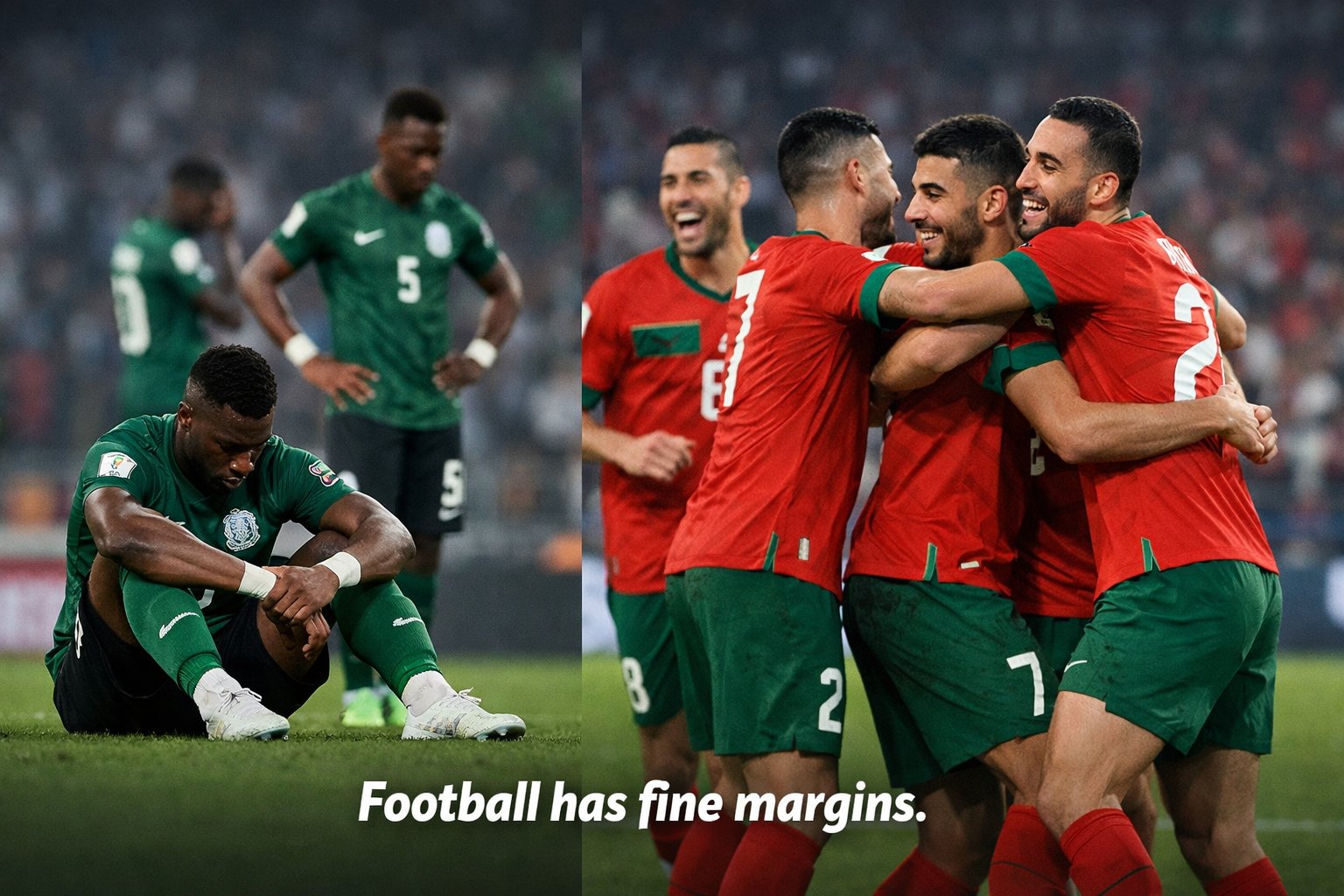
It will be a battle of “Lions” in the Africa Cup of Nations final as Morocco, the Atlas Lions, face Senegal’s Lions of Teranga, after the hosts beat Nigeria 4-2 on penalties in a dramatic semi-final.
The match, played at Stade Prince Moulay Abdallah in Rabat, ended 0-0 after extra time, with Morocco edging Nigeria in a tense shootout.
Tactical Battle Ends Goalless
The semi-final was a cautious affair, with both sides struggling to create clear chances. Nigeria’s Super Eagles, unbeaten in the tournament, were repeatedly denied by Morocco’s organised defence and inspired goalkeeping from Yassine Bounou.
Join our WhatsApp ChannelMorocco, buoyed by a passionate home crowd, pressed sporadically but could not break through a resilient Nigerian backline.
Penalty Shootout Drama
The outcome was decided from the spot. Morocco’s Neil El Aynaoui opened the scoring, with Nigeria’s Paul Onuachu immediately equalising.
Early misses from Hamza Igamane and Samuel Chukwueze kept the shootout level at 2-2 after two rounds.
Morocco then regained the lead through Eliesse Ben Seghir, matched by Nigeria’s Fisayo Dele-Bashiru.
In the decisive kicks, Achraf Hakimi calmly converted to make it 3-2 before Nigeria’s Bruno Onyemaechi missed, handing Morocco the win and sending the home crowd into celebration.
Morocco Set Up Final With Senegal
The victory ends Nigeria’s impressive run in the tournament and takes Morocco to their first AFCON final in decades.
AFCON 2025: ‘Morocco Is Beatable on Their Own Soil — I Was There on August 28, 1983’
The Raw Goat in Morocco 2025: AFCON and the Burden of Crude Representation
Obiano Congratulates Super Falcons On WAFCON Triumph Over Morocco
They will meet Senegal, who earlier beat Egypt in the other semi-final.
Morocco now chase their first Africa Cup of Nations title since 1976, while Nigeria, champions in 2013, fell just short of reaching the final

Prosper Okoye is a Correspondent and Research Writer at Prime Business Africa, a Nigerian journalist with experience in development reporting, public affairs, and policy-focused storytelling across Africa