 Prosper Okoye
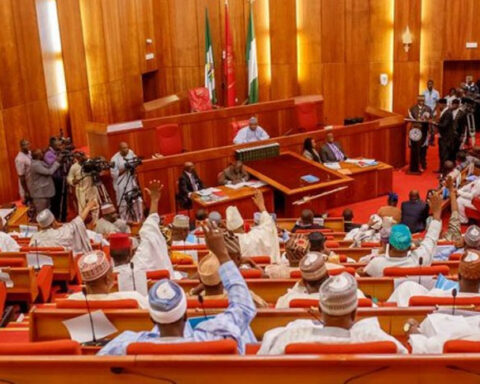
Senate has passed the Electoral Act 2022 (Repeal and Re-Enactment) Bill 2026 after a tense and sometimes chaotic debate over a key provision on the electronic transmission of election results.
Proceedings were disrupted when opposition lawmaker Enyinnaya Abaribe demanded a formal vote on Clause 60, which deals with how results should be transmitted if electronic systems fail.
Senate President Godswill Akpabio said he believed the demand had earlier been withdrawn, a claim immediately disputed by several opposition senators.
Join our WhatsApp ChannelThe Deputy Senate President, Barau Jibrin, argued that it would be out of order to reopen a matter on which the Senate President had already ruled. That intervention triggered further protests in the chamber, including a brief confrontation between Mr Abaribe and another senator.
Senate Leader Opeyemi Bamidele said a motion to rescind the earlier amendment had been formally moved, meaning previous decisions were no longer binding. He said Mr Abaribe’s demand was therefore valid.
Mr Abaribe then invoked the Senate’s standing orders to request a division on Clause 60(3), which allows manual transmission of results if electronic transmission fails. He argued that Form EC8A should not be used as the sole basis for collation where electronic transmission is unsuccessful.
During the vote, senators were asked to stand for or against the proviso. Fifteen senators opposed it, while 55 voted in favour, allowing the clause to remain in the bill.
Election Timetable Concerns
The debate came after the Senate had earlier agreed to rescind its initial passage of the bill to allow fresh consideration of its provisions.
Mr Bamidele said the move followed the release of a new election timetable by Independent National Electoral Commission (INEC), which scheduled the 2027 general elections for February.
READ ALSO:
Senator Natasha Protests Exclusion from Key Senate Committee
Senate U-Turn or Smoke Screen? Loopholes in Electoral Reform Persist
Senate Reverses Position, Endorses Electronic Transmission of Election Results
He said that date could conflict with the bill’s requirement that elections be held no later than 360 days before the end of the current administration’s term. Lawmakers also warned that, under the amended timetable, voting could fall during the Ramadan fasting period, potentially affecting turnout, logistics and overall participation.
The Senate also identified technical inconsistencies and drafting errors across several clauses of the bill, including problems with numbering, cross-referencing and internal alignment.
Following a closed-door session and clause-by-clause review, lawmakers proceeded to pass the re-enacted Electoral Act, paving the way for the revised legislation to move to the next stage of the legislative process.

Prosper Okoye is a Correspondent and Research Writer at Prime Business Africa, a Nigerian journalist with experience in development reporting, public affairs, and policy-focused storytelling across Africa