Amanze Chinonye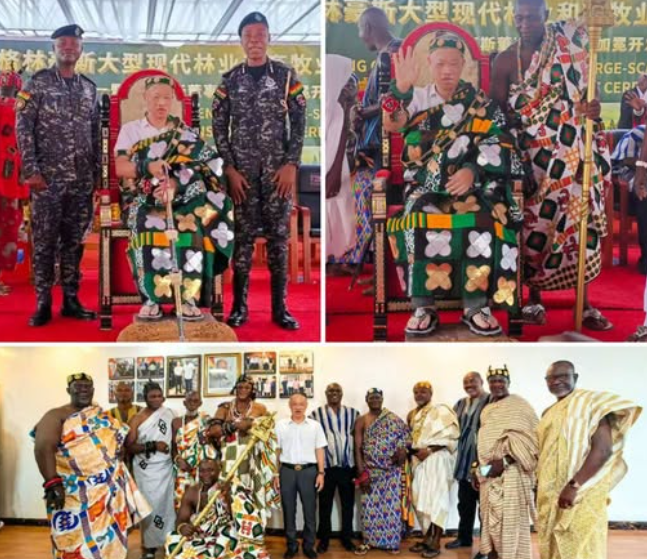
A Chinese investor’s installation as a traditional chief in Ghana is drawing attention to the role customary authorities can play in recognising foreign capital and strengthening ties between businesses and the communities where they operate.
Join our WhatsApp Channel
Zheng Xiangming, chairman of Greenhouse International Development Group Ghana Ltd, was installed as Hiowe Golaka Noryam Matse Nene Asumahtsu I, following years of investment in the country by his company.
READ ALSO :
The installation has attracted attention because Zheng is a foreign national. But the practice of granting traditional titles to people from outside a community in recognition of their contributions is not new in Ghana.
For traditional authorities, such recognition can help cement relationships with investors whose projects bring employment and commercial activity to their communities. For investors, close engagement with host communities can help build local support for projects that require access to land, labour and infrastructure.
Greenhouse has developed the Bright International Industrial Park at Afienya in Ghana’s Greater Accra Region. President John Dramani Mahama said in October 2025 that Zheng’s operations included almost 70 factories and had created more than 10,000 jobs.
The company is also developing the Bright International Amusement Park, a $300 million project expected to include a five-star hotel, conference and exhibition facilities, a water park, golf villas, an artificial beach and other leisure facilities.
The projects illustrate how large investments can make businesses significant economic actors within host communities, particularly where industrial or tourism developments create jobs and generate demand for local suppliers and services.
But the conferment of a traditional title on a foreign businessman has also raised questions among some Ghanaians about the limits of customary recognition and who should be eligible to hold traditional office.
Those concerns point to a broader tension facing Ghana’s chieftaincy institution as traditional authorities increasingly engage with businesses, government agencies and foreign investors.
Ghana’s chieftaincy system is rooted in customary law, and the status and authority attached to a stool depend on the traditions and jurisdiction of the relevant traditional authority. An honorary or development-oriented title does not, by itself, confer governmental powers on its holder.
Academic research on Ghanaian chieftaincy has documented cases in which migrants and foreigners have been recognised as development chiefs because of their contributions to local communities.
The practice can provide a channel for communities to acknowledge investment while strengthening relationships with people whose economic activities have a direct impact on local livelihoods.
But its value ultimately depends on what follows the ceremony.
READ MORE :
For communities, the measure of an investor’s contribution is likely to be reflected in jobs, local procurement, infrastructure and sustained economic activity. For investors, the value of community recognition may lie in the goodwill and relationships needed to maintain long-term operations.
Zheng’s installation offers a glimpse of how Ghana’s traditional institutions are interacting with a modern investment landscape in which foreign capital increasingly operates alongside customary structures that retain considerable influence at community level.
The debate surrounding his title is therefore about more than one businessman or one ceremony. It raises a wider question for Ghana: how traditional authority can support economic development and investor relations while preserving the customary foundations and public boundaries of the institution.

Amanze Chinonye is a Staff Correspondent at Prime Business Africa, a rising star in the literary world, weaving captivating stories that transport readers to the vibrant landscapes of Nigeria and the rest of Africa. With a unique voice that blends with the newspaper's tradition and style, Chinonye's writing is a masterful exploration of the human condition, delving into themes of identity, culture, and social justice. Through her words, Chinonye paints vivid portraits of everyday African life, from the bustling markets of Nigeria's Lagos to the quiet villages of South Africa's countryside . With a keen eye for detail and a deep understanding of the complexities of Nigerian society, Chinonye's writing is both a testament to the country's rich cultural heritage and a powerful call to action for a brighter future. As a writer, Chinonye is a true storyteller, using her dexterity to educate, inspire, and uplift readers around the world.