Opening Reflection: Before the First Whistle
Before every football match, there are predictions: supporters, pundits, journalists make them, and coaches quietly make them too. Even players step onto the field with expectations of how the match may unfold.
Statistics are analysed, historical records are revisited, head-to-head meetings are examined, current form is evaluated, injuries are considered, likely lineups are discussed, and every possible scenario is debated.
The referee then blows the whistle, and football begins writing a story that no human being can completely predict.
Join our WhatsApp ChannelThat is why I have often said:
Football Has No Human Script; It Has Its Own Script
As a football analyst and writer, before every major match, I begin preparation long before kickoff. I study tactics, examine statistics, revisit history, and consider the many storylines that could unfold.
Preparation matters; it gives us a foundation, and it sharpens our understanding.
After decades as an international footballer, coach, mentor, project management professional, football analyst, and writer, I have learnt one lesson that football never stops teaching.
Preparation Gives Us Possibilities; But Football Determines Reality
No tactical board can account for every bounce of the ball; no statistic can fully measure courage; no prediction can anticipate every moment of brilliance—or heartbreak.
That uncertainty is not football’s weakness; it is its greatest strength.
It is why ninety minutes can create memories that last a lifetime; it is why billions of people continue to fall in love with the game; and it is why football remains, in my view, the world’s most beautiful sport.
Spain’s Perfect Tournament Meets Football’s Greatest Truth
Going into their World Cup quarter-final against Belgium, Spain appeared almost untouchable; they had progressed through the tournament without conceding a single goal.
Match after match, opponents searched for weaknesses; none found one.
Their defensive organisation had been exceptional, their pressing was coordinated, their movement without the ball was disciplined, and their confidence grew with every victory.
Watching the match, I honestly believed Belgium would struggle to become the first team to score against Spain, not because Belgium lacked quality.
Far from it.
Belgium possessed enough attacking talent to punish any lapse in concentration, but Spain had given the football world little reason to believe such a lapse would come.
When Fabián Ruiz calmly finished in the 30th minute to give Spain a deserved 1–0 lead, the match seemed to be following the expected script.
Spain controlled possession while Belgium defended patiently; the rhythm favoured La Roja.
Many supporters probably believed another Spanish victory was only a matter of time. I understood that thinking; in truth, I had the same thought.
Then, football reminded us why it refuses to be imprisoned by statistics.
One Goal Changed Everything
Just eleven minutes later, Belgium produced the moment that transformed the entire quarterfinal: Charles De Ketelaere found the equaliser.
In an instant, Spain’s remarkable defensive record disappeared: one goal, one finish, one moment.
Spain had finally conceded, but the importance of that goal went far beyond the scoreboard; it changed the psychology of the match.
Belgium suddenly believed they could win, and Spain suddenly realised they were no longer managing a comfortable lead.
The tension inside the stadium increased; every pass carried greater significance, every attack carried greater danger.
Momentum no longer belonged exclusively to Spain, and that is one of football’s most fascinating qualities.
Sometimes a single goal changes not only the scoreline but also the entire game; it changes belief, confidence, emotion, and ultimately, the direction of the entire match.
When The Clock Lies
One lesson has been reinforced repeatedly throughout this World Cup: never assume you know how the story ends before the final whistle.
Throughout this tournament, we have witnessed dramatic late winners, stoppage-time heartbreak, and matches that appeared destined for extra time were suddenly decided by one decisive moment; this quarterfinal became another chapter in that story.
As the match approached ninety minutes, extra time looked increasingly inevitable.
Belgium had recovered; Spain continued searching; the tension became almost unbearable.
Then football wrote another ending that a few could have predicted before kickoff.
The Substitute Who Changed The Story
Football has always had an extraordinary way of producing unlikely heroes; sometimes they wear the captain’s armband, and sometimes they begin the match on the bench.
As the quarterfinal moved toward the ninetieth minute, Spain continued searching for the breakthrough that would spare them another thirty minutes of football.
Belgium had grown stronger after equalising; their confidence had replaced caution, every successful tackle increased belief.
Every Spanish attack carried greater urgency.
Extra time seemed inevitable.
Then came another reminder that football never follows a script written by human hands.
In the 88th minute, substitute Mikel Merino found the decisive goal: one finish, one defining moment, one place in World Cup history; Spain celebrated while Belgium stood in disbelief.
That goal demonstrated one of football’s greatest lessons: you do not have to start the match to become its hero.
Professional football demands that every player remain mentally prepared, regardless of whether the opportunity arrives in the first minute or the eighty-eighth.
Merino’s contribution was not measured by the number of minutes he played; it was measured by the impact of the moment he seized.
That is football; sometimes the smallest window creates the biggest memory.
The World Cup’s Unfinished Script
This quarterfinal was not an isolated drama; it reflected a pattern that has defined much of the 2026 FIFA World Cup.
Again and again, matches have refused to follow expectations; teams that appeared comfortably in control suddenly found themselves under pressure, matches destined for extra time were settled by late goals, favourites survived narrow escapes, and underdogs refused to surrender, and supporters celebrated, while others experienced heartbreak within moments.
That unpredictability is one of football’s greatest gifts; unlike many sports where superiority often reveals itself over time, football allows hope to survive until the final whistle.
One opportunity can change everything, one mistake can erase ninety minutes of excellent football, and one moment of brilliance can become the difference between elimination and history.
That uncertainty is precisely what makes the FIFA World Cup the most captivating sporting event on earth.
The World Cup Was Never A Tournament Of Perfection
Watching Spain against Belgium also reminded us of another important truth: even at football’s highest level, perfection does not exist.
The world’s finest players misplace passes, elite defenders lose concentration, world-class strikers miss chances, great coaches make decisions that are questioned, and referees occasionally make mistakes.
That reality explains why football continues to refine itself.
The introduction of the Video Assistant Referee (VAR) was never an admission that referees had failed; it was an acknowledgement that football is played and officiated by human beings.
Human beings are capable of remarkable excellence, and they are also capable of error.
Even with VAR, debate continues, supporters disagree, managers protest, and television analysts offer different interpretations.
Not because football is broken, but because football remains wonderfully human, perfection has never been the objective; continuous improvement has, and that philosophy extends beyond officiating; it applies to coaching, player development, sports science, medical care, and technology.
Every generation attempts to leave the game stronger than it inherited it; and that is how football evolves.
Now Comes A Semifinal Worthy Of The World Cup
Spain’s reward is a meeting with France.
For football supporters around the world, few semifinal pairings could generate greater anticipation.
These are two nations whose influence extends far beyond international football; both have produced World Cup champions, both continue producing extraordinary young talent, both possess world-class coaches, and both carry enormous expectations every time they take the field.
The tactical battle promises to be fascinating; Spain will seek to dominate possession with its patient, technically refined approach, while France possesses devastating pace, athleticism, and the ability to transform defence into attack within seconds.
It is a contrast of styles, a contrast of philosophies, a contrast worthy of a World Cup semifinal.
Regardless of the tactical plans drawn before kickoff, this quarterfinal has already reminded us of one enduring truth: preparation matters, but preparation alone never determines the outcome; football always reserves the final chapter for itself.
That is precisely why predictions remain fascinating and why they remain incomplete.
READ ALSO: FIFA World Cup 2026: Durable Themes in Troubled Times
The Greatest Lesson Spain And Belgium Gave Us
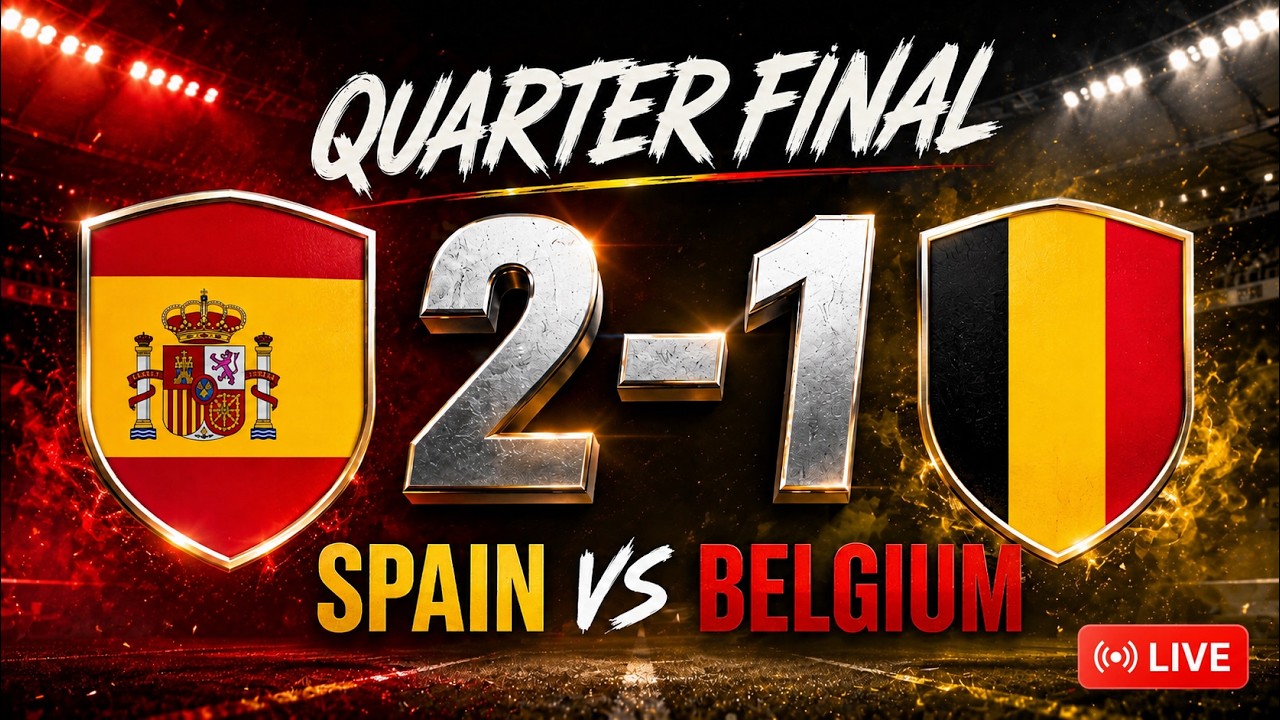
When historians look back on this World Cup, they will remember that Spain defeated Belgium 2–1 to reach the semifinal, Fabián Ruiz’s opening goal, Charles De Ketelaere becoming the first player to score against Spain in the tournament and Mikel Merino’s dramatic late winner.
Those moments deserve to be remembered, but I hope they also remember something less visible.
This quarterfinal reminded us why football remains unlike any other sport.
Preparation, discipline, talent, experience, and tactics matter, but none of them can completely control what happens once the referee blows the whistle.
Football always leaves room for the unexpected; perhaps that is why every generation falls in love with the game all over again.
Beyond Spain And Belgium
Every World Cup eventually comes to an end; champions are crowned, records are broken, and new stars emerge, while others play their final international match, but football’s greatest gift is not the trophy; it is the lessons each tournament leaves behind.
Spain’s victory over Belgium reminds us that success is rarely accidental; it is usually built upon years of preparation, countless hours on training grounds, attention to detail, discipline, patience, and resilience.
Yet even with all that preparation, victory is never guaranteed, and that is the beauty of football.
The game respects preparation, but it never becomes a prisoner of it.
Every match begins with possibility and ends with reality, and sometimes, those two are very different.
A Lesson for Every Football Nation
As the football world now turns its attention to Spain and France, every nation watching this World Cup has an opportunity to learn.
It is not by copying one country and assuming there is only one path to success, but by recognising certain principles that transcend borders: long-term planning, investment in youth development, continuous learning, respect for the Laws of the Game, strong coaching education, institutional stability, and the humility to recognise that improvement never ends.
Those lessons belong to every football nation, whether they are former world champions or nations still pursuing their first appearance on football’s biggest stage.
They are enduring values of the FIFA World Cup; they inspire us not only to celebrate excellence but also to understand how excellence is built.
Personal Reflection: Football Has A Mind of Its Own
Whenever it’s about football, the goal extends beyond reporting the final score.
Scores may become history within hours, statistics can eventually be broken, and records can be surpassed, but lessons endure.
That is why I enjoy connecting football with leadership, history, culture, and personal responsibility.
Football is not merely ninety minutes of entertainment; it reflects our personalities, preparation, responses to adversity, and growth.
If Spain’s victory over Belgium encourages us to think a little more deeply about those lessons, then this quarterfinal has already achieved something far greater than producing another semifinalist.
After all, football has no human script; it has its own script
And perhaps the most beautiful part of that script is that every match leaves us with an opportunity to become better than we were before kickoff.
If this article expanded your understanding of football or encouraged you to see the game beyond the final score, please consider sharing it with fellow football lovers, coaches, players, journalists, students, and anyone who believes football has lessons that extend far beyond the pitch.
Paul Lucky Okoku: FIFA Legend | Football Analyst | Journalist-at-Large | CAF Africa Cup of Nations Silver Medalist | Former Nigerian Super Eagles & Flying Eagles International | Former Vice-Captain, Flying Eagles | Former Olympic Qualifying Team Member | Founder & CEO, Greater Tomorrow Children’s Fund (GTCF)
The views expressed in this article are intended to educate, preserve football history, encourage thoughtful dialogue, and contribute to the long-term development of football in Nigeria, Africa, and the global game.