 Amanze Chinonye
At least 23 people have been confirmed dead and 108 others injured following coordinated suicide bombings that struck Maiduguri on the evening of March 16, in what authorities describe as one of the most significant attacks in the city in recent years, Prime Business Africa reports.
The near-simultaneous explosions targeted crowded civilian locations, including the popular Monday Market, the Post Office Flyover, and the gate of the University of Maiduguri Teaching Hospital. Parts of the Kaleri neighbourhood were also affected, as the attackers struck during peak evening activity to maximise casualties.
Police authorities said the attacks bore the hallmarks of coordinated suicide bombings, with multiple assailants detonating explosive devices within a short time frame. While no group has officially claimed responsibility, suspicion has fallen on insurgent factions linked to Boko Haram and the Islamic State West Africa Province (ISWAP), both of which have a history of carrying out similar attacks in Nigeria’s northeast.
Join our WhatsApp ChannelEyewitnesses described scenes of chaos, with victims strewn across blast sites and emergency responders rushing to evacuate the wounded. Medical facilities across Maiduguri were quickly overwhelmed, as health workers treated more than 200 victims and issued urgent appeals for blood donations.
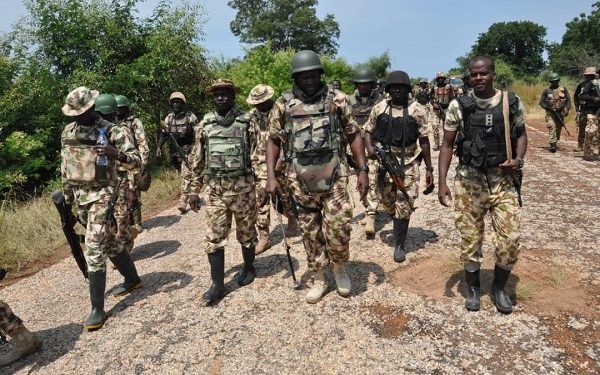
The bombings coincided with renewed insurgent activity on the outskirts of the city, where Nigerian troops reportedly repelled separate assaults on military positions earlier in the day.
Security sources said no casualties were recorded among troops in those engagements, but the timing has heightened concerns about a coordinated escalation strategy targeting both civilian centres and military infrastructure.
READ ALSO : University of Maiduguri Dismisses Viral Claims of Boko Haram Links
Borno State Governor Babagana Zulum condemned the attacks as “barbaric and inhumane,” assuring residents that security agencies were intensifying efforts to track down those responsible. Authorities have since increased patrols, mounted checkpoints, and tightened surveillance across key parts of the city, while urging residents to remain calm but vigilant.
The attacks have drawn reactions from political figures within and outside Nigeria.
In Nigeria, Rabiu Musa Kwankwaso expressed deep sorrow over the incident, warning that the resurgence of violence in Borno signals a troubling setback after years of relative calm. He urged federal and state authorities to fully empower the armed forces to take decisive action against insurgent groups.
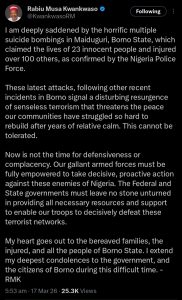
Maiduguri, long regarded as the epicentre of Nigeria’s insurgency, has witnessed intermittent attacks despite sustained military operations over the past decade. The conflict, which began in 2009, has claimed more than 35,000 lives and displaced millions across the northeast.
Monday’s coordinated bombings have renewed fears of a return to large-scale urban attacks in the city, raising fresh concerns about the durability of recent security gains. Emergency services continue to treat the injured, while security agencies have launched investigations aimed at dismantling the network behind the attacks.

Amanze Chinonye is a Staff Correspondent at Prime Business Africa, a rising star in the literary world, weaving captivating stories that transport readers to the vibrant landscapes of Nigeria and the rest of Africa. With a unique voice that blends with the newspaper's tradition and style, Chinonye's writing is a masterful exploration of the human condition, delving into themes of identity, culture, and social justice. Through her words, Chinonye paints vivid portraits of everyday African life, from the bustling markets of Nigeria's Lagos to the quiet villages of South Africa's countryside . With a keen eye for detail and a deep understanding of the complexities of Nigerian society, Chinonye's writing is both a testament to the country's rich cultural heritage and a powerful call to action for a brighter future. As a writer, Chinonye is a true storyteller, using her dexterity to educate, inspire, and uplift readers around the world.
![Electricity Debt: Abuja DisCo Gives Final Disconnection Notice To 25 Govt Agencies [Full List]](https://www.primebusiness.africa/wp-content/uploads/2024/06/Abuja-Electricity-pole.jpg)