 Amanze Chinonye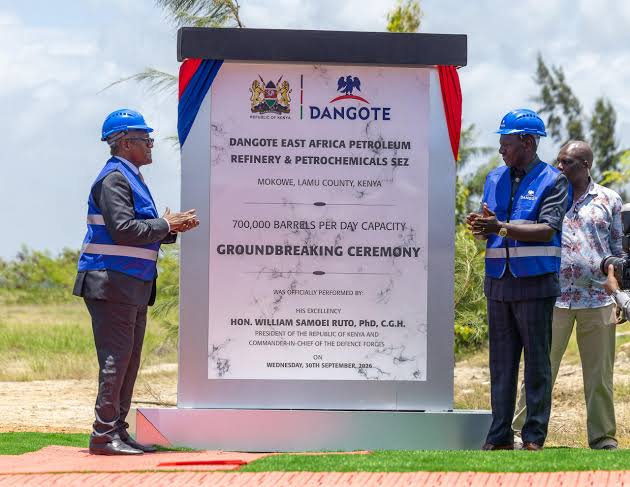
A $16 billion oil refinery planned by Nigerian billionaire Aliko Dangote in Kenya is facing growing scrutiny over ownership, government commitments and transparency, days after construction formally began.
Join our WhatsApp Channel
Dangote and Kenyan President William Ruto broke ground on the proposed refinery in Lamu on Sept. 30, presenting the 700,000-barrel-per-day facility as a major investment that could reduce East Africa’s reliance on imported refined petroleum products and establish a wider industrial hub. The refinery is targeted for completion around 2030.
READ ALSO :
The project has drawn particular scrutiny from Kenyan opposition politician Ekuru Aukot, who is seeking access to the agreement underpinning the investment and details of the government’s participation.
In a letter received by Attorney-General Dorcas Oduor on Oct. 2, Aukot, leader of Thirdway Alliance Kenya, invoked Article 35 of the Constitution and provisions of the Access to Information Act to request the full agreement between the Kenyan government, any associated public entity and Dangote East Africa Petroleum Refinery and Petrochemicals SEZ.
His request covers execution copies of the agreement, schedules, side letters and subsequent amendments. He also wants the Attorney-General to clarify whether a definitive agreement has been executed and, if not, disclose the status of negotiations, existing drafts and government approvals relating to the project.
Aukot is also seeking evidence of parliamentary scrutiny. He wants the government to establish whether the refinery agreement or project was presented to Parliament and, if so, provide relevant Hansard records, committee proceedings, resolutions and approval documents. He has further asked whether the arrangement constitutes a public-private partnership and whether it creates any financial liability for the Kenyan state.
Those questions are significant because Kenya is expected to participate in the project through an equity arrangement involving public assets. Ruto has said the government will use the National Infrastructure Fund and assets including land to secure a stake in the refinery.
Dangote has offered East African governments a combined 30% stake in the project, with Kenya reported to have an initial 10% allocation. The proposed arrangement does not, however, amount to completed ownership, as the final structure depends on the uptake of the offered stakes and other investment arrangements.
Aukot has therefore requested details of the refinery’s ownership structure, including the names of beneficial owners and directors, corporate records for Kenyan shareholders and equivalent information for foreign shareholders. He is also seeking constitutional documents and beneficial ownership information relating to companies holding interests in the project.
READ MORE :
Kenya Court Keeps Lamu Refinery Plans on Track Despite Land Challenge
The disclosure demand places the terms of Kenya’s participation at the centre of debate over a project the government has promoted as a landmark private-sector investment. It also raises questions about how public assets contributed to the development will be valued and whether the state will assume obligations beyond its eventual equity holding.
The refinery’s scale underpins its regional ambitions. Designed to process 700,000 barrels of crude oil per day, it is expected to supply petroleum products to Kenya and other East African markets. Dangote has said the project will help meet regional fuel demand while reducing dependence on imported refined products.
The development is also expected to extend beyond crude processing. Dangote has said it will include a 1,000-megawatt power plant, with surplus electricity potentially supplied to Kenyan industries. Petrochemical and other industrial activities are planned around the refinery, supporting the government’s ambition to develop Lamu as a major industrial and logistics centre.
For Kenya, the project is closely linked to the development of Lamu Port and the LAPSSET corridor. Government officials have highlighted potential employment, technical training, manufacturing and other economic opportunities arising from the refinery and associated facilities.
But the investment has also encountered disputes over land and public participation. Residents have challenged the use of land earmarked for the refinery, raising issues including ancestral ownership and compensation. A Kenyan court has ordered the status quo to be maintained, with further proceedings expected on Oct. 14.
The land dispute has added to questions about Kenya’s contribution to the development. Ruto has said about 9,000 acres have been identified for the project, with the government seeking additional land as the refinery and associated special economic zone expand.
Aukot has separately questioned Dangote’s decision to commit billions of dollars to Kenya while Nigeria, where the businessman operates the 700,000-barrel-per-day Dangote refinery in Lagos, continues to face electricity-supply challenges.
That criticism gives the project a cross-border political dimension. The Lamu refinery is being presented as a private investment involving Dangote’s group, prospective financing arrangements and equity opportunities for regional governments and investors.
Aukot’s formal intervention is broader than his criticism of Dangote’s investment priorities. He has said he is not opposed to an investment that could benefit Kenya but wants projects involving the government to remain subject to public scrutiny.
He also rejected what he described as Ruto’s characterisation of citizens questioning the refinery as “matapeli”, or con artists, arguing that access to government contracts is a constitutional right.
Ruto has defended the project and urged critics to use parliamentary channels to raise questions about the investment. His administration has presented the refinery as a strategic development capable of strengthening energy security, attracting private capital and establishing Lamu as an industrial centre.
READ ALSO :
Dangote’s $16 Billion Kenya Refinery Faces Scrutiny over Undisclosed Government Commitments
Aukot’s request has since been joined by calls from other Kenyan political figures for greater disclosure of the agreement and ownership structure, increasing pressure on the government to provide details of the arrangement.
Under Section 9 of Kenya’s Access to Information Act, Aukot says the Attorney-General has 21 days to decide on his request. He has warned that failure to provide the information would be treated as a deemed rejection and could lead to legal action.
The government’s response could clarify whether a definitive agreement has been executed, what public assets and commitments Kenya has made, how ownership will be structured and whether taxpayers face any direct or contingent financial exposure.
For Dangote and the Kenyan government, the Lamu refinery represents an attempt to combine private capital with regional energy security and industrial development. For critics, the immediate question is whether the public can see the contractual terms underpinning that ambition.
As construction begins and the land dispute remains before the courts, the debate is shifting beyond the refinery’s headline investment figure to the obligations behind it: who will own the project, what has Kenya committed and whether those commitments have received the scrutiny required by law.

Amanze Chinonye is a Staff Correspondent at Prime Business Africa, a rising star in the literary world, weaving captivating stories that transport readers to the vibrant landscapes of Nigeria and the rest of Africa. With a unique voice that blends with the newspaper's tradition and style, Chinonye's writing is a masterful exploration of the human condition, delving into themes of identity, culture, and social justice. Through her words, Chinonye paints vivid portraits of everyday African life, from the bustling markets of Nigeria's Lagos to the quiet villages of South Africa's countryside . With a keen eye for detail and a deep understanding of the complexities of Nigerian society, Chinonye's writing is both a testament to the country's rich cultural heritage and a powerful call to action for a brighter future. As a writer, Chinonye is a true storyteller, using her dexterity to educate, inspire, and uplift readers around the world.