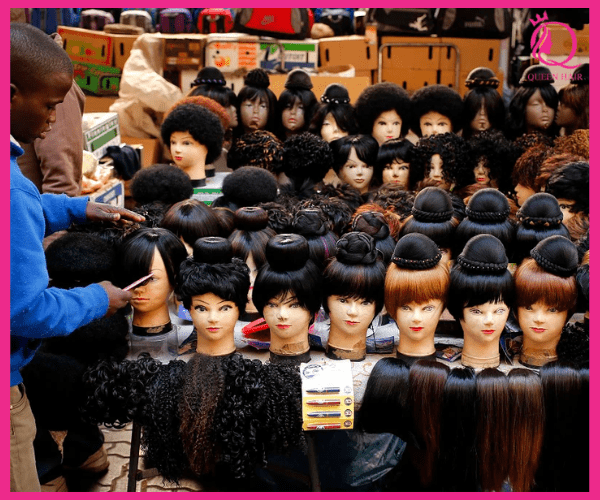
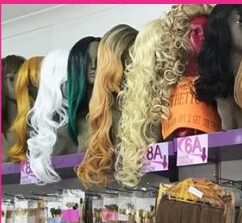
In an exclusive interview with Prime Business Africa, hair vendors – Austin Hair and Olysaint Hair, spoke on the dynamic world of Nigeria’s hair business. Despite the challenges posed by fluctuating exchange rates, these entrepreneurs shed light on the opportunities and resilience within the industry.
In Nigeria, the hair business is not just about beauty – it provides a flourishing opportunity for entrepreneurship, with countless individuals diving into the vibrant dealership on hair extensions and wigs. In a country where entrepreneurship is a driving force, the hair business has provided a unique opportunity for Nigerians to earn money for themselves without being hobbled by the drudgery of 9-5 jobs. The lure of owning a hair salon or creating a signature hair care product line is enticing, as it not only empowers individuals but fuels job creation and revenue generation as well.
Austin Hair, located in Ajao Estate, Abule Market, noted that the Dollar to Naira exchange rate has emerged as a pivotal factor in hair vendors’ business. When the Naira weakens against the Dollar, the cost of importing hair products escalates, inevitably leading to higher retail prices. Yet, vendors’ success lies in establishing reliable connections with suppliers who offer reasonable rates, allowing them to retain a loyal customer base.
Price fluctuations have not only contracted sale volumes for the hair entrepreneur but have also triggered intriguing customer behavior. While some remained loyal despite soaring prices, others opted for more affordable alternatives, such as single drone hair instead of double drone. Indeed, these fluctuations have not deterred the enduring love that Nigerian women have for their hair.
Olysaint Hair, located in Molete, Ibadan shares these sentiments, highlighting the unique challenges and opportunities in the hair business in Nigeria. Both entrepreneurs recognize the need for a robust monetary policy that can stabilize exchange rates and support local manufacturing of wigs and hair extensions. This move would reduce dependency on imported variants and create a thriving ecosystem that benefits both business owners and customers.
Hair
At the broader level, the place of the hair business in bridging the unemployment gap in Nigeria calls for more robust monetary policy measures that will stabilize the exchange rates and bolster local manufacturing of wigs and hair extensions, thereby reducing dependency on imported variants. The goal is to create an ecosystem that favors business owners and customers alike.
It goes without saying that the hair business in Nigeria is not just about aesthetics; it’s dynamic and has grown to the level where entrepreneurs succeed against all odds. The government just needs to give them the right support by implementing policies that will stabilize the foreign exchange rates in Nigeria. As Nigeria strives for economic growth, the hair industry should be factored in based on the burgeoning market for it.
Over N710 billion was gained in the Nigerian Exchange (NGX), also known as the stock market, on Tuesday, March 3. This led to the market capitalisation of the NGX rising from N125.48 trillion recorded on Monday, March 2, to N126.19 trillion.Join our
Out of six oil companies listed on the Nigerian Exchange (NGX), also known as the stock market, three saw their valuation in the bourse decline, while three recorded a surge in their market capitalisation between January 2, 2025 and February 20, 2026.
Fuel prices in Nigeria are expected to rise sharply after a hike in refinery rates, as Africa’s richest man Aliko Dangote outlined broader plans to expand into power, steel and infrastructure. The Dangote Petroleum Refinery has increased its gantry price for Premium
The foreign exchange (FX) rate for the United States dollar (USD) was relatively stable in the black market on Monday, March 2, as the American greenback traded at N1,382.52 kobo per $1. According to Naira Rates, the black market aggregator, the USD
Terra Industries has reappointed security strategist Nnamdi Chife to lead its military relations portfolio, a move that underscores the company’s transition from an emerging hardware innovator to a more deeply embedded player within Nigeria’s formal defence architecture. Chife’s return comes at a
Ex-Power Minister, Nnaji Identifies Those Behind Nigeria’s Electricity Woes
We use cookies on our website to give you the most relevant experience by remembering your preferences and repeat visits. By clicking “Accept”, you consent to the use of ALL the cookies.
This website uses cookies to improve your experience while you navigate through the website. Out of these, the cookies that are categorized as necessary are stored on your browser as they are essential for the working of basic functionalities of the website. We also use third-party cookies that help us analyze and understand how you use this website. These cookies will be stored in your browser only with your consent. You also have the option to opt-out of these cookies. But opting out of some of these cookies may affect your browsing experience.
Necessary cookies are absolutely essential for the website to function properly. These cookies ensure basic functionalities and security features of the website, anonymously.
Cookie
Duration
Description
cookielawinfo-checbox-analytics
11 months
This cookie is set by GDPR Cookie Consent plugin. The cookie is used to store the user consent for the cookies in the category "Analytics".
cookielawinfo-checbox-functional
11 months
The cookie is set by GDPR cookie consent to record the user consent for the cookies in the category "Functional".
cookielawinfo-checbox-others
11 months
This cookie is set by GDPR Cookie Consent plugin. The cookie is used to store the user consent for the cookies in the category "Other.
cookielawinfo-checkbox-necessary
11 months
This cookie is set by GDPR Cookie Consent plugin. The cookies is used to store the user consent for the cookies in the category "Necessary".
cookielawinfo-checkbox-performance
11 months
This cookie is set by GDPR Cookie Consent plugin. The cookie is used to store the user consent for the cookies in the category "Performance".
viewed_cookie_policy
11 months
The cookie is set by the GDPR Cookie Consent plugin and is used to store whether or not user has consented to the use of cookies. It does not store any personal data.
Functional cookies help to perform certain functionalities like sharing the content of the website on social media platforms, collect feedbacks, and other third-party features.
Performance cookies are used to understand and analyze the key performance indexes of the website which helps in delivering a better user experience for the visitors.
Analytical cookies are used to understand how visitors interact with the website. These cookies help provide information on metrics the number of visitors, bounce rate, traffic source, etc.
Advertisement cookies are used to provide visitors with relevant ads and marketing campaigns. These cookies track visitors across websites and collect information to provide customized ads.


 Loveth Ugwu