 Amanze Chinonye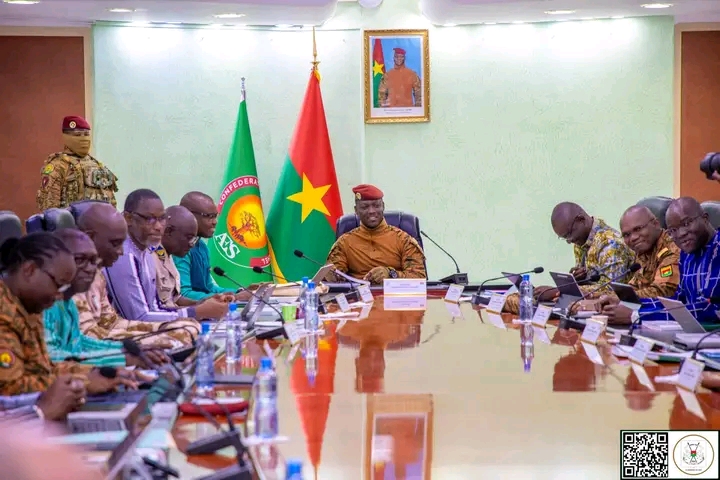
Burkina Faso’s government has proposed expenditure of 4,839.4 billion CFA francs in 2027, with a projected budget deficit of 619 billion CFA francs, as President Ibrahim Traoré’s administration plans investments in healthcare, agriculture, education and infrastructure, Prime Business Africa reports.
The draft budget, approved for submission to the People’s Legislative Assembly by the Council of Ministers at a meeting chaired by Traoré on Thursday, projects revenue of 4,220.4 billion CFA francs, an increase of 13.2% from the revised 2026 forecast, according to the official minutes.
Join our WhatsApp ChannelREAD ALSO :
Burkina Faso Inaugurates First National Gold Refinery as Traore Pushes Local Processing
The council also approved healthcare projects worth 67.08 billion CFA francs, additional funding for territorial development, a regional football competition and measures to support domestic manufacturing. It further endorsed a draft law that would restrict the privatisation of strategic public enterprises.
The proposed budget provides for a deficit equivalent to 2.9% of nominal gross domestic product. Revenue is projected to increase by 491.9 billion CFA francs from the revised 2026 estimate.
The budget was prepared under the government’s RELANCE 2026–2030 development plan, which outlines its economic and social priorities amid efforts to restore territorial control, expectations of favourable agricultural and livestock production, and uncertainty in the international environment. The proposed revenue and spending framework must receive legislative consideration before implementation.
The government raised its economic growth forecast for 2026 to 6.0%, from 5.7% projected in March, citing improved expectations for gold production and revenue.
The services sector is expected to contribute 2.7 percentage points to growth, while industry is projected to contribute 1.9 points and agriculture and related activities 1.3 points. Inflation is forecast at 0.3% for the year.
The government attributed its price outlook to measures including price controls, restrictions on cereal exports and efforts to secure supplies to areas affected by insecurity.
Revenue collected in the first half of 2026 reached 2,118.4 billion CFA francs, up 27.7% from 1,659.4 billion CFA francs in the same period of 2025, reflecting higher tax receipts, other revenue and grants. Government expenditure rose to 1,907.6 billion CFA francs from 1,857.7 billion CFA francs.
Economic growth is projected at 5.6% in 2027, 5.0% in 2028 and 5.2% in 2029. The government said the outlook would depend partly on improvements in security, favourable weather, regional stability and implementation of its development plan.
The council approved healthcare infrastructure projects worth 67.082 billion CFA francs under the Presidential Health Initiative. They include 20 municipal medical centres, 20 modern maternity facilities, four operating theatres at the Halassane Coulibaly military hospital in Ouagadougou and a heart institute.
READ MORE :
Tinubu Seeks $6bn Loans, N9.09tn Budget Increase as Lawmakers Pass Spending Plan
The projects will be financed through the 2026 state budget and are intended to expand access to healthcare and improve medical services.
The health ministry also presented plans for the 2026 Pink October breast cancer campaign, which aims to strengthen public awareness, prevention and screening while improving access to cancer services for at least two million women.
The government also approved the establishment of the Sovereignty League, a regional football championship intended to expand sporting opportunities beyond major urban centres. The competition is designed to decentralise investment in sports, identify local talent, increase participation and promote national cohesion.
The council approved additional financing of about $100 million, equivalent to 55 billion CFA francs, for the Emergency Project for Territorial Development and Resilience. The government said the first phase had met all targets associated with its 22 performance indicators by September 30, 2026.
The additional funding, provided by the state and the International Development Association, will support education, drainage, public lighting, agricultural storage and production, and community facilities.
Planned investments include two vocational high schools, two high schools in urban municipalities, four school complexes in secondary cities and an administrative building. The programme also includes 44 km of drainage canals, 600 solar-powered public lighting systems, eight food-security storage facilities measuring 5,000 square metres each, 150 hectares of lowlands and 40 hectares of market-gardening areas.
Six urban parks with sports and recreational facilities and a centre for artisanal training and processing are also planned.
In a move to consolidate agricultural training, the government approved the creation of the Burkina Faso Institute of Agropastoral Training, known as IFAP-BF, through the merger of the National School of Agricultural Training in Matourkou and the National School of Livestock and Animal Health. The new institution is intended to coordinate training in agriculture, livestock and fisheries and better align professional education with rural development needs.
The council also approved a revised list of products subject to special import and export authorisations, including detergents, soaps, bleach, chalk and tomato concentrate.
The government said investments totalling 26 billion CFA francs had been made since 2022 in 26 industrial units producing detergents and soaps, tomato paste and chalk. Seven units had received state support through Investment Code incentives and public savings mobilised through popular shareholding.
The revised authorisation regime is intended to regulate imports competing with locally manufactured goods and support domestic industry. However, the council minutes did not specify the new authorisation requirements or explain how the measures might affect import volumes and consumer prices.
The council also approved a draft law defining strategic economic, commercial and industrial entities for submission to the People’s Legislative Assembly. The proposed legislation would prohibit the privatisation of designated strategic public enterprises, introduce monopoly status as a criterion for classifying companies as strategic, and allow the state to acquire stakes in businesses considered important to national interests.
The proposal would revise a 1993 law governing strategic companies and enterprises. The government said the changes were intended to reflect current economic priorities and strengthen oversight of businesses deemed vital to national interests.
READ ALSO :
Other decisions included amendments to the statutes of state-owned company Faso Yaar, including the creation of a deputy director-general position and changes to its board composition. The council also approved regulations governing licensing for film and audiovisual professionals and established a national commission to issue film distribution and exhibition visas, with provisions covering film classification and protections for audiences, particularly minors.
The council renewed Modeste Yameogo’s appointment as permanent secretary of the Public Procurement Regulatory Authority for a final four-year term. It also approved appointments to the National Academy of Sciences, Arts and Letters, regional governorships and senior positions across several ministries, as well as board appointments at public institutions and state-owned enterprises.
The decisions reflect the government’s broader focus on fiscal planning, public-sector restructuring, domestic production and investment in essential services.

Amanze Chinonye is a Staff Correspondent at Prime Business Africa, a rising star in the literary world, weaving captivating stories that transport readers to the vibrant landscapes of Nigeria and the rest of Africa. With a unique voice that blends with the newspaper's tradition and style, Chinonye's writing is a masterful exploration of the human condition, delving into themes of identity, culture, and social justice. Through her words, Chinonye paints vivid portraits of everyday African life, from the bustling markets of Nigeria's Lagos to the quiet villages of South Africa's countryside . With a keen eye for detail and a deep understanding of the complexities of Nigerian society, Chinonye's writing is both a testament to the country's rich cultural heritage and a powerful call to action for a brighter future. As a writer, Chinonye is a true storyteller, using her dexterity to educate, inspire, and uplift readers around the world.