 MARCEL MBAMALU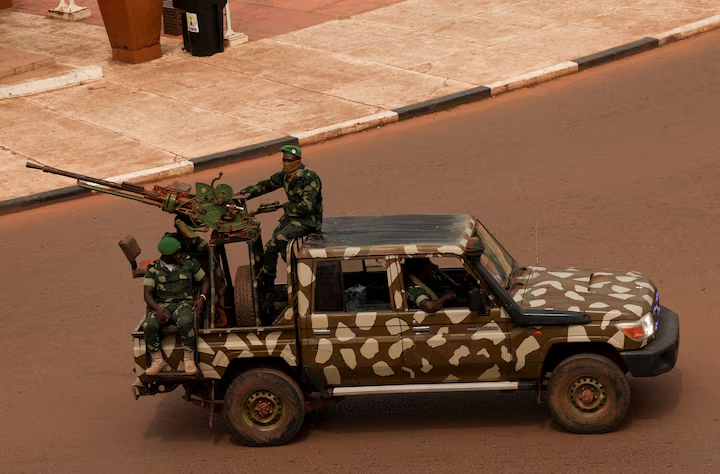
Imagine a region where democracy feels more like a revolving door than a steady rhythm — where tired citizens watch neighboring juntas promise security, swift decisions, and a dash of national pride, and start wondering if the military might just be the “reset button” they’ve been waiting for.
That’s the uneasy mood sweeping West Africa today, and Guinea‑Bissau’s latest upheaval is the tremor that’s making everyone sit up and listen. From the streets of Bissau to the corridors of ECOWAS, the debate is heating up: can a strong‑arm regime deliver the stability that fragile democracies have struggled to provide, or are we merely trading one set of problems for another?
As ECOWAS grapples with its own credibility after condemning the coup as “unacceptable” and sending a high‑level delegation to negotiate with the junta, the region faces a crossroads. Meanwhile, the electoral commission’s claim that the vote tally was destroyed adds another layer of chaos. The outcome in Guinea‑Bissau could either tip the balance toward a new era of barracks logic or force West Africa back to the drawing board of inclusive governance.
Join our WhatsApp ChannelShouldn’t we say that West Africa is again entering familiar territory marked by fatigued democracies, ambitious military officers, fragmented political elites, and citizens exhausted by insecurity and economic stagnation. The recent upheaval in Guinea-Bissau is not an isolated tremor but part of a broader seismic shift reshaping governance across the subregion. From Mali to Guinea, Burkina Faso to Niger, the continent’s once-reliable democratic map is being redrawn by barracks logic.
READ ALSO : Guinea-Bissau Coup : Military Topples President Embaló, Installs General as Transitional Leader
ECOWAS Suspends Guinea-Bissau, Demands Immediate Release of President Embaló
Nigeria’s State Police Plans: Before We Democratize Terrorism
Guinea-Bissau’s latest crisis bears the signature patterns already observed elsewhere: fragile institutions, politicised security agencies, and governance systems unable to absorb crises without collapsing into confrontation. The country has suffered at least nine coups or attempted coups since 2003 and this is a staggering frequency that stifles public confidence in both civilian and military authority.
Is Military rule becoming attractive?
Yet, what makes this moment particularly unsettling is how regional narratives from other coup-hit countries are beginning to influence public perception within Guinea-Bissau.
Across West Africa, a controversial but increasingly popular sentiment is gaining traction. That is, Burkina Faso, Mali, and even Guinea are “doing better” under military rule. It is a claim fuelled by palpable evidence: improved security in certain rural zones, quick executive decision-making unencumbered by legislative debate, and an aggressively nationalist rhetoric that promises dignity and sovereignty. In Burkina Faso, some communities report a sense of renewed purpose under the junta, as security operations appear more coordinated and public communication more assertive.
Citizens frustrated by years of political instability may begin to view military intervention as a reset button. Burkina Faso is on the verge of showing that it is not an illusion that the strong arm of the military can succeed where civilian leaders have failed. This is the psychological contagion now spreading across the region. And the people of Guinea Bissau may also feel this way.
But this sentiment, compelling as it may sound, masks deeper structural risks. Military regimes tend to frontload quick wins, patriotic speeches, symbolic reforms, and renegotiated security partnerships. Burkina Faso has done this well, and must not postpone the complex, unglamorous work of institution-building. The celebrated “gains” must not rest on fragile foundations of restricted civil liberties, militarised civic spaces, and an absence of mechanisms for long-term accountability.
For ECOWAS
For ECOWAS, the implications are existential. The bloc has long adopted, or mouthed, zero tolerance for unconstitutional changes of government, yet its credibility has been battered by uneven enforcement and the departure or suspension of several member states under military rule. The Guinea-Bissau incident places ECOWAS at a crossroads: Act decisively, and risk alienating more member states already drifting away. Act weakly, and risk normalizing coups as a legitimate method of political reset.
Worse still, citizens across West Africa increasingly perceive ECOWAS not as a guardian of democratic norms. ECOWAS is seen more as a protector of entrenched political elites who are often co-conspirators with foreign mercantilist interests that nurture instability. This credibility gap creates fertile ground for military adventures.
The cycle of coups in Guinea-Bissau may introduce even more instability. Yet, it may offer some seductive comparison with Burkina Faso’s early military “successes.” Therefore, the situation presents a rare opportunity. The political crisis in Guinea-Bissau could catalyze overdue reforms. It could pave the way for a more inclusive political arrangement, renewed engagement between civilian leaders and the security sector, and a more strategic oversight role for regional bodies like ECOWAS and the African Union. But this will require humility from political elites, neutrality from the military, and consistency from regional guarantors. Better governance, whether civilian or military, cannot emerge without strengthening state institutions, depoliticizing the security forces, and building a resilient civic culture rooted in participation rather than coercion. What looks promising from the military may go sour very quickly if the underlying governance gaps remain unaddressed.
West Africa stands at an inflection point. The Guinea-Bissau crisis should remind the region that governance cannot be repaired through shortcuts. Military rule may provide temporary order, but democracy, imperfect as it is, often assures a more sustainable path to stability. The choice now before ECOWAS, and indeed before Guinea-Bissau, is whether to confront the deeper structural rot that produces coups or to continue reacting to symptoms while allowing the disease to spread.
The Nigerian connection and poser
Nigeria is expected to play a major role in upcoming diplomatic activities in Guinea Bissau to restore order, Nigeria is traditionally the anchor of ECOWAS. However, the country now faces its own political and security concerns. Recent coup rumours, rising public frustration, and economic hardship have worsened Nigeria’s internal stability. This inevitably weakens its ability to mobilize strong regional action.
The coup in Guinea Bissau therefore has direct implications for Nigeria because it supports a growing “coup climate” across West Africa, strains ECOWAS’ crisis-management credibility, and may fire up fringe actors within the region. A weakened ECOWAS, coupled with Nigeria’s domestic pressures, may create openings for external influence and transnational crime networks already known to operate through Guinea Bissau. For Nigeria, the challenge is twofold, i.e., maintaining internal democratic strength, while reasserting credible leadership in preventing further regional instability.
Unfortunately, Nigeria doesn’t seem ready for this. How Guinea Bissau fares in the next couple of months may make even bolder statements about coup as an alternative to failing democracy in West Africa.
Dr Mbamalu, publisher of Prime Business Africa, is a Jefferson Fellow of the East-West Center Hawaii.

Dr. Marcel Mbamalu is a distinguished communication scholar, journalist, and entrepreneur with three decades of experience in the media industry. He holds a Ph.D. in Mass Communication from the University of Nigeria, Nsukka, and serves as the publisher of Prime Business Africa, a renowned multimedia news platform catering to Nigeria and Africa's socio-economic needs.
Dr. Mbamalu's journalism career spans over two decades, during which he honed his skills at The Guardian Newspaper, rising to the position of senior editor. Notably, between 2018 and 2023, he collaborated with the World Health Organization (WHO) in Northeast Nigeria, training senior journalists on conflict reporting and health journalism.
Dr. Mbamalu's expertise has earned him international recognition. He was the sole African representative at the 2023 Jefferson Fellowship program, participating in a study tour of the United States and Asia (Japan and Hong Kong) on inclusion, income gaps, and migration issues.
In 2020, he was part of a global media team that covered the United States presidential election.
Dr. Mbamalu has attended prestigious media trainings, including the Bloomberg Financial Journalism Training and the Reuters/AfDB Training on "Effective Coverage of Infrastructural Development in Africa."
As a columnist for The Punch Newspaper, with insightful articles published in other prominent Nigerian dailies, including ThisDay, Leadership, The Sun, and The Guardian, Dr. Mbamalu regularly provides in-depth analysis on socio-political and economic issues.