 Victor Ezeja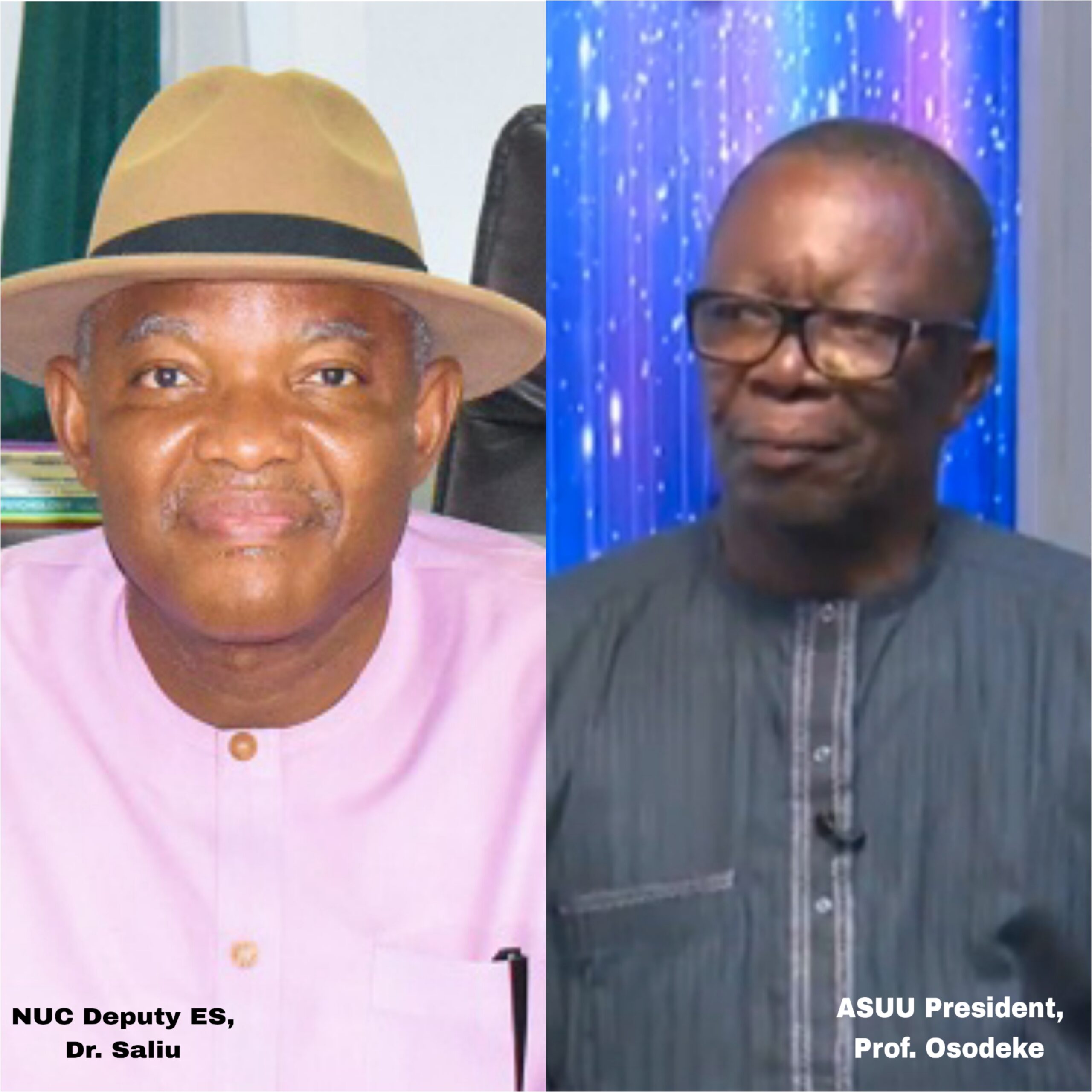
The National Universities Commission (NUC) has warned the Academic Staff Union of Universities (ASUU) against misleading Nigerians about the new curriculum designed for tertiary institutions across the nation.
This was contained in a statement by the NUC Deputy Executive Secretary, Academics, Dr Noel Saliu, released on Friday in Abuja.
Join our WhatsApp ChannelThe Commission’s statement was in reaction to the claims by the Academic Staff Union of Universities (ASUU) that Nigerian universities were not carried along in the process leading to the development of the Core Curriculum Minimum Academic Standards (CCMAS).
NUC recently developed CCMAS for 17 programmes in Nigerian universities. The curriculum stipulates the minimum academic requirements for the training of undergraduates in various disciplines.
ASUU’s national president, Prof. Emmanuel had in a statement earlier on Friday said the curriculum design process poses a threat to the principle of autonomy of the university system.
According to ASUU’s statement, universities are statutorily responsible for academic programme development but made only 30 per cent of input in the curriculum, while NUC contributed 70 per cent.
READ ALSO: NUC’s New Curriculum Threatens University Autonomy – ASUU
It also claimed that there was no official communication from NUC to universities about the curriculum design.
However, Saliu said that the assertion that there was no official communication from NUC to the Universities on the review of the Benchmark Minimum Academic Standard (BMAS) was not correct.
He said: “Vice-Chancellors can attest to the fact that the commission has been communicating with them on the issue over the last five years.
”In addition, several virtual and on-site meetings were held to intimate them of the curriculum review and provide them with updates from time to time.
”The claim that there is no evidence to show that the universities were involved in the true sense of revision of the BMAS development and the subsequent implementation of the CCMAS in the university is also far from the truth.”
The NUC Deputy Executive Secretary explained that the curriculum review process started in 2018 with experts on various subjects in Nigerian universities producing the draft documents, adding that the draft was further forwarded to other experts in Nigerian universities for their input.
“Comments received from universities that responded formed part of the working documents forwarded to the various curriculum review panels,” he said.
Saliu further stated that when the initial drafts of the CCMAS were ready, they were also circulated amongst Nigerian academics, and their inputs were synthesised and incorporated into the respective programmes.
On the claim of ASUU that it was only allowed to provide 30 per cent input in the curriculum design, Saliu explained that the Commission had informed universities from the beginning of the exercise that it would provide for 70 per cent of the minimum course requirements for graduation in Nigerian universities.
“The commission did not arbitrarily arrive at this ratio.
“As a matter of fact, the NUC had in previous minimum standards documents, made provision for 100 per cent curriculum requirements to Nigerian universities.
”It is instructive to note that in a retreat with Vice-Chancellors of Nigerian Universities in 2017, the NUC proposed to the universities a 50/50 NUC/Universities Curriculum Provision.
”This was rejected as the universities felt that the action was drastic and that the proposal should be gradually implemented; they proposed 80:20 NUC/ University contribution to the curriculum.
“However, the NUC during the comprehensive curriculum review, decided to adopt a 70:30 NUC/University ratio for the curriculum contents,” he added.
The idea behind the 70:30 ratio, he said, was to place the curriculum in the domain of the universities, where it belongs.
“Based on the foregoing, even when courses are omitted in the 70 per cent CCMAS, such courses can be introduced by the universities in the 30 per cent component.
“Besides, the provision made in the CCMAS is the minimum requirement and the universities can go beyond the minimum stipulations, provided the students are not overloaded,” he explained.
The NUC Deputy Executive Secretary further reminded ASUU that the commission was empowered by law to lay minimum standards for all universities and other institutions of higher learning in the federation.

Victor Ezeja is a passionate journalist with seven years of experience writing on economy, politics and energy. He holds a Master's degree in Mass Communication.