 Amanze Chinonye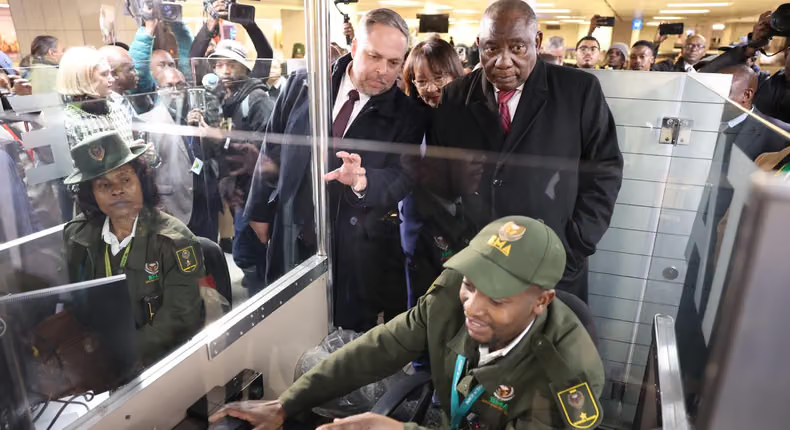
South Africa has officially launched its Electronic Travel Authorisation (ETA), introducing a digital immigration system designed to make international travel faster and more predictable while strengthening border security and combating visa fraud, Prime Business Africa reports.
Join our WhatsApp Channel
President Cyril Ramaphosa launched the system at OR Tambo International Airport on Wednesday, alongside Home Affairs Minister Leon Schreiber, who described the initiative as a major transformation of the country’s immigration system.
READ ALSO :
South Africa Seeks Reimbursement From Nigeria, Malawi, Ethiopia for Repatriation Costs
The ETA is currently available for eligible travellers from China, India, Indonesia and Mexico, four strategic markets included in the pilot during South Africa’s G20 presidency. The government plans to extend the system to additional countries as implementation progresses.
Under the new system, eligible travellers can apply online without visiting a South African embassy, consulate or visa-processing centre. Applications undergo automated risk assessment and biometric checks, with the system designed to identify fraudulent documents and other potential immigration risks before travellers arrive.
Schreiber said 216,204 applications had been processed since the pilot began, with 6,126 fraudulent applications rejected, including cases involving fraudulent passports and manipulated documents.
Approved applicants are expected to receive their ETA within 24 hours, with the authorisation stored digitally on their smartphones. Upon arrival in South Africa, facial biometric verification will be used to confirm that the traveller presenting at the border is the same person who received the travel authorisation.
Schreiber said the combination of automated risk analysis and biometric verification would allow authorities to improve security without imposing additional burdens on legitimate travellers.
The system is initially operational at OR Tambo International Airport, Cape Town International Airport, King Shaka International Airport and Lanseria International Airport. The Department of Home Affairs plans to extend facial recognition and the upgraded Electronic Movement Control System to land and seaports in the coming months.
The government also intends to expand the platform beyond visitor travel to accommodate more complex immigration categories, including study, spousal and work visas.
READ MORE :
Ramaphosa Condemns Xenophobic Violence, Vows Tougher Action Against Illegal Immigration
Another feature allows eligible visitors admitted for up to 90 days to apply digitally for an additional 90-day stay, subject to the requirements of South Africa’s Immigration Act. Schreiber said the facility could encourage longer visits and contribute to tourism revenues.
Ramaphosa said the reform should be viewed as an economic intervention rather than simply an immigration upgrade, arguing that cumbersome visa procedures can influence whether tourists, investors, students and skilled professionals choose South Africa over competing destinations.
“Visa reform is not simply an immigration reform. It is an economic reform. It is a jobs reform,” the president said.
He said increased international arrivals could generate additional activity across hotels, restaurants, airlines, tour operators, conferences, exports and investment, creating more opportunities for South African businesses and workers.
At the same time, Ramaphosa stressed that making legitimate travel easier would not mean relaxing border controls.
“A modern immigration system is not a weaker immigration system. It is a smarter immigration system,” he said.
The ETA allows authorities to obtain information about travellers before they arrive, while biometric verification and automated risk assessment strengthen identity management and help identify attempts to exploit the immigration system.
READ ALSO :
Ramaphosa Unveils Tougher Migration Strategy, Vows Crackdown on Illegal Immigration
The rollout forms part of the government’s broader Home Affairs transformation programme and the structural reforms being implemented under Operation Vulindlela, which seeks to remove longstanding constraints to economic growth, investment and job creation.
The Department of Home Affairs has identified digital immigration processing as a key component of efforts to modernise public services and improve the efficiency and integrity of South Africa’s border management system.
For South Africa, the economic significance of the ETA lies in its potential to reduce the administrative barriers facing international visitors while improving the government’s ability to screen travellers before arrival. The approach is intended to make the country more attractive to tourists, investors and skilled professionals without compromising immigration enforcement.
The initial rollout to four major source markets is therefore the first stage of a broader transformation of South Africa’s visa and border-management system, with further expansion planned across countries, ports of entry and visa categories.

Amanze Chinonye is a Staff Correspondent at Prime Business Africa, a rising star in the literary world, weaving captivating stories that transport readers to the vibrant landscapes of Nigeria and the rest of Africa. With a unique voice that blends with the newspaper's tradition and style, Chinonye's writing is a masterful exploration of the human condition, delving into themes of identity, culture, and social justice. Through her words, Chinonye paints vivid portraits of everyday African life, from the bustling markets of Nigeria's Lagos to the quiet villages of South Africa's countryside . With a keen eye for detail and a deep understanding of the complexities of Nigerian society, Chinonye's writing is both a testament to the country's rich cultural heritage and a powerful call to action for a brighter future. As a writer, Chinonye is a true storyteller, using her dexterity to educate, inspire, and uplift readers around the world.