

 MARCEL MBAMALU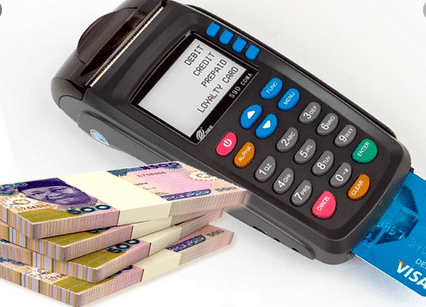
By Marcel Mbamalu
The landscape of Nigeria’s financial institutions has, in recent times, witnessed interesting changes that simultaneously embrace and challenge technological advancements.
Point of Sale (POS) technologies have become the most popular example of this shift in financial transaction patterns. What simply served the purpose of processing card payments for shoppers at retail stores has metamorphosed into a seemingly profitable business venture for Nigerians. POS service terminals now line every street and turn. Even children now wonder what and why the popping inscription – POS – everywhere.
Apparently, the ubiquity of the enterprise indicates its lucrative nature. A going concern.
Join our WhatsApp ChannelAcquiring a POS machine may be a piece of cake. Getting a POS machine in Nigeria may be a zero-cost affair in which case only a functional account, preferably a current or corporate account, is required and a number of requirements which must be met in accordance with CBN directives.
READ ALSO: Nigerian Banks Record Over N200 trillion Transaction Via Kiosks, POS, ATM, Others
But banking institutions that issue POS machines to their customers for free are not charity organisations; terms and conditions apply. In this case, the bank is entitled to a fixed commission often ranging from 0.25% to 1.5% of each transaction done through the issued POS terminal. However, in most cases, the cost of acquiring a POS machine varies from bank to bank, and full or part payment is acceptable.
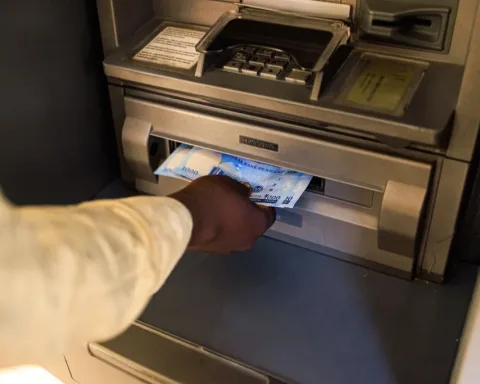
Clients, on the average, are charged N100 for cash withdrawals and deposits below 10k, done through POS terminals. A significantly higher rate than bank charges for ATM withdrawals and over -the-counter withdrawals and deposits.
In January 2022, the Central Bank of Nigeria (CBN) announced that it had slashed charges for Automated Teller Machine (ATM) withdrawal and inter-bank transfers.
According to The Guardian, ATM withdrawals that attract a service charge of N65 will now be N35 after the third withdrawal within the same month. It also slashed the interbank transfers to a maximum of N50 per transaction from N300.
Despite the relatively high charge that accompanies POS transactions, the customer base of POS terminals continues to soar as well as the terminals.
Perhaps, the most alluring feature of this development is its ease of use and convenience. Commuters and travelers, who are pressed for time and in need of cash easily find their way to a POS terminal and get along with their businesses.
In Nigeria, POS transactions hit N3.20 trillion in 2019 with an increased value of transactions done across its channels from N1.14 trillion recorded between January and May 2019 to N1.64 trillion within the same period in 2020. According to Nigeria Inter-Bank Settlement System (NIBSS) report, this implies that the total value of transactions from POS machines rose by N500 billion, representing a 43.8% increase in five months.
But fraud ever again, rears its ugly head up here.
With the increased patronage of POS terminals, fraudsters have infiltrated the camp of POS service providers, and have defrauded unsuspecting customers of their money.
According to reports, swindlers defraud customers of their money by distracting them at the point of payment in order to take a quick photo of their card details and thus gain unlimited access to the victim’s bank account.
Also, some unauthorized POS machines can retain details of a user’s credit/debit card and defraud the customer of sums of money after usage. On social media, individuals call out POS agents in different locations, or simply share their experiences with fraudsters linked with POS operation.
Notwithstanding the enormous challenge of theft in POS transactions, Nigerians seem to be unperturbed and continue to patronise the business. Perhaps, this is in view of the fact that even direct bank transactions do not guarantee absolute protection from fraud.
With soaring record of POS related frauds, it has become necessary for commercial banks which approve and issue POS machines, and the POS operators, to come together to find ways to better serve the clients.
Since commercial banks approve POS agents and issue the machines, and remain the overall custodian of an individual’s fund, they should rise to the challenge and fish out illegal POS agents, as well as bridge the gaps in the banking system which scammers take advantage of to defraud individuals. A thorough assessment of business owners who wish to apply for POS machines should be done in order to make it easier to identify and nab criminals from among them whenever a complaint is filed against them.
Banks should latch onto technology and introduce more of POS machines that rotate the numbers on their keypads to make it difficult to use secret cameras to capture passwords.
Recall that in 2019, the CBN announced that its circular on stamp duty fee was misinterpreted by POS operators, and that the increase in POS charges were against its directive. According to CBN Director of Payment System Management, Musa Jimoh, ‘Stamp duty is not a CBN regulated fee, it is a fee regulated by an act, and so we can’t change or push anything in that direction,’ he explained. He added that the stamp duty remains and cannot be changed by the CBN. ‘What we are doing is to ensure that the institutions we regulate (the banks) become more responsible to ensure that these fees are collected and given to the government.’
But, in accordance with Nigerians’ seemingly characteristic lawlessness, some POS operators continue to disregard these laws and directives. Some POS operators continue to charge their customers additional #50 on every POS transaction, and insist it is in compliance with the directives of the CBN.
I hope that customers should resist such breaches of their rights, while the banks and CBN can use public campaigns to educate the public and POS operators given the ubiquity of terminals.
Dr Marcel Mbamalu, a Development Journalist, Media Consultant and former Editor at The Guardian, is the Publisher/Editor-in-Chief of Prime Business Africa
Email: [email protected]
+234(0)8094000017

Dr. Marcel Mbamalu is a distinguished communication scholar, journalist, and entrepreneur with three decades of experience in the media industry. He holds a Ph.D. in Mass Communication from the University of Nigeria, Nsukka, and serves as the publisher of Prime Business Africa, a renowned multimedia news platform catering to Nigeria and Africa's socio-economic needs.
Dr. Mbamalu's journalism career spans over two decades, during which he honed his skills at The Guardian Newspaper, rising to the position of senior editor. Notably, between 2018 and 2023, he collaborated with the World Health Organization (WHO) in Northeast Nigeria, training senior journalists on conflict reporting and health journalism.
Dr. Mbamalu's expertise has earned him international recognition. He was the sole African representative at the 2023 Jefferson Fellowship program, participating in a study tour of the United States and Asia (Japan and Hong Kong) on inclusion, income gaps, and migration issues.
In 2020, he was part of a global media team that covered the United States presidential election.
Dr. Mbamalu has attended prestigious media trainings, including the Bloomberg Financial Journalism Training and the Reuters/AfDB Training on "Effective Coverage of Infrastructural Development in Africa."
As a columnist for The Punch Newspaper, with insightful articles published in other prominent Nigerian dailies, including ThisDay, Leadership, The Sun, and The Guardian, Dr. Mbamalu regularly provides in-depth analysis on socio-political and economic issues.










A good piece and advisory in these uncertain times.