Amanze Chinonye
Nigeria’s multidimensional poverty rate rose to 38.7% in 2024 from 33% in 2021, reversing gains recorded during the previous decade and adding 17.9 million people to the number affected, according to the 2026 Global Multidimensional Poverty Index released by the United Nations Development Programme (UNDP) and the Oxford Poverty and Human Development Initiative (OPHI), Prime Business Africa reports.
Join our WhatsApp Channel
An estimated 90.1 million Nigerians were living in multidimensional poverty in 2024, compared with 72.2 million in 2021, according to figures reported by TheCable from the latest update. Nigeria recorded the largest increase in the number of people affected among countries whose latest estimates showed rising poverty, the report said.
READ ALSO :
Nigeria: Tracking Poverty and Hunger as Gauge for Economic Reforms?
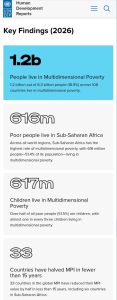
The findings coincide with a rise in global multidimensional poverty for the first time since the index was launched in 2010. An estimated 1.2 billion people across 108 developing countries were living in acute multidimensional poverty, 51.5 million more than in the previous update on a like-for-like basis.
The index measures poverty beyond income, assessing overlapping deprivations in health, education and living standards. Its 10 weighted indicators cover nutrition, child mortality, years of schooling, school attendance, cooking fuel, sanitation, drinking water, electricity, housing materials and household assets. People are classified as multidimensionally poor when they experience deprivation in at least one-third of the weighted indicators.
Children accounted for 617 million of those living in multidimensional poverty worldwide, representing more than half of the total, while 83% of affected people lived in rural areas. The 108 countries covered had a combined population of 6.3 billion, of whom 18.9% were living in acute multidimensional poverty.
“The rise in poverty should be a wake-up call for the world,” UNDP Administrator Alexander De Croo said, citing the overlapping effects of hunger, missed schooling and inadequate access to clean water and electricity.
He said progress remained possible, pointing to countries that had tackled multiple forms of deprivation together rather than addressing them separately.
Population growth accounted for part of the increase in the global poverty count. In 95 countries without new household survey data for the latest update, revised population estimates added 15.8 million people to the number counted as poor. The remaining change reflected a combination of shifts in poverty incidence, demographic changes and differences in indicator coverage across survey rounds, the report said.
Among 13 countries with newly updated MPI estimates, five recorded significant reductions in the proportion of people living in multidimensional poverty. Egypt, Nepal and Tajikistan reduced both their poverty rates and the number of people affected. Angola and Zambia also reduced their poverty rates, but population growth outpaced those gains, resulting in an increase in the number of people living in poverty.
READ MORE :
The report highlighted progress towards the United Nations’ Sustainable Development Goal target of halving, by 2030, the proportion of people living in poverty in all its forms. Of the 89 countries with comparable MPI trend data, 33 had halved their MPI value in fewer than 15 years, including six in sub-Saharan Africa.
Eswatini reduced its multidimensional poverty rate from 38.7% to 8.0% over 15 years. China halved its MPI value in four years, with its poverty rate falling from 9.5% to 4.2% between 2010 and 2014. Vietnam also halved its MPI value within seven years.
The report said these examples demonstrated that sustained reductions in multidimensional poverty were achievable, although progress remained uneven across countries.
It did not attribute Nigeria’s reversal to a single policy or economic development. The findings instead highlight the need to assess poverty through access to essential services and living conditions, alongside conventional economic indicators.

Amanze Chinonye is a Staff Correspondent at Prime Business Africa, a rising star in the literary world, weaving captivating stories that transport readers to the vibrant landscapes of Nigeria and the rest of Africa. With a unique voice that blends with the newspaper's tradition and style, Chinonye's writing is a masterful exploration of the human condition, delving into themes of identity, culture, and social justice. Through her words, Chinonye paints vivid portraits of everyday African life, from the bustling markets of Nigeria's Lagos to the quiet villages of South Africa's countryside . With a keen eye for detail and a deep understanding of the complexities of Nigerian society, Chinonye's writing is both a testament to the country's rich cultural heritage and a powerful call to action for a brighter future. As a writer, Chinonye is a true storyteller, using her dexterity to educate, inspire, and uplift readers around the world.