 Amanze Chinonye
Former Deputy Governor of the Central Bank of Nigeria and President of the Institute for Governance and Economic Transformation, Kingsley Moghalu, has said that competent governance remains the indispensable foundation for economic transformation and regional stability in Nigeria and across Africa.
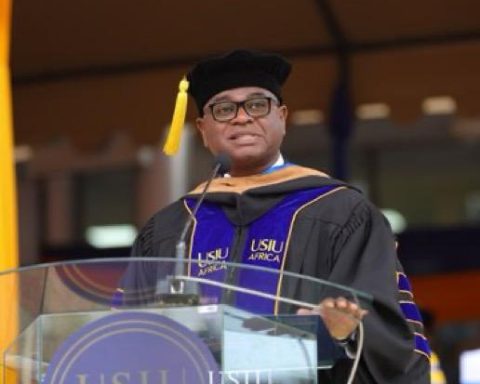
Speaking on Wednesday at the 2026 International Civil Service Conference organised by the Office of the Head of Service of the Federation in Abuja, Moghalu argued that no nation can achieve sustainable prosperity without strong state institutions, effective public administration, and accountable leadership.
Delivering a keynote address titled “Governance Reform, Economic Transformation, and Regional Stability,” the former presidential candidate said many African countries continue to fall short on governance despite frequent public rhetoric about reforms.
Join our WhatsApp ChannelREAD ALSO :
Moghalu to Speak at Harvard CID Global Meeting on Rethinking Development
According to him, governance goes beyond political declarations and must be reflected in state capacity, rule of law, transparency, accountability, efficiency, and responsiveness to citizens’ needs. “Economic transformation cannot be achieved without competent governance as its foundation,” Moghalu said.
He criticised what he described as the tendency of political actors in developing countries to separate economic management from governance, warning that technocratic reforms alone cannot succeed where institutions remain weak.
The former CBN deputy governor identified four critical dimensions of state capacity necessary for national development: protective capacity through security and rule of law; extractive capacity through transparent taxation; administrative capacity for public service delivery; and the ability to create an enabling business environment.
Using Nigeria as an example, Moghalu noted that despite huge corporate profits declared by banks and major firms, widespread poverty and low GDP per capita persist due to structural economic weaknesses, uncontrolled population growth, and currency depreciation.
He compared Nigeria’s economic trajectory with countries such as Malaysia, Indonesia, Botswana and South Africa, which he said achieved structural transformation through investment in human capital, infrastructure, and policy stability.
Drawing historical lessons from Europe and Asia, Moghalu cited the governance reforms that shaped the rise of Britain, Singapore, China, South Korea, and other advanced economies. He particularly highlighted Lee Kuan Yew’s transformation of Singapore through a merit-driven and corruption-resistant civil service, as well as China’s investment in infrastructure and administrative competence before pursuing aggressive market reforms.
According to him, successful countries followed a clear developmental sequence of governance capacity, human development, structural transformation, and inclusive growth. “There are no credible shortcuts,” he stated.
Moghalu also described the civil service as the “engine of government and governance,” stressing that efficient bureaucracies remain central to policy implementation and national stability.
While acknowledging reforms undertaken in Nigeria’s civil service since independence, including the Morgan, Adebo, and Udoji commissions, he said the public sector continues to face challenges such as politicisation, corruption, weak implementation capacity, red tape, and poor institutional continuity.
He warned that quota systems that undermine merit and repeated purges within the bureaucracy have weakened institutional memory and performance.
READ MORE :
Moghalu to Lead Strategic Dialogue on Africa’s Economic Security at CoSPAL Assembly in Morocco
The former deputy governor further examined the relevance of the New Public Management model, which promotes market-oriented reforms and private-sector management techniques in public administration.
Although he acknowledged some gains from initiatives such as the Integrated Payroll and Personnel Information System and Government Integrated Financial Management Information System, he argued that reforms would remain superficial without deeper institutional strengthening and political commitment.
On insecurity and regional instability, Moghalu linked governance failures to Nigeria’s persistent security challenges, including insurgency in the Northeast, banditry in the Northwest, separatist agitations in the Southeast, and communal conflicts in the Middle Belt. He said weak state presence, corruption, poor service delivery, and socio-economic inequality continue to fuel unrest across the country.
As part of his recommendations, Moghalu called for merit-based recruitment and continuous training in the civil service, improved professionalism and independence of public institutions, evidence-based policymaking, and stronger coordination between federal and state governments.
He also advocated the adaptation of private-sector corporate governance principles in the public sector, including stronger transparency standards, risk management frameworks, performance monitoring, and accountability mechanisms in ministries, agencies, and state-owned enterprises.
According to him, citizens should be treated as stakeholders entitled to measurable returns on public resources. He further urged government to prioritise education, healthcare, electricity, water supply, and infrastructure development as the foundation for long-term economic transformation and inclusive growth.
Moghalu called on civil servants to champion inclusive policies capable of reducing regional disparities and strengthening national cohesion. He said Nigeria possesses immense human and natural potential but must rebuild state capacity and restore trust between citizens and government to unlock sustainable development.
“Governance reform is the gateway to economic transformation and regional stability,” he said. The conference brought together civil servants, development partners, and governance experts from across different countries to discuss reforms aimed at strengthening public administration and promoting sustainable development.

Amanze Chinonye is a Staff Correspondent at Prime Business Africa, a rising star in the literary world, weaving captivating stories that transport readers to the vibrant landscapes of Nigeria and the rest of Africa. With a unique voice that blends with the newspaper's tradition and style, Chinonye's writing is a masterful exploration of the human condition, delving into themes of identity, culture, and social justice. Through her words, Chinonye paints vivid portraits of everyday African life, from the bustling markets of Nigeria's Lagos to the quiet villages of South Africa's countryside . With a keen eye for detail and a deep understanding of the complexities of Nigerian society, Chinonye's writing is both a testament to the country's rich cultural heritage and a powerful call to action for a brighter future. As a writer, Chinonye is a true storyteller, using her dexterity to educate, inspire, and uplift readers around the world.