Amanze Chinonye
Development economics as we have known it for 70 years is “intellectually exhausted” and must be buried, Professor Bongo Adi of Lagos Business School declared Friday in his inaugural lecture, arguing that Africa must abandon the manufacturing-led model and build a new framework for prosperity in the age of Artificial Intelligence.
Delivering the 23rd Inaugural Lecture of Pan-Atlantic University titled “The End of Development Economics: A Manifesto for Post-Industrial Policy” on Friday, July 17, 2026, Prof. Adi said the old paradigm built by Lewis and Rostow — that nations must industrialize through factories to get rich — has collapsed under four forces: technology, epistemology, evidence, and politics.
Join our WhatsApp ChannelREAD ALSO :
MEDIA ADVISORY: Governance of Artificial Intelligence for Global Health in Africa
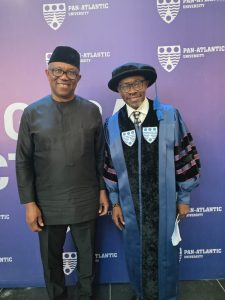
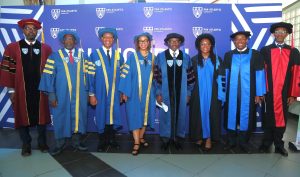
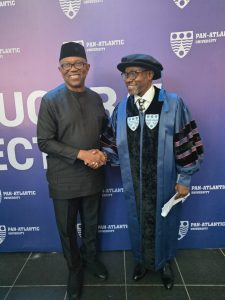
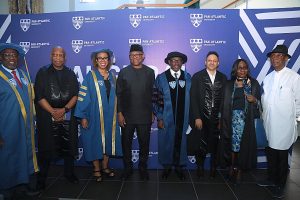
The lecture drew a high-profile audience, with former presidential candidate Mr. Peter Obi, Sahara Group Vice Chairman Kola Adesina, Financial Derivatives Company CEO Bismarck Rewane, former Presidential Economic Adviser Prof. Doyin Salami, Cowry Assets CEO Johnson Chukwu, and LBS Dean Prof. Chris Ogbechie among those in attendance.
Prof. Adi, who is also Chairman of the Board of Directors of Newstide Publications Limited, serves as a Director at Prime Business Africa.
“The manufacturing escalator has stopped accepting new passengers,” he said. “The end of development economics is not the end of development. It is the beginning of the harder task: building frameworks for transformation without the comfort of a known destination.”
Why The Old Model Failed
Prof. Adi said automation and AI have made labour-intensive manufacturing less competitive. Citing Acemoglu’s 2024 estimate that AI will only add 0.53% to 0.66% to global productivity in the next decade, he warned that Africa risks being left behind unless it shapes how AI is deployed rather than just consuming it.
Empirically, he argued, the evidence is already in. Africa’s share of global manufacturing value added remains below 2% despite AfCFTA. Referencing Rodrik’s work on “premature deindustrialisation” and studies of Ethiopian and Tanzanian firms, he noted that even where factories exist, they are not creating jobs at scale.
He also faulted the discipline on intellectual grounds, saying development economics carries “colonial residue” — a hierarchy that treats Western industrial modernity as the destination. Quoting Senegalese scholar Felwine Sarr, he called for “absolute intellectual sovereignty” so Africa can build theories from its own data.
On politics, using the “deals” framework by Pritchett, Sen and Werker, Prof. Adi said growth does not depend on perfect policies but on whether elites strike credible, ordered deals with firms. Without that, he warned, any industrial policy degenerates into rent-seeking.
A New Manifesto For The AI Era
In place of the old model, Prof. Adi proposed a fundamental shift “from comparative advantage in production to comparative advantage in capability orchestration” — the ability to govern networks of human, data and institutional capabilities.
Photos :

He said industrial policy must move away from picking specific sectors to building dense capability ecosystems that link universities, firms, state agencies and civil society. Nigeria’s fintech boom, with companies like Paystack and Flutterwave processing over 500,000 daily transactions, was cited as an example. But he cautioned that the sector still employs only about 10,000 people directly, showing the limits of growth without deeper ecosystem investment.
On technology, he argued that governments must deliberately regulate and procure AI to augment human labour instead of replacing it. He warned of “algorithmic colonisation” and called for African-owned AI systems built for low-bandwidth, multilingual contexts, not imported models that replicate foreign biases.
Prof. Adi also made the case for a services-led transformation. With AI boosting productivity in education, health and creative work, and the African Development Bank projecting that AI could add up to $1 trillion to Africa’s GDP by 2035, he said “industries without smokestacks” like Nollywood and fintech should be treated as core engines of development, not side stories.
He described data as the new oil and said data sovereignty will define power in the 21st century. With Google controlling over 92% of search in South Africa and Africa accounting for just 1% of global data centres, he said legal frameworks alone are not enough. Africa needs technical capacity to process data locally or risk a new extractive model.
Finally, he positioned the African university as a central developmental actor. Universities, he said, must produce original research, train the AI-era workforce, and provide critical reflection. “If African universities do not produce the intellectual frameworks for AI-era development, those frameworks will be produced elsewhere and imported,” he warned.
READ MORE :
Chatbots: An Innovative Extension Of Artificial Intelligence
A Confession And An Invitation
In a rare self-critique, Prof. Adi admitted he had spent years asking the wrong question: “why has Africa failed to industrialise?”
“The question I should have been asking was: what if industrialisation, as the twentieth century understood it, is no longer the right objective?”
He pointed to Lagos tech hubs and Nollywood — which employs an estimated 1 million people — as proof that development is already happening outside the textbook.
Closing with an invitation to young African scholars, he said: “What is emerging across this continent… does not yet have a name. It is post-development in the generative sense: it refuses the maps we inherited and insists on drawing new ones.”
The lecture, published by Pan-Atlantic University Press with ISBN 978-978-60877-3-3, comes as total foreign aid fell 23.1% in 2025, the largest annual drop on record, according to OECD data cited by the professor.
For Prime Business Africa, the message was clear: Nigeria and Africa cannot wait for factories to save them. In the AI era, the winners will be those who can orchestrate talent, data, and institutions — fast.

Amanze Chinonye is a Staff Correspondent at Prime Business Africa, a rising star in the literary world, weaving captivating stories that transport readers to the vibrant landscapes of Nigeria and the rest of Africa. With a unique voice that blends with the newspaper's tradition and style, Chinonye's writing is a masterful exploration of the human condition, delving into themes of identity, culture, and social justice. Through her words, Chinonye paints vivid portraits of everyday African life, from the bustling markets of Nigeria's Lagos to the quiet villages of South Africa's countryside . With a keen eye for detail and a deep understanding of the complexities of Nigerian society, Chinonye's writing is both a testament to the country's rich cultural heritage and a powerful call to action for a brighter future. As a writer, Chinonye is a true storyteller, using her dexterity to educate, inspire, and uplift readers around the world.