 Prosper Okoye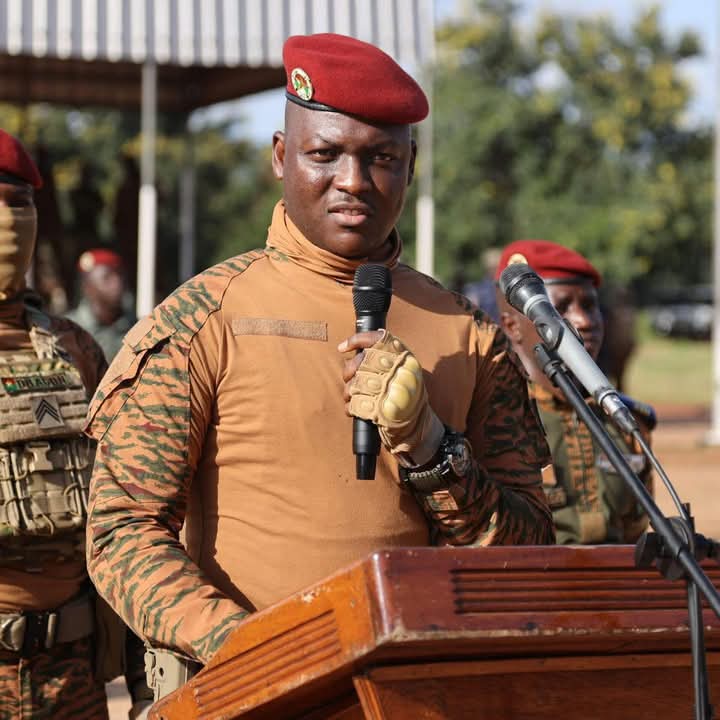
Burkina Faso’s transitional government has dissolved all political parties, repealed the laws that governed their operation, and transferred their assets to the state, the presidency announced on Thursday.
The move comes more than three years after a September 2022 coup brought junta leader Captain Ibrahim Traoré to power.
The decision was formally adopted during a council of ministers meeting chaired by Traoré. Émile Zerbo, minister of territorial administration and mobility, described it as “a great and important decision as part of the re-founding of the state.”
The presidency said the country’s numerous political parties had contributed to fragmentation, division among citizens, and a weakened social fabric.
The decree aims to strengthen national unity, improve coherence in government action, and pave the way for broader political governance reforms.
All property belonging to dissolved parties will now be transferred to the state, and draft laws to implement the measure are expected to be submitted to the Transitional Legislative Assembly.
Before the coup, Burkina Faso had more than 100 registered political parties, with 15 represented in parliament after the 2020 general election. Following Traoré’s takeover, parties were forced to suspend activities, leaving the country without formal political representation under the transitional government.
At the same meeting, the council approved a five-year economic and development plan, the “Reliance Plan,” valued at FCFA 36 trillion ($65 billion). The plan outlines projects to boost infrastructure, economic growth, and social welfare across the country between 2026 and 2030.
The dissolution of political parties has sparked mixed reactions. Supporters of Traoré’s junta say the move is necessary to promote national unity amid ongoing security crises. Zerbo and other officials have argued that the proliferation of over 100 parties created division and weakened the state, and that the decision will allow the government to focus on combating jihadist insurgencies. Some Burkinabè citizens and Pan-Africanist voices online praised what they call Traoré’s “revolutionary path,” seeing it as a break from a corrupt political class and a step toward security and social cohesion. One X user described it as a push for “more armed revolution” rather than “political propaganda,” aligning with anti-colonial sentiments.
Critics, however, warn the move risks deepening authoritarian control. Rights groups and opposition voices have expressed concern that the dissolution further limits civic freedoms after years of suspended political activities, media restrictions, and suppression of dissent since the 2022 coup.
An anonymous civil society member said “This will not help the country move forward. We’re not happy with this.” Analysts warn that it could entrench military rule, delay elections indefinitely, and even spark underground resistance.
Some commentators likened Traoré’s actions to long-time rulers such as Paul Biya or Robert Mugabe, suggesting a fear of losing power.
Social media reactions have reflected a mix of support and scepticism. On X, some users corrected misconceptions, clarifying that the dissolution affects all parties, not just the opposition, while others mocked Western coverage of the ban.
The online discourse illustrates the polarized views within Burkina Faso and the wider Sahel region.
Guinea-Bissau Coup : Military Topples President Embaló, Installs General as Transitional Leader
Barracks Logic: Guinea‑Bissau’s Coup Fuels West Africa’s Military Temptation
Coup Plot: Raid on Ex-Governor Timipre Sylva’s Abuja Home Confirms PBA Report
Analysts note that the junta’s moves follow a broader regional trend of military-led transitions in West Africa and are aimed at consolidating authority, preventing political fragmentation, and maintaining stability during the transitional period. Despite international concerns about democratic backsliding, Traoré’s administration has defended the measures as necessary to create a more cohesive and resilient state capable of addressing the country’s social and economic challenges.

Prosper Okoye is a Correspondent and Research Writer at Prime Business Africa, a Nigerian journalist with experience in development reporting, public affairs, and policy-focused storytelling across Africa