 MARCEL MBAMALU
Across Nigerian farms, market stalls and social media platforms, a single word now carries the weight of several intersecting anxieties: safety, sovereignty, survival. Genetically Modified Organism (GMO) has become shorthand for a debate that is at once scientific, economic and geopolitical.
A GMO is a plant, microorganism or animal whose genetic makeup has been altered to express traits desired by engineers, usually for higher yields, pest resistance, or climate resilience. As these organisms spread globally, fears about their safety have grown. Those fears are now tangled with a deeper worry: an increasing dependence on a handful of countries and corporations that control GMO seeds, especially plant seedlings.
That anxiety is sharpened by insecurity that has turned Nigeria’s most fertile belts into contested, sometimes deserted, ground. As concerns mount, we must separate the documented from the speculative to make the debate useful to farmers, policymakers and the public who must live with the consequences of GMOs — good, bad or ugly.
Safety, Food Security and the Fog of Suspicion: Is it safe?
In 2015, about 300 scientists, physicians and legal scholars published a statement in Environmental Sciences Europe pointing to a scarcity of independent, long-term feeding studies and questioning claims of a scientific consensus on GMO safety. They noted much of the reassuring research comes from biotechnology companies themselves. Groups like the U.S.-based Center for Food Safety argue that without epidemiological studies on human populations, claims of total safety go beyond current evidence.
READ ALSO: Seeds of Controversy: Global GMO Debate Takes Root in Nigeria
On the other side, in 2016 the U.S. National Academies of Sciences, Engineering and Medicine reviewed decades of data and found no substantiated differences in health outcomes — including cancer and allergies — between populations that consume GM foods and those that do not. The Genetic Literacy Project has catalogued more than 280 science and health bodies worldwide and over 3,000 peer-reviewed studies concluding that approved GM crops carry no more risk than conventionally bred crops. Japan’s expert panels reached similar conclusions in 2019, and the World Health Organization considers approved GMOs on the international market safe for consumption.
The picture, therefore, is not settled. It remains an ongoing debate, which helps explain the caution in developing countries where GMOs are making serious inroads.
Can GMOs solve food insecurity?
Proponents point to yield and resilience data. In Nigeria, farmers using approved pod-borer-resistant (PBR) cowpea report harvests rising from 3–4 bags per hectare under conventional varieties to more than 20, with some reporting over 80 bags from 100kg of planted seed. Pesticide spraying has dropped from multiple applications to as little as one.
TELA maize, approved for commercial release in January 2024, has shown yield advantages of up to 10 tonnes per hectare under good agronomic practice, against a national average of 6 tonnes for comparable hybrids. Field reports from Nigeria’s biotechnology regulators cite gains of 20–35% under pest pressure and erratic rainfall. For advocates, this proves biotechnology, properly regulated, is a food-security tool, not a threat. Yet safety concerns persist, fueling public demand for ways to identify GMOs.
How Can a Shopper Identify a GMO?
In practice, it’s harder than it should be. The produce industry’s PLU code system once reserved a 5-digit code beginning with “8” for GE produce, but that prefix was dropped in 2015 and never adopted at retail. PLU codes cannot reliably identify GM produce.
More dependable markers are formal labels. In the U.S., the National Bioengineered Food Disclosure Standard requires “bioengineered” labels or QR codes on packaged foods with GM ingredients. The Non-GMO Project Verified seal and USDA Organic certification also offer assurance, as organic by law excludes GMOs.
In Nigeria, the National Biosafety Management Agency Act of 2015 requires labelling, risk assessment and public engagement for approved GM products. This is administered by the National Biosafety Management Agency (NBMA) and the National Biotechnology Research and Development Agency (NBRDA).
The Conspiracy Dimension
Social media has amplified claims researchers continue to fact-check. One is “terminator seeds” — GM seeds engineered to be sterile so farmers must buy new seed each season. The Genetic Literacy Project notes no such sterile GM seed has ever been commercially planted anywhere. Still, the claim circulates, including a 2015 assertion by activist Vandana Shiva regarding GM mustard in India.
Bill Gates is another recurring figure. Africa Check and Dubawa traced viral clips accusing him of using GMOs and vaccines to depopulate Africa to two unrelated speeches from 2010 and 2015 edited out of context. Academic analysis also links GMO discussion online to recurring, debunked clusters tying GMOs to Monsanto conspiracies, COVID-19, and vaccine misinformation.
While these are debunked, a real concern remains: concentration. A small number of corporations dominate the global seed market. Foremost is Monsanto, now Bayer. Market domination does not prove sterilisation or depopulation claims, but it does fuel fears of control.
Has GMO Reached Nigeria, and Where Is It Prevalent?
Nigeria has moved from bystander to participant. NBMA approved Bt cotton for commercial cultivation first, followed by pod-borer-resistant cowpea in 2019 — making Nigeria the first African country to commercialise a genetically engineered food crop.
In January 2024, four TELA maize varieties — SAMMAZ 72T, 73T, 74T and 75T — were commercialised. Developed locally by the Institute for Agricultural Research, Ahmadu Bello University, Zaria, under the TELA Maize Public-Private Partnership coordinated by AATF.
A genetically engineered, late-blight-resistant potato is in regulatory field trials, with possible commercial release from 2025. As of now, GM tomato and GM rice remain in trials and are not legally approved for commercial planting. This matters because “tomato” frequently comes up in public anxiety about foreign seed. Many Nigerians also urge caution about PPPs, NGOs and university research that may be heavily undergirded by foreign corporations dominating the seed market.
Globally, GM cultivation is concentrated. Five countries — the U.S., Brazil, Argentina, India and Canada — account for roughly 91% of the world’s GM crop area, with Brazil recently overtaking the U.S. by hectares. Since around 2012, developing countries collectively have planted more GM area than developed ones, led by soybean, maize, cotton and canola. South Africa remains Africa’s leader; Nigeria is emerging as the next most active adopter. Ghana’s progress has been slower amid civil-society resistance.
Nigeria’s Fears of Agricultural Colonialism: GMO vs Hybrid
Beyond safety sits a distinctly Nigerian unease about a quiet inflow of new planting material. Farmers allege cereals, especially corn, pawpaw, tomatoes, cassava stems, and citrus arrive through commercial and donor channels. The record: apart from TELA maize, none of these as commonly sold to smallholders are approved GM varieties. Most are hybrids — products of conventional cross-breeding, commonly labelled F1, not genetic engineering. The distinction matters for diagnosing the complaint, even where anxiety about dependency is genuine.
New crop yields, but no saved seed
Farmers complain that seed saved from hybrid tomato, maize or cassava performs poorly when replanted. This has an agronomic basis. Hybrid seed is bred to concentrate traits in the first generation. Saved seed in the second generation loses uniformity and vigour. Companies therefore advise buying fresh hybrid seed each season.
Compounding this, experts warn of substandard or counterfeit seed sold without traceable genetic capacity. Prof. Lateef Sanni of FUNAAB says such seed damages root formation, canopy and plant size. Prof. Samuel Olakojo of IAR&T notes many farmers still plant ordinary grain rather than certified seed, depressing yields well below the ∼2 tonnes/ha Nigerian maize farmers might expect.
Whether genuine hybrid or adulterated, the practical effect is the same: constant dependence on a supplier each season, at a price farmers don’t control. In 2026, a handful of tomato seedlings sold for as high as ₦200,000 in some areas, with no yield guarantee.
The imperialism argument
This dependence gives “agricultural colonialism” fears their force. Duke Tagoe of Food Sovereignty Ghana argues seeds entering African markets remain the property of foreign corporations, a modern imperialism operating through the food chain. A recent scholarly paper calls the wholesale adoption of hybrid and GM seed an “agro-epistemicide” — the erosion of indigenous seed-saving knowledge in favor of perpetual dependency.
Nigeria’s regulators reject the framing. An NBRDA-backed op-ed argued approved GM crops were developed substantially by Nigerian scientists at ABU under domestic biosafety oversight, representing capacity-building, not imposition.
The pawpaw that would not seed
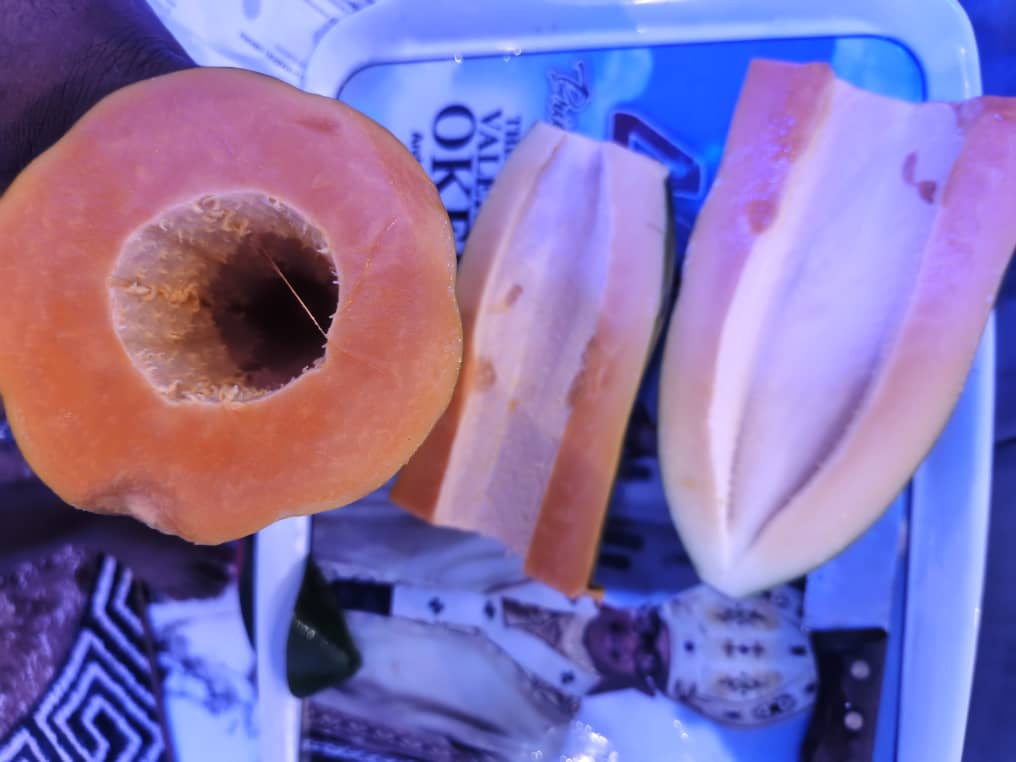
A case in point: after receiving a gift of pawpaw, the fruit had no seeds. Beyond taste, the question is how cultivation renews if seedless varieties displace seed-bearing trees common in home compounds. The donor urged uprooting existing plants for the new variety, prioritizing immediate taste over long-term reproductive capacity. Many Nigerians, unknowingly, have become distributors of such seedless varieties.
The soil-fit problem
Tomato growers complain imported and hybrid varieties bred for other climates underperform on Nigerian farmland without extra fertiliser, soil amendment, or irrigation. Extension guidance treats this as a known reality: selection guides routinely advise soil testing before planting imported/hybrid tomatoes. The complaint is genuine, even if it reflects breeding trade-offs rather than sabotage.
Government’s Role: Blind Spot or Quiet Participant?
Far from disengaged, government agencies have distributed hybrid seedlings at scale, heightening concern about what is being normalized. In 2026, the Federal Ministry of Agriculture and Food Security, via NASC, flagged off the Renewed Hope Seed Support Programme delivering 46 metric tonnes of certified seed to 4,600 farmers in Zamfara. The Bank of Agriculture reported distributing 1.8 million bags of fertiliser and 329,000 bags of high-yielding seed to nearly 500,000 farmers in over 20 states. In mid-2026, the FG also flagged off distribution of 1 million improved hybrid cocoa seedlings nationwide via CRIN. The Nigerian Conservation Foundation runs seed-exchange schemes with Yobe farmers.
Officials cite productivity and food security. Minister Abubakar Kyari says the 2025–2026 allocation of over 10% of the budget to agriculture, plus seed/fertiliser interventions, has helped moderate food inflation.
What’s largely absent is sustained public communication distinguishing certified seed, hybrid seed, and GM seed. That gap leaves room for the anxieties above.
Nigeria’s Food Belt Under Fire
This seed-dependency debate unfolds alongside severe insecurity. Nigeria Watch recorded at least 12,954 violence-related deaths in 2025 and 5,272 from Jan–May 2026 — over 18,000 in 17 months. The Global Terrorism Index recorded a 46% increase in terrorism deaths in 2025, with incidents rising from 120 in 2024 to 171 in 2025.
Food-producing states bore the brunt. HR groups estimate more than 2,200 killed in Plateau and over 3,600 in Benue between 2023–early 2026. Amnesty documented at least 2,600 deaths across 135 attacks on 50+ communities in both states from Jan 2023–Feb 2024, with ovet 500,000 displaced. The June 2025 Yelwata attack in Benue killed more than 100, with Nextier citing ∼200 in coordinated Guma LGA attacks.
In the middle of the 2026 planting season, attacks in Plateau and Benue killed over 40 farmers in a month, closing village markets. Livestock theft and grazing violence also hit Kebbi, Zamfara, Katsina, Sokoto and Niger, displacing an estimated 1 million. On 26 Nov 2025, the president declared a national security emergency after attacks in Kwara, Kebbi and Niger with over 350 abducted.
Is it organised?
Opinion is divided. Tor Tiv James Ayatse describes Benue attacks as a calculated invasion and land-grab. Emeka Umeagbalasi of Intersociety alleges government inaction reflects complicity with a religious domination agenda. Allegations of land grab now intersect with fears about food-seed security.
What Should Be Done
For Government:
1. Invest in public understanding as much as biosafety science: a plain-language campaign distinguishing certified, hybrid and GM seed.
2. Empower NASC to crack down on counterfeit/substandard seed flagged by Nigerian breeders.
3. Prioritize farmer protection in Benue, Plateau, Zamfara, Katsina, Kebbi and neighbors during planting/harvest.
4. Invest in community and national seed banks to preserve open-pollinated and indigenous varieties farmers can save and replant — a direct answer to dependency concerns.
For Farmers and Organisations: Bodies like AFAN should organize collective seed verification and bulk purchase to reduce exposure to fake seed, and press NASC for redress. Cooperative seed banks, like pilots in Yobe, hedge against single-supplier dependence. Farmers should demand written info on seed origin, performance, and replanting potential before accepting seedlings.
For Public and Media: Treat GMO claims like any extraordinary claim: verify against NBMA and NBRDA before sharing. Journalists and scholars must unpack debates on corporate seed dependency, weak regulation, and insecurity in the food belt, and keep investigating claims about depopulation or sterile seeds.
Bottom Line:
Nigeria’s seed anxiety is not irrational, even if parts are misdirected. The country has adopted GM crops, with locally developed varieties showing documented yield benefits. What lags is public understanding of what a GMO is, distinct from the hybrid and often substandard seed farmers more commonly encounter. Substandard seed, more than GM seed, traps farmers in costly repurchase cycles. Yet both GM and substandard seed trajectories must be tracked, especially where foreign partnerships enter Nigerian universities and civil society.
Layered on this is a real, escalating food-belt security crisis. Nigeria’s food future depends on verifying claims against evidence, and building regulatory transparency, security, and public literacy so farmers can make informed choices.

Dr. Marcel Mbamalu is a distinguished communication scholar, journalist, and entrepreneur with three decades of experience in the media industry. He holds a Ph.D. in Mass Communication from the University of Nigeria, Nsukka, and serves as the publisher of Prime Business Africa, a renowned multimedia news platform catering to Nigeria and Africa's socio-economic needs.
Dr. Mbamalu's journalism career spans over two decades, during which he honed his skills at The Guardian Newspaper, rising to the position of senior editor. Notably, between 2018 and 2023, he collaborated with the World Health Organization (WHO) in Northeast Nigeria, training senior journalists on conflict reporting and health journalism.
Dr. Mbamalu's expertise has earned him international recognition. He was the sole African representative at the 2023 Jefferson Fellowship program, participating in a study tour of the United States and Asia (Japan and Hong Kong) on inclusion, income gaps, and migration issues.
In 2020, he was part of a global media team that covered the United States presidential election.
Dr. Mbamalu has attended prestigious media trainings, including the Bloomberg Financial Journalism Training and the Reuters/AfDB Training on "Effective Coverage of Infrastructural Development in Africa."
As a columnist for The Punch Newspaper, with insightful articles published in other prominent Nigerian dailies, including ThisDay, Leadership, The Sun, and The Guardian, Dr. Mbamalu regularly provides in-depth analysis on socio-political and economic issues.