

 Etim Etim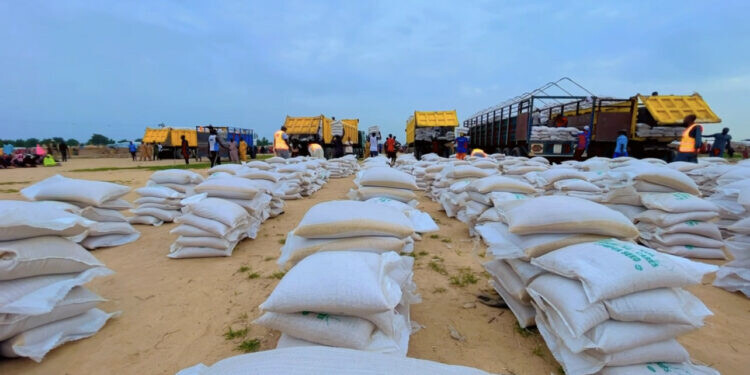
The big news of the week is that the federal government is distributing 24,000 bags of rice to each state of the federation in a desperate move to stave off mass protests nationwide planned to begin next Thursday. On receiving its share, Akwa Ibom State government announced that it would add another 24,000 bags so as to reach as many people as possible in the state. The commissioner for Agriculture and Rural Development, Dr. Offiong Offor noted that the gesture is “to mitigate the high level of hunger, food unavailability and poverty’’ in the state. She announced that each of the officially recognised 2,272 villages will receive some bags of rice. She did not specify the quantity, but on average, each village should get 21 bags. Each bag weighs 25 kg and in the market, it goes for around N40,000. If the government bought them for N50,000 each (government procurements typically attract higher prices), it means that the 24,000 bags cost a whopping N1.2 billion.
Each village in the state has between 1,000 and 2,000 persons, according to the recent population estimates, and they will have to share 21 bags. How do 1,000 people, for example, share 21 bags of rice? You can be sure that the bulk of the 21 bags will go to the village heads, the clan heads, family heads, the youth leaders and other influential persons in the village; and this brings me to the question: Is spending N1.2 billion to procure rice for sharing a worthy idea? Could the money have been used in alternative ways to obtain better results?
Join our WhatsApp ChannelREAD ALSO: Nigerian Govt Begs Citizens To Shelve Planned Nationwide Protest
Welfare schemes are usually designed to benefit very poor individuals and households or persons living with disability who are not able to provide for themselves. Such schemes are actually more effective if they entail honest and transparent transfer of cash to the intended beneficiaries. With cash, the recipient could buy preferred items of need which may not necessarily be rice. As a matter of fact, a lot of rural folks have access to tubers and other sources of carbohydrates, but they lack money to buy protein-rich foods which are very essential, especially for the children. In this particular case of rice distribution, I actually believe that the government would have made greater impacts on the greatest number of people if the N1.2 billion was given out as grants to small holder farmers in each village to assist them in food production.
READ ALSO: World Bank Allocates $300 Million In Palliative Loans For Nigeria
The village economy across the country is dominated by subsistence farming. These subsistence farmers require little or no capital for their businesses. Thus, any little additional capital input will trigger significant output increase. They obtain inputs (mostly seeds and cuttings) from friends, relatives or neighbours and are the source of their own farm labour, often with the help of children in the household. If the government could provide as little as N20,000 to each farmer in rural Akwa Ibom, the N1.2 billion would reach 600,000 of them and that would make enormous impact on overall food production in the state. Alternatively, if the government could invest N387 million in setting up a farming scheme in each of the 31 LGAs in the state, the total outlay would not be more than the N1.2 billion spent on purchase of rice. The rice, I am afraid, will not even get to the poor! Better still, since pests prevalence has been a major problem impeding food production in the state this season, the government could have spent the N1.2 billion in procuring and spraying pesticides across farmlands in the state.
I urge Gov. Umo Eno to rethink some of his welfare schemes, otherwise he will only succeed in catering for only PDP stalwarts in the state. When I visited Uyo in June, a prominent politician who owns a transport business told me that he had succeeded in enrolling his mother as a beneficiary of the state’s N50,000 monthly cash transfer scheme. “But I am not proud of doing that because I know that my mother ought not to be a beneficiary’’, he told me rather ruefully, adding, “my siblings and I are capable of taking care of her. But because I am in a position and I have contacts, I got her enrolled.’’ This is the way many government’s welfare schemes go, and it applies to every state of the federation, including FCT. The governor may be sincere and well-intentioned in buying thousands of bags of rice (or other foodstuffs) to share to his people, but he should be well aware that the bulk of the items will never get to the intended groups of citizens. They are seized by those who can afford. Last Christmas, Senator Godswill Akpabio distributed bags of rice to each LGA to be shared among APC members. My friend, Dr. Ita Udosen, who is a prominent APC official and a successful medical doctor, told me that soon after, he received a call from his local leaders that two bags have been reserved for him. “I wasted no time in turning down the offer. I can afford to buy rice for my family’’, he told me. Not many are that conscionable, but this is a further proof that the so-called palliatives hardly get to the right quarters.












Temp Mail This is my first time pay a quick visit at here and i am really happy to read everthing at one place