 John Adoyi, PBA Journalism Mentee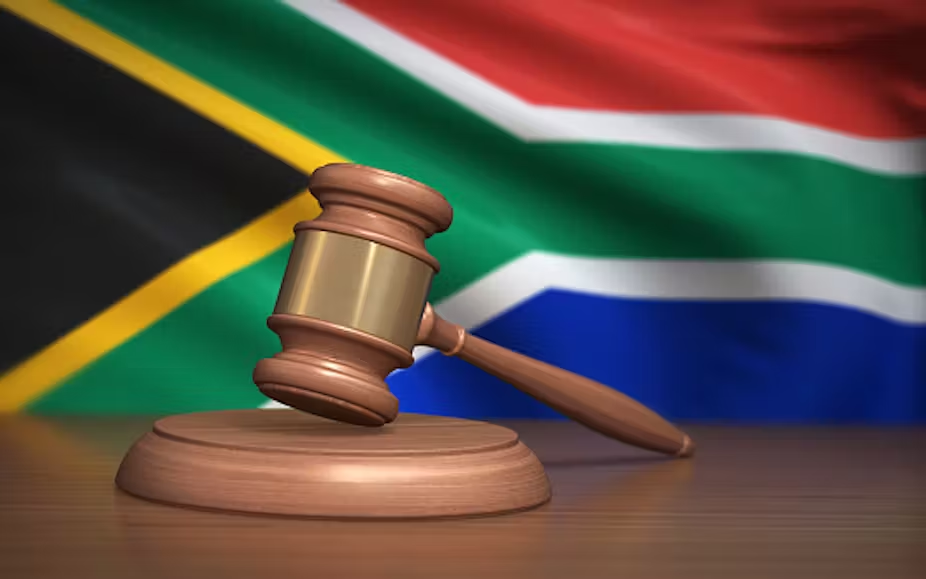
The Pretoria High Court has thrown out a controversial agreement between Eskom, South Africa’s state-owned power utility, and the National Energy Regulator of South Africa (Nersa), allowing the company to recover an extra $3 billion from electricity consumers.
Earlier this year, Eskom and Nersa reached an agreement that would result in a nationwide electricity price increase. This agreement stemmed from a regulatory miscalculation that left Eskom with an unjustifiable shortfall in allowable revenue.
In August, Nersa conceded it had miscomputed Eskom’s finances under the Multi-Year Price Determination (MYPD6) model. The miscomputation generated a gap of roughly $5.9 billion. Eskom argued that it was entitled to more income while Nersa estimated the shortfall at $2.4 billion. This led to the two parties ultimately agreeing on a compromise figure of $3 billion to be recovered. Amount to be recovered through higher tariffs over the coming financial years.
Join our WhatsApp ChannelHowever, Judge Jan Swanepoel ruled that the out-of-court deal could not stand because it lacked public participation. A requirement by law for changes that affect electricity pricing. He said that electricity tariffs affect millions of South Africans and cannot be decided behind closed doors.
“Decisions made in secret and without public knowledge are anathema to the statutory framework and to our constitutional norms,” Swanepoel said.
The judge also questioned the basis of the $3 billion figure, describing it as a compromise rather than a rigorously calculated value based on regulatory methodology. He added that the amount appeared to be “thumb-sucked,” leaving uncertainty about Eskom’s actual allowable revenue.
As a result, the court set aside Nersa’s decision on Eskom’s allowable revenue application for the 2025/2026, 2026/2027, and 2027/2028 financial years. The matter was remitted to the regulator to conduct a fresh determination, this time with full public participation. Under the court order, Nersa must invite public submissions and reconsider Eskom’s regulatory asset base and allowable revenue before adjusting tariffs for the 2026/2027 and 2027/2028 tariff years.
READ ALSO: Spending-Spree Black Friday Sees South Africans Swipe Over US$27.5 Million by Noon
The ruling follows months of public controversy over the proposed tariff increases. Trade unions, civil society organisations, and consumer groups have repeatedly warned that sharp electricity price hikes would deepen energy poverty, particularly for low-income households already struggling with high living costs and unreliable power supply.
Critics also raised concerns about transparency, arguing that decisions with such broad economic and social consequences should not be negotiated privately between a regulator and Eskom.
Legal advocacy groups that challenged the settlement welcomed the judgment, describing it as a victory for accountability and public participation. They stated that the ruling reaffirmed the need for electricity pricing decisions to follow lawful and inclusive processes.
Nersa is now required to restart the process of determining Eskom’s allowable revenue, taking into account public comments and submissions. Only after completing that process can any revised tariff increases be approved.
For Eskom, which supplies about 90 per cent of South Africa’s electricity, the judgment introduces uncertainty into its short-term revenue plans. More broadly, the case highlights ongoing tensions in South Africa’s energy sector between maintaining the financial sustainability of the utility and protecting consumers from steep increases in electricity prices.