 MARCEL MBAMALU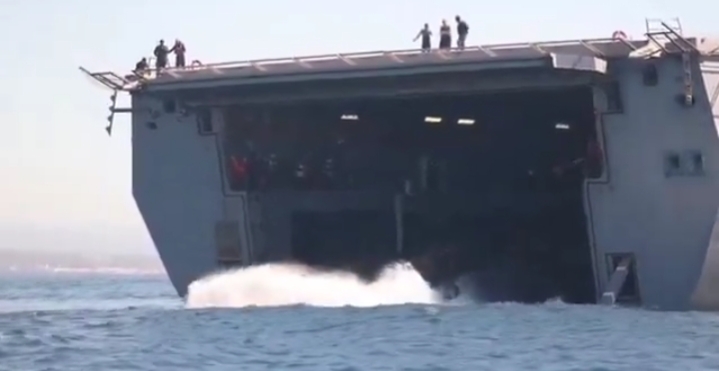
The world’s largest international maritime exercise is scaling up, with 30 nations gathering under the banner “Partners: Integrated and Prepared” for RIMPAC 2026, a U.S. Navy commander said Monday.
Rear Admiral Suzanne M. Bailey, Commander of the RIMPAC Combined Exercise Control Group and Deputy Commander of U.S. 3rd Fleet, told journalists in a U.S. Department of State virtual briefing that the exercise is shifting beyond traditional warships to test drones, multinational command, and live-fire kill chains in a real-world Pacific setting.
Drones Take Center Stage
Prime Business Africa reports that a major focus for 2026 is the integration of uncrewed systems, particularly Unmanned Undersea Vehicles, UUVs, for anti-submarine warfare.
Join our WhatsApp Channel“Unmanned systems aren’t just an incremental improvement to our Navy. They’re an absolutely essential part of today and our future in naval warfare,” Bailey said. “They give us capacity and resilience. They give us options. They create dilemmas.”
While she did not name specific platforms for operational security, Bailey, a former MQ-9 Reaper pilot and RQ-4 Global Hawk mission commander, said RIMPAC serves as a “primary laboratory” to fuse manned and unmanned platforms into a single fighting force.
Allies in the Lead: Korea, Philippines, Indonesia
RIMPAC 2026 is marking a leadership milestone with the Republic of Korea Navy assuming the Maritime Component Commander role for the first time. Admiral Kim In-ho will direct a multinational force at sea.
“That is a powerful testament to the strength and maturity of our alliance,” Bailey said, adding that Korea’s deployment of new naval assets is “a model for the future”.
The Philippines is also expanding its footprint with air assets, special operations forces, two surface platforms, and a historic first: participation by the Philippine Coast Guard. Bailey said Manila would be “incorporated in each and every one of our events” during the at-sea phase.
Indonesia is contributing Indonesian Marines, infantry platoons, staff officers, and a medical team to integrate across amphibious and medical operations.
Live-Fire Testing and New Capabilities
The exercise will feature a SINKEX, or sinking exercise, described by Bailey as “the ultimate test of our kill chain” requiring allies to detect, track, target, and strike a vessel with live ordnance. Amphibious operations will also run alongside USS Essex and multinational marine forces following a harbor-phase buildup.
Bailey confirmed about 40 experimentation initiatives are slated under the Fleet Experimentation Program, aimed at exposing partners to emerging capabilities and collecting warfighter feedback early. The U.S. Coast Guard is also on station with a cutter.
Framed around a “free and open theater,” RIMPAC 2026 brings together forces from across the Indo-Pacific and beyond, including Sri Lanka, which Bailey said reflects the value of cooperation “regardless of size or strength”.
“While RIMPAC only lasts a few weeks, the relationships, trust, and interoperability built here endure long after the exercise concludes,” Bailey said in closing remarks.
For African maritime and defense stakeholders, the scale of experimentation and allied integration at RIMPAC underscores a global shift toward networked, drone-enabled naval operations and deeper multinational command roles — trends likely to influence future naval procurement and training partnerships.

Dr. Marcel Mbamalu is a distinguished communication scholar, journalist, and entrepreneur with three decades of experience in the media industry. He holds a Ph.D. in Mass Communication from the University of Nigeria, Nsukka, and serves as the publisher of Prime Business Africa, a renowned multimedia news platform catering to Nigeria and Africa's socio-economic needs.
Dr. Mbamalu's journalism career spans over two decades, during which he honed his skills at The Guardian Newspaper, rising to the position of senior editor. Notably, between 2018 and 2023, he collaborated with the World Health Organization (WHO) in Northeast Nigeria, training senior journalists on conflict reporting and health journalism.
Dr. Mbamalu's expertise has earned him international recognition. He was the sole African representative at the 2023 Jefferson Fellowship program, participating in a study tour of the United States and Asia (Japan and Hong Kong) on inclusion, income gaps, and migration issues.
In 2020, he was part of a global media team that covered the United States presidential election.
Dr. Mbamalu has attended prestigious media trainings, including the Bloomberg Financial Journalism Training and the Reuters/AfDB Training on "Effective Coverage of Infrastructural Development in Africa."
As a columnist for The Punch Newspaper, with insightful articles published in other prominent Nigerian dailies, including ThisDay, Leadership, The Sun, and The Guardian, Dr. Mbamalu regularly provides in-depth analysis on socio-political and economic issues.