JOSEPH AFAMHE
The recurrent component of the country’s total spending outlay is heading towards 80 per cent, the 2022-2024 Medium Term Expenditure Framework and Fiscal Strategy Paper (MTEF/FSP) has suggested.
Whereas the ratio of the recurrent expenditure to the total budget of the current year is pegged at 68 per cent, the new MTEF/FSP, which the Minister of Finance, Budget and National Planning, Zainab Ahmed, presented to the National Economic Council (NEC) last week, shows that it will grow to 78 per cent in 2024. Its 2022 and 2023 projections are 74 per cent and 77 per cent respectively.
Join our WhatsApp ChannelWith the linear progression, the ratio would surpass 80 per cent in the next five years, suggesting that the amount available for all-important infrastructure will increasingly dwindle.
Already, the document estimates the ratio of capital spending to ebb to 22 per cent in the terminal year of the new MTEF/FSP. Accordingly, the country’s estimate for a capital vote next year will be 26 per cent while that of 2023 is 23 per cent.
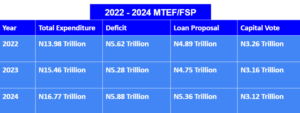
While ratios regress, the figures are also getting smaller even in naira terms, notwithstanding the call for an increase in infrastructure spending. The figures being reviewed as capital votes in the next three years are N3.23 trillion (2022), N3.16 trillion (2023) and N3.12 (trillion) – all in descending order.
This year, the Federal Government will be spending N4.13 trillion on capital projects, and that will decline by over N1 trillion or 25 per cent in the next three years. By simple regression principle, the figures may come down below N3 trillion in the next five to seven years.
Amid the declining capital expenditures, the government’s total will hit an all-time high, in nominal terms, in the next three years, rising from N13.59 trillion earmarked for this year to N13.98 trillion in 2022.
In 2023 and 2024, the budget estimates, which will be reviewed against economic realities before they are presented to the National Assembly, are N15.46 trillion and N16.77 trillion respectively.
Sadly, the government’s projected revenue will not support the expended spending outlays. Hence, the Ministry of Finance, Budget and National Planning is putting “fresh borrowings” of N15 trillion on the table in the three years covered by the medium-term planning document.
The projected loans are spread as: N4.89 trillion (2022), N4.75 trillion (2023) and N5.36 trillion (2024). The amount will raise the country’s debt stocks to the region of N60 trillion.
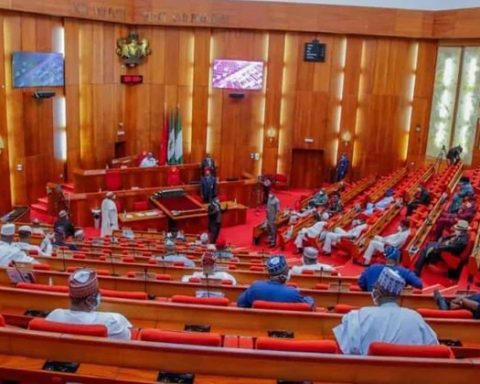
Earlier today, the Senate approved President Mohammadu Buhari’s request for a fresh $6.18 billion loan to fund part of this year’s fiscal deficit estimated at N5.6 trillion. The requested external loan translates to N2.5 trillion (using N410/$ rate).
The documented existing national debt stood at N33.1 trillion as of the end of March. The Minister of Finance, Budget and National Planning, Zainab Ahmed, had told a gathering of African leaders two weeks ago that debts of some states were yet to be computed.