 Emmanuel Ochayi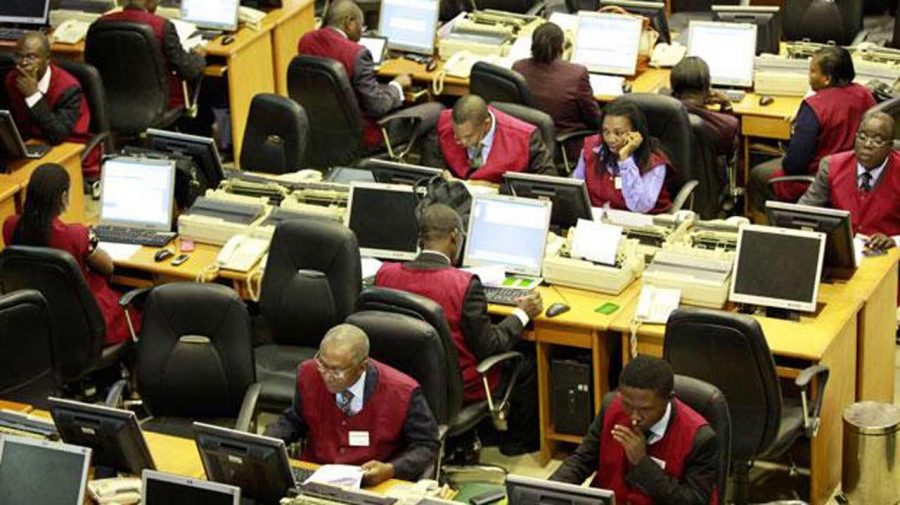
Nigerian Equity Market Faces Extended Downtrend
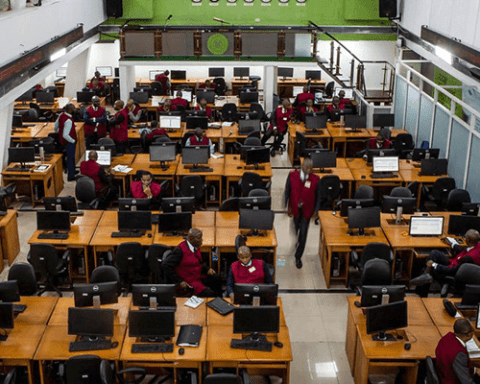
The Nigerian equity market continued its downward trend for the second consecutive week, losing a staggering N847.03 billion due to widespread sell-offs.
This ongoing decline is raising concerns among investors and market analysts alike.
Join our WhatsApp ChannelEquity Market Indicators Show Decline
By the end of the week, the All-Share Index (ASI) had dropped by 1.51 percent, closing at 97,100.31 points. Similarly, the market capitalisation shrank to N55.13 trillion.
Compared to the previous week, where 2.68 billion shares worth N49.02 billion were traded in 47,451 deals, this week saw a lower trading volume of 2.03 billion shares valued at N42.16 billion, across 45,157 deals.
Financial Services Dominate Trading Activity
The financial services industry led the trading activity, accounting for 1.38 billion shares valued at N25.65 billion. These figures represent 67.73 percent of the total equity turnover volume and 60.85 percent of the total value.
The oil and gas industry followed with 276.73 million shares worth N6.03 billion, while the services industry traded 101.22 million shares valued at N682.06 million.
READ ALSO: Nigeria’s Equity Market Declines By 1.51% As Profit-Taking Hits Industrial, Banking Stocks
Top-Traded Stocks in the Equity Market
The most actively traded stocks during the week were Guaranty Trust Holdings Company, Veritas Kapital Assurance, and Japaul Gold & Ventures.
These stocks collectively accounted for 674.233 million shares valued at N16.055 billion, representing 33.16 percent of the total turnover volume and 38.08 percent of the total value.
Mixed Performance in Market Indices
Most of the market indices closed lower, except for the insurance, consumer goods, oil & gas, lotus II, and growth indices, which posted gains of 0.79 percent, 0.37 percent, 5.25 percent, 0.42 percent, and 6.14 percent, respectively. The ASeM index remained unchanged.
Fluctuations in Equity Prices
Last week saw a decrease in the number of gainers, with 39 equities appreciating compared to 46 in the previous week.
On the other hand, 66 equities recorded price declines, up from 38 in the prior week. The number of unchanged equities also dropped to 46 from 67 the previous week.
R.T. Briscoe emerged as the top gainer, with its stock price rising by 33.86 percent. Following closely were TotalEnergies Marketing Nigeria Plc, which increased by 19.69 percent, and Julius Berger Nigeria Plc, which saw an 18.18 percent gain.
Conversely, Cutix recorded the largest drop, falling by 17.50 percent, followed by BUA Cement and Oando, which declined by 14.82 percent and 11.70 percent, respectively.
Analysts Predict Continuous Bearish Trend
Analysts from Afrinvest have expressed concerns about the continuing bearish trend in the equity market.
“We anticipate an extended bearish outing, fuelled by the cautious reaction to the mixed H1 earnings performances and improved valuation of the FI instrument owing to the modest decline in the headline inflation rate in July,” they noted.
The Nigerian equity market’s persistent downturn reflects investor caution amid fluctuating earnings and broader economic uncertainties.
As the market navigates these challenges, all eyes remain on the upcoming financial reports and economic indicators.

Emmanuel Ochayi is a journalist. He is a graduate of the University of Lagos, School of first choice and the nations pride. Emmanuel is keen on exploring writing angles in different areas, including Business, climate change, politics, Education, and others.