 Amanze Chinonye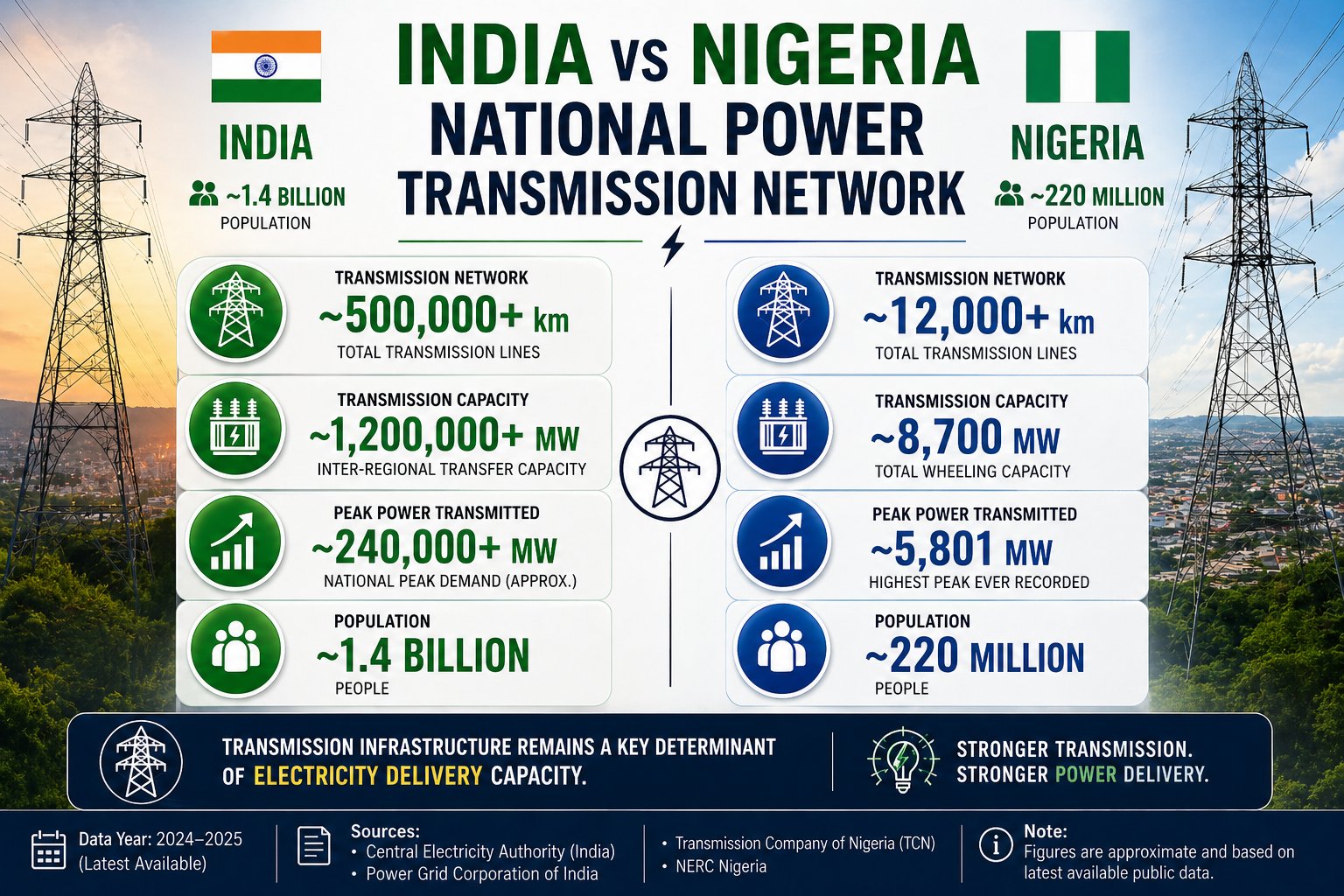
A comparative review of national power transmission infrastructures in India and Nigeria highlights a significant disparity in scale, capacity, and network reach, underscoring the differing stages of grid development in both countries, Prime Business Africa reports.
India, with an estimated population of about 1.4 billion people, operates one of the world’s largest and most interconnected electricity transmission systems, while Nigeria, with a population of approximately 220 million, continues gradual expansion of its comparatively smaller national grid.
In India, the transmission network has grown to over 500,000 circuit kilometres, supported by an estimated total transmission capacity of more than 1.2 million megawatts.
Join our WhatsApp ChannelThe country also maintains inter-regional transfer capacity exceeding 120,000 megawatts, enabling large-scale movement of electricity across states to balance supply and demand. Peak power transmitted has been recorded at over 240,000 megawatts, reflecting the system’s ability to handle high-demand periods within a highly integrated national grid structure.
READ ALSO :
NERC Mandates Regional Reporting of Transmission Losses to Boost Grid Efficiency
The infrastructure is overseen by institutions including the Central Electricity Authority and the Power Grid Corporation of India, which have driven sustained expansion and interconnection improvements over the past decade.
By contrast, Nigeria’s transmission network remains significantly smaller in scale. Data from the Transmission Company of Nigeria (TCN) and the Nigerian Electricity Regulatory Commission (NERC) indicate that the country’s transmission infrastructure currently spans over 12,000 kilometres, with a wheeling capacity of approximately 8,700 megawatts.
Nigeria’s highest recorded peak power transmission stands at about 5,801 megawatts.
Despite incremental improvements in recent years, the system continues to face structural challenges, including transmission constraints, limited redundancy, and persistent infrastructure bottlenecks, which have affected efficient power delivery across the country.
Industry data further show that India’s transmission network is more than 40 times longer than Nigeria’s, while its capacity for power transfer is several orders of magnitude higher. Analysts note that this gap reflects both differences in investment scale and the maturity of grid development in both countries.
READ MORE :
However, both nations continue to prioritise transmission expansion as part of broader efforts to strengthen electricity reliability, support industrial growth, and improve nationwide access to power.
While India’s grid reflects a highly developed and interconnected system capable of large-scale energy balancing, Nigeria’s network remains in a phase of steady expansion, with ongoing reforms aimed at increasing capacity and improving operational efficiency.

Amanze Chinonye is a Staff Correspondent at Prime Business Africa, a rising star in the literary world, weaving captivating stories that transport readers to the vibrant landscapes of Nigeria and the rest of Africa. With a unique voice that blends with the newspaper's tradition and style, Chinonye's writing is a masterful exploration of the human condition, delving into themes of identity, culture, and social justice. Through her words, Chinonye paints vivid portraits of everyday African life, from the bustling markets of Nigeria's Lagos to the quiet villages of South Africa's countryside . With a keen eye for detail and a deep understanding of the complexities of Nigerian society, Chinonye's writing is both a testament to the country's rich cultural heritage and a powerful call to action for a brighter future. As a writer, Chinonye is a true storyteller, using her dexterity to educate, inspire, and uplift readers around the world.