 Amanze Chinonye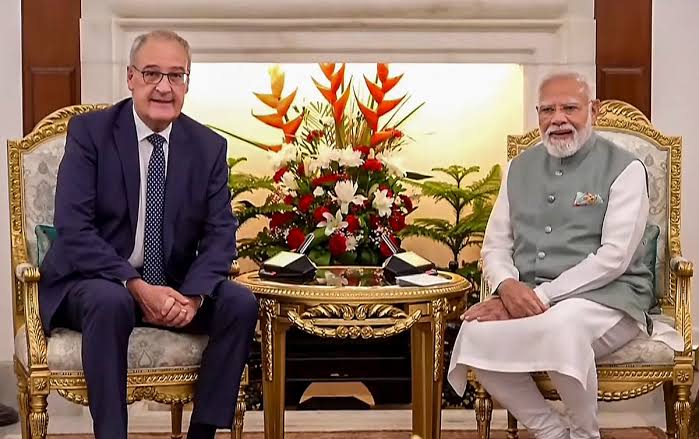
India and Switzerland have agreed to establish a special group to address trade and investment concerns and strengthen economic ties, as the two countries mark one year since the India-European Free Trade Association (EFTA) Trade and Economic Partnership Agreement (TEPA) took effect.
The mechanism is expected to provide a forum for addressing commercial concerns and improving implementation of the trade pact, which India and the four EFTA members Switzerland, Norway, Iceland and Liechtenstein signed in March 2024 and brought into force on Oct. 1, 2025.
Join our WhatsApp ChannelREAD ALSO :
India-New Zealand Free Trade Agreement to Take Effect on Oct. 20
Swiss President Guy Parmelin said the agreement should give a significant boost to bilateral trade and investment, with Swiss companies already investing or planning investments in sectors including transport and logistics, financial services, manufacturing, pharmaceuticals, biotechnology, technology and electronics.
“I expect that the TEPA will provide a significant boost to bilateral trade between Switzerland and India in the years to come,” Parmelin said in an interview with WION.
The agreement commits EFTA countries to facilitate $100 billion in investment in India over 15 years and support the creation of one million direct jobs. Those figures are targets under the pact, rather than investment or employment already delivered.
TEPA provides a framework covering trade in goods and services, investment promotion, intellectual property, government procurement and sustainable development, as well as provisions governing professional mobility.
Parmelin said the next phase of the relationship should translate the agreement into greater investment and employment on both sides, alongside deeper cooperation among universities, start-ups and research institutions.
Switzerland and India have also concluded two migration agreements a Migration and Mobility Partnership and a Young Professionals Agreement aimed at facilitating legal migration and mobility while strengthening cooperation on return and readmission.
Parmelin said between 1,500 and 1,900 work permits are issued annually to Indian nationals, while about 19,000 Indian nationals currently live in Switzerland. More than 450 Indian students are enrolled at Switzerland’s two federal technological universities, ETH Zurich and EPFL, while ETH Zurich employs six Indian professors and more than 200 Indian research assistants, he said.
Artificial intelligence is emerging as another area of strategic cooperation. Switzerland is preparing to host a global AI summit in Geneva in 2027, following India’s AI Impact Summit in New Delhi in 2026.
Parmelin said India would be a key partner for the Geneva summit and that both countries shared priorities on responsible and inclusive AI governance. Switzerland also plans to build on India’s efforts to give greater representation to developing countries in global technology discussions.
The two countries have a longstanding record of scientific and technological cooperation, dating back to a bilateral agreement signed in 2003. Their collaboration covers research and innovation, while Swiss universities and research institutions maintain partnerships with Indian counterparts.
READ MORE :
UAE Signals Additional $25 Billion Investment in India as Energy, Trade ties Deepen
The economic relationship also extends beyond TEPA. India and Switzerland have operated automatic exchange of financial-account information since 2018, supporting wider efforts to improve international tax transparency.
Switzerland remains India’s largest economic partner within EFTA, with hundreds of Swiss companies operating in India. EFTA has said TEPA is intended to deepen market access and increase investment flows between India and its member states.
Parmelin said the ultimate measure of success would be whether the partnership produces tangible benefits for businesses, researchers, students and workers.
“The EFTA-India agreement gives us a great framework, and now the real work is using it well,” he said, adding that stronger cooperation on responsible AI could extend the partnership beyond trade.
The creation of the special trade and investment group marks a shift from establishing the framework for cooperation to addressing practical commercial barriers and translating the agreement into increased trade, investment and economic activity.

Amanze Chinonye is a Staff Correspondent at Prime Business Africa, a rising star in the literary world, weaving captivating stories that transport readers to the vibrant landscapes of Nigeria and the rest of Africa. With a unique voice that blends with the newspaper's tradition and style, Chinonye's writing is a masterful exploration of the human condition, delving into themes of identity, culture, and social justice. Through her words, Chinonye paints vivid portraits of everyday African life, from the bustling markets of Nigeria's Lagos to the quiet villages of South Africa's countryside . With a keen eye for detail and a deep understanding of the complexities of Nigerian society, Chinonye's writing is both a testament to the country's rich cultural heritage and a powerful call to action for a brighter future. As a writer, Chinonye is a true storyteller, using her dexterity to educate, inspire, and uplift readers around the world.