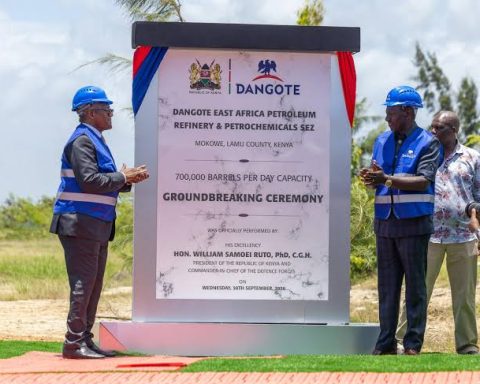
The Nigerian Upstream Petroleum Regulatory Commission (NUPRC) addressed the ongoing controversy between oil producers and the Dangote Refinery over crude oil supply, highlighting regulatory challenges, and the broader implications for Nigeria’s energy sector.
The Commission shared its challenges in trying to mandate oil producers to supply a portion of their output to Dangote refinery and other local refiners, as stipulated under the Domestic Crude Supply Obligation (DCSO) in the Petroleum Industry Act (PIA) 2021.
Join our WhatsApp ChannelIn a recent report, NUPRC said several crude oil producers in the country resisted every move to make them comply with the DCSO in 2024.
The report said several upstream oil companies that failed to supply crude to Dangote Refinery and other local refiners gave various reasons.
It said while some requested waivers, others gave reasons they could not meet the monthly crude volumes allocated to them under the DCSO, making the enforcement difficult for NUPRC.
The upstream regulator lamented that its attempt to enforce the DCSO received pushbacks from the Independent Petroleum Producers Group (IPPG), Oil Producers Trade Section (OPTS), some producers and their equity partners.
The report explained that their complaints came through “formal letters, either requesting for waivers on the allocated monthly obligations or giving detailed explanations why they might not be able to meet up with the allocated volumes.”
READ ALSO: NUPRC Mandates Oil Licence Holders To Pay $5,000 For Extension
In February 2024, the Commission implemented a number of initiatives to fulfill the Domestic Crude Supply Obligations in compliance with the Petroleum Industry Act’s provisions, including facilitating crude supply to the Dangote refinery and other refiners through the monthly production curtailment platform.
In a letter to all oil-exploring and producing companies, the NUPRC had asked them to provide copies of all active crude sales and purchase agreements related to crude oil sales that could affect the domestic crude oil supply.
It highlighted other efforts made towards implementing the DCSO such as organising industry stakeholder sensitisation to raise awareness of the responsibilities related to domestic crude supply and also formed a working committee in March last year with the goal of creating a comprehensive framework that addresses significant issues that might have an impact on how the DCSO policy is implemented.
READ ALSO: NUPRC’s New Guidelines On Crude Exports Tackle Oil Theft, Boost Revenue Generation
It said the committee comprised representatives from the OPTG, IPPG, Crude Oil Refinery Owners Association of Nigeria (CORAN, and NNPC Upstream Investment Management Services.
Other efforts by the Commission to implement the DCSO policy included creating metrics that evaluate each producer’s functional capability (past, present, and future) before assigning them a daily task. These metrics were to be distributed to each producer every two years.
On 11 July 2024, NUPRC Chief Executive Gbenga Komolafe finally approved the DCSO guidelines that were created using the operational template that industry stakeholders had collaboratively created.
READ ALSO: Why NRS Must Integrate NUPRC Audit System For Oil, Gas Sector Royalty Collection – Expert
Despite the efforts, oil producers have, however, resisted, citing contractual export commitments and pricing disputes. Some refiners, including Dangote, were temporarily barred from production curtailment meetings to address producers’ concerns.
Oil Producers’ Resistance to Mandatory Crude Supply
The Independent Petroleum Producers Group, representing oil producers, had rejected mandates to supply crude to Dangote Refinery and other local refineries, arguing that such obligations violate the “willing buyer, willing seller” framework under the PIA 2021.
The IPPG Chairman, Abdulrazak Isa, had in a letter dated 16 August 2024, addressed to the NUPRC Chief Executive, Gbenga Komolafe, said their members should not be forced to sell crude oil to the Dangote Refinery and other local ones in Nigeria.
The producers insisted that the Nigerian National Petroleum Company (NNPC) should use its allocated 445,000 barrels per day (intervention crude) to meet domestic refining needs instead of forcing private producers to divert export-bound volumes.
The situation forced Dangote refinery to resort to importation of crude to sustain its operations.
While NUPRC claimed that it had facilitated the supply of 29 million barrels of crude to Dangote Refinery between January and June 2024, as part of its Domestic Crude Supply Obligation under the PIA, the $20 billion company countered the claim, stating that it had only secured one cargo from a domestic producer (aside from NNPC’s term contracts) and relies on expensive imports from international traders.
The refinery accused International Oil Companies (IOCs) of imposing $2–$4 per barrel premiums on Nigerian crude, forcing it to import from distant markets like the U.S.
The 650,000 barrels per day refinery insisted that the NUPRC has failed to enforce the PIA’s DCSO, undermining local refining capacity.
Underlying Issues
According to analysts, the underlying issues include: pricing and foreign exchange challenges, production shortfall, and regulatory gaps.
Oil producers prefer dollar-denominated export sales over naira payments, while Dangote faces higher costs due to premiums charged by IOCs’ trading arms.
Nigeria’s crude output remains below its OPEC quota limiting available supply for domestic refiners.
While Dangote hails the Federal Government of implementing Naira-for-crude policy, which is said to have fuel cheaper in Nigeria than many West African countries, the persistent crude supply deficit has made the refinery to continue importing crude to sustain its operations.

Victor Ezeja is a passionate journalist with seven years of experience writing on economy, politics and energy. He holds a Master's degree in Mass Communication.