 Emmanuel Ochayi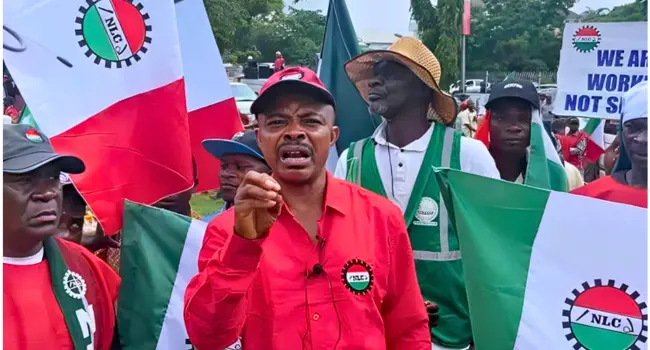
The Organised Private Sector has raised the alarm over the proposed strike by organised labour, scheduled to start today, warning of severe economic repercussions.
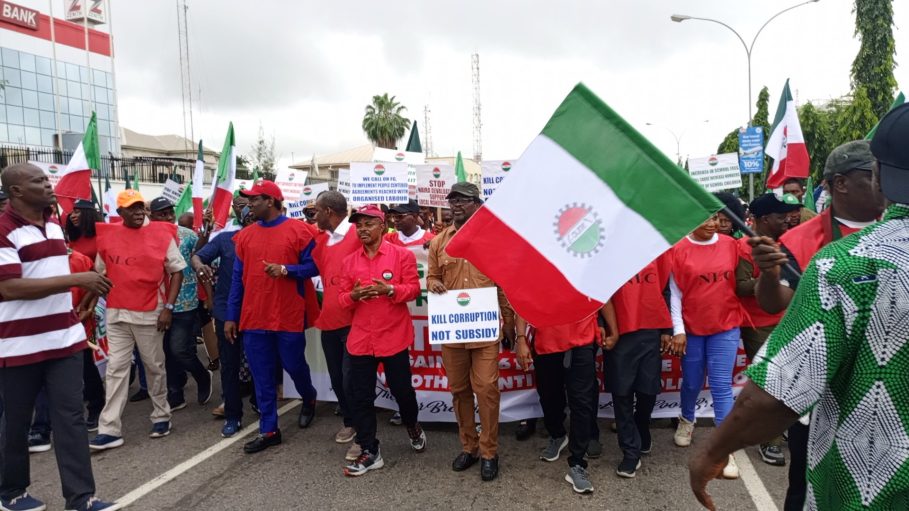
The Nigeria Labour Congress (NLC) declared an indefinite nationwide strike following failed negotiations with the Federal Government over the minimum wage.
Join our WhatsApp Channel“The economy is too fragile to withstand another strike,” stated Adewale-Smatt Oyerinde, Director General of the Nigeria Employers Consultative Association (NECA). “We need a balanced approach to address these issues.”
Last Friday, the NLC, led by President Joe Ajaero, announced the strike due to the government’s refusal to raise the proposed minimum wage above N60,000. The labour unions had initially demanded N497,000 but later revised it to N494,000, which the government still found unacceptable.
Reacting to the announcement, members of the Organised Private Sector (OPS), expressed their concerns. Oyerinde emphasised that the tripartite committee, comprising the government, labour unions, and private sector representatives, should be allowed to complete its proceedings. “It is worrisome that Organised Labour would call for an indefinite strike when these processes are yet to be concluded,” he added.
READ ALSO: Minimum Wage: Nigerian Govt Begs Labour Union To Reconsider Strike Action
Dele Oye, National President of the Nigerian Association of Chambers of Commerce, Industry, Mines and Agriculture (NACCIMA), also urged the NLC to reconsider. “We cannot afford it as the economy is too fragile to take that shock. We are appealing to labor to reconsider the decision.”
Segun Ajayi-Kadir, Director General of the Manufacturers Association of Nigeria (MAN), highlighted the potential negative impact on productivity and revenue. “This is not a good time for a strike considering the ailing economic situation,” he said. “There will be a reduction in production capacity, and this will lead to lower sales and reduced government revenue.”
Echoing these sentiments, Segun Kuti-George, National Vice President of the Nigerian Association of Small-Scale Industrialists (NASSI), noted that a strike would bring economic activities to a standstill. “Every strike action has consequences. If it is obeyed, it means there would be a standstill in the economy, adversely affecting the country,” he explained.
Economists have also weighed in on the issue. Professor Leo Ukpong of the University of Uyo, argued that the labour unions’ demand was unrealistic given the current economic challenges. “The amount they are asking for as a minimum wage is not feasible. The economy is too weak to embark on a strike; it is not going to help,” he said.
Paul Alaje, Chief Economist, at SPM Professionals, agreed that the strike would negatively impact the economy but criticised the government’s stance. “The minimum wage in Nigeria should be at least 100,000, and N150,000 would be more appropriate. The government needs to do the needful to stop the strike,” he stated.
Jonathan Thomas, an economist, cautioned that frequent industrial actions foster a dependency culture on the government. “Industrial strike is a period where productivity is suspended, implying that income is also suspended,” he noted.
Despite these warnings, the NLC remains resolute. “The strike is a necessary step to ensure that the government addresses our demands,” said NLC President Joe Ajaero. “We are fighting for a fair wage that reflects the economic realities faced by Nigerian workers.”
As the strike begins, all eyes will be on the impact it will have on the fragile economy. The business community and economists hope that dialogue and negotiation will prevail to avoid long-term damage.

Emmanuel Ochayi is a journalist. He is a graduate of the University of Lagos, School of first choice and the nations pride. Emmanuel is keen on exploring writing angles in different areas, including Business, climate change, politics, Education, and others.
- Emmanuel Ochayihttps://www.primebusiness.africa/author/ochayi/
- Emmanuel Ochayihttps://www.primebusiness.africa/author/ochayi/
- Emmanuel Ochayihttps://www.primebusiness.africa/author/ochayi/
- Emmanuel Ochayihttps://www.primebusiness.africa/author/ochayi/