 MARCEL MBAMALU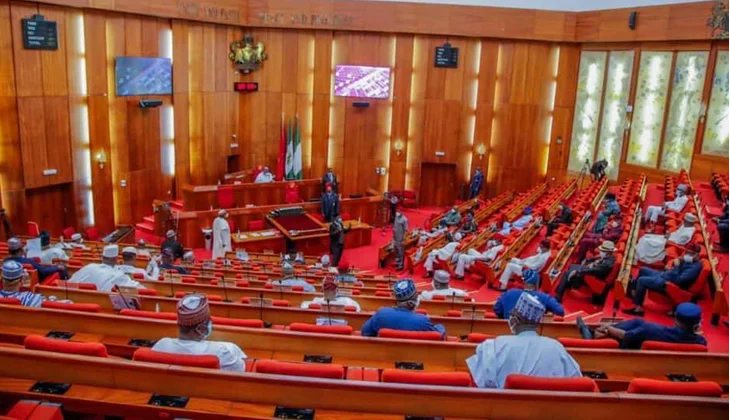
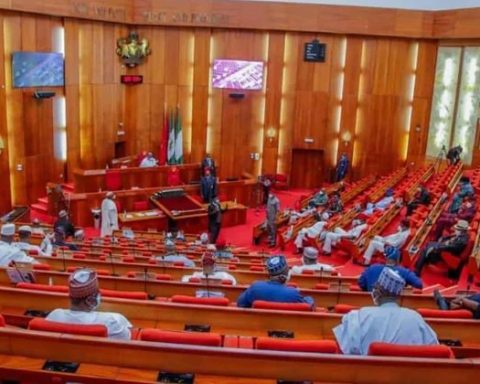
Amid sustained public backlash and protests, the Senate’s tense and at times rowdy sitting to revisit the electronic transmission of election results may appear to signal a dramatic shift, yet in substance, little has truly changed.
As I had stated in my initial opinion article on this subject, even if lawmakers end up making electronic transmission mandatory, the deeper question remains unresolved: how does such a mandate function in a country where many polling units are located in rural areas without reliable electricity or network coverage?
That concern I raised is precisely what played out during the emergency plenary session. The Senate had insisted that network limitations will affect many of Nigeria’s polling units.
Join our WhatsApp ChannelYet, as I argued earlier, this justification risks sounding more like a strategy that ultimately favours the political elite.
The real question is not whether infrastructure gaps exist, but who should be held accountable for a development failure that continues to shape the credibility of the country’s elections, a question that exposes how irresponsible the Nigerian government of which the Senate is part of is. Is the Senate not supposed to pass a law that will aid such development?
Perhaps it is not their concern; no senator stays in rural areas: it is only farmers who battle insecurity that remain there.
The countless amended clause 60(3), which was the object of the protest, now reads: “that results shall be transmitted electronically from each polling unit to IReV.
“And such transmission shall be done after the prescribed EC8A has been signed and stamped by the presiding officer and party agents who are available at the polling unit. Provided that if the electronic transmission of the result fails as a result of communication failure, the result contained in form EC8A signed by the presiding officer and/or countersigned by the polling agents shall, in such a case, be the primary source of collation and declaration of results.”
It is very obvious that the Senate cleverly touched this section because of the public outcry, but what about clause 22, which also raises serious concerns? Reducing the ten-year recommended jail term and relying primarily on fines for offences such as vote buying and manipulation of PVCs appears convenient for politicians.
Can politicians, who can afford the enormous costs of running for office, not pay a fine of N5 million? Such offences should carry non-negotiable penalties, as vote buying has been a major, persistent problem in Nigeria’s democratic growth. Yet, the Senate did not address that during Tuesday’s session. Perhaps it is still waiting for citizens to protest differently for it to do the right thing.
The Peoples Democratic Party (PDP) just yesterday warned that the Senate’s insertion of an “escape clause” allowing manual transmission of election results where technology is said to fail poses a threat to the credibility of the 2027 general elections and described it as a “clever by half”. One may simply argue that PDP is an opposition party, but a close look at the said section 60(3) suggests that the PDP is right.
Recall that the protests and controversy that forced this reconsideration did not emerge in isolation.
READ ALSO:Voting in the Dark: Nigeria’s Electoral Reform Fails to Shine
Electoral Reforms: Nigeria’s Senate on the Spot as Protests Highlight Flawed Democracy
Senate Reverses Position, Endorses Electronic Transmission of Election Results
Since 1999, Nigeria has amended the Electoral Act multiple times, yet the law has consistently failed to empower the electorate to freely and transparently choose their leaders. Practices such as ballot box snatching, manipulation of results, and tallying votes beyond the number of accredited voters have remained recurrent.
In 2023, these challenges persisted despite the deployment of BVAS devices intended to modernise voting and enable real-time transmission of results. Many election officers were unable to upload results immediately from polling units to INEC’s portal.
The outcome of the 2023 presidential election was widely perceived as manipulated, fuelling claims that the public will had been compromised.
This situation prompted opponents, including Mr Obi and Mr Atiku Abubakar, to challenge the outcome in court, presenting evidence they said showed widespread mutilation of election result sheets.
Much of this material had already begun circulating online during the election, with many citizens tagging it as proof that the process had been rigged, further intensifying public suspicion and debate.
Meanwhile, the Supreme Court, in its post-election judgement, clarified that the Independent National Electoral Commission’s Results Viewing Portal (IReV) cannot be considered part of the official collation system unless expressly entrenched in law.
The adoption of electronic transmission, the court emphasised, must be explicitly stipulated in the Electoral Act to be legally binding. It was this legal and procedural gap that prompted the current amendment. The reform was then necessary if Nigeria genuinely seeks a credible, transparent, and modern democratic process.
Loopholes Persist Despite Tuesday’s Amendment
Tuesday’s amendment shows that the Senate at least heard the growing public outcry and felt compelled to revisit its earlier position. That acknowledgment matters. Yet the revised framework still leaves room for abuse, raising questions that cannot be ignored.
A central concern is how a communication failure is determined and, more importantly, who makes that determination. To many observers, the issue may appear resolved for now, but such grey areas tend to resurface when disputes reach the courtroom.
A compromised electoral officer could claim network failure even where electronic transmission was possible, thereby activating the fallback to paper forms as the official record.
In a legal contest, how does one prove that no failure occurred without independent, verifiable evidence? Courts rely on proof recognised by law, and where discretion is broad and safeguards are unclear, accountability becomes difficult to establish.
The original purpose of the IReV portal was to allow Nigerians to observe transmissions and build confidence through transparency. Under the present arrangement, however, many results may still never be uploaded, limiting that visibility, much like what Nigerians witnessed during the 2023 election. In practice, the paper record continues to carry greater authority than electronic transmission, leaving unresolved the very vulnerabilities the countless amendments were meant to address.
It therefore raises a difficult but necessary question: what exactly is the Senate afraid of? If transparency is truly the stated goal of reform, provisions that dilute real time visibility risk reopening the same trust deficit that reform is meant to close.
In the end, true electoral reform requires more than legislative gestures.
A well-meaning National Assembly, truly committed to projecting democracy and respecting the will of the people, could have made real-time transmission of election results mandatory without conditions, and then proceeded to implement policies and development plans that ensure reliable electricity and nationwide network coverage to enable real-time transmission.
Anything less risks serving as a strategic design to perpetuate electoral manipulation, allowing those in power to exploit, while public trust will continue to erode, since the promise of credible, transparent elections will remain unfulfilled.

Amanze Chinonye is a Staff Correspondent at Prime Business Africa, a rising star in the literary world, weaving captivating stories that transport readers to the vibrant landscapes of Nigeria and the rest of Africa. With a unique voice that blends with the newspaper's tradition and style, Chinonye's writing is a masterful exploration of the human condition, delving into themes of identity, culture, and social justice. Through her words, Chinonye paints vivid portraits of everyday African life, from the bustling markets of Nigeria's Lagos to the quiet villages of South Africa's countryside . With a keen eye for detail and a deep understanding of the complexities of Nigerian society, Chinonye's writing is both a testament to the country's rich cultural heritage and a powerful call to action for a brighter future. As a writer, Chinonye is a true storyteller, using her dexterity to educate, inspire, and uplift readers around the world.