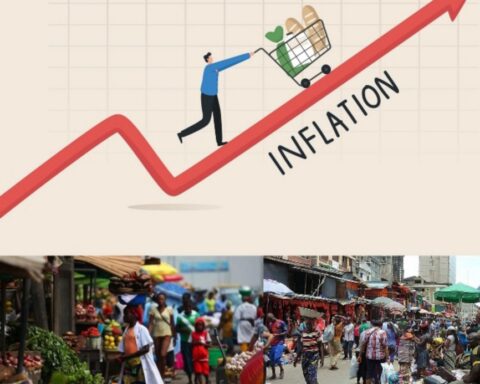
Nigeria’s headline inflation rate has further dropped to 32.15 per cent in August 2024 against 33.40 per cent in July 2024. This reflects a decrease of 1.25 per cent point, according to the latest National Bureau of Statistics (NBS) Consumer Price Index (CPI) report for August released on Monday.
This is the second time the inflation rate dropped after a consecutive acceleration for 19 months when it reached a 28-year high of 34.19 per cent in June 2024.
Join our WhatsApp ChannelAccording to the NBS report, looking at the headline inflation rate on a year-on-year basis, there was 6.35 per cent points higher compared to the rate recorded in August 2023 which was 25.80 per cent. “This shows that the headline inflation rate (year-on-year basis) increased in August 2024 when compared to the same month in the preceding year (i.e., August 2023),” the NBS report added.
On a month-on-month basis, the headline inflation rate in August 2024 was 2.22 per cent, which shows 06 per cent lower than the rate recorded in July 2024 (2.28 per cent). “This means that in August 2024, the rate of increase in the average price level is lower than the rate of increase in the average price level in July 2024.”
READ ALSO: Nigeria’s Inflation Drops To 19-month Low At 33.40%
According to the report, food and non-alcoholic beverages remains the highest contributor with 16.65 per cent (YoY), items on the divisional level, to the Headline index. This followed by Housing, Water, Electricity. Gas & Other Fuel (5.38 percent), clothing & Footwear (2.46 per cent), and Transport (2.09 per cent) among others.
Food Inflation eases to 37.52%
The NBS report shows that food inflation rate stood at 37.52 per cent, reflecting a drop of 2.03 per cent from 39.53 per cent in July 2024.
However, on a year-on-year basis, food inflation rate in August 2024 was 8.18 per cent points higher when compared to the rate recorded in August 2023 which was 29.34 per cent.
According to the report, the surge in Food inflation on a year-on-year basis was caused by increases in prices of the following Bread, Maize Grains, Guinea Corn, Yam, Irish Potatoes, Water Yam, Cassava Tuber, Palm Oil, Vegetable, and Ovaltine, Milo, Lipton.
However, on a month-on-month basis, the report indicated that there was a 0.10 per cent decrease in the Food inflation rate in August 2024 to 2.37 per cent from 2.47 per cent recorded in July 2024.
“The fall can be attributed to the decline in the rate of increase in the average prices of Tobacco, Tea, Coco, Coffee, Groundnut Oil, Milk, Yam, Irish Potatoes, Water Yam, Cassava Tuber, Palm Oil, Vegetable etc.”
In terms of states, Bauchi recorded the highest inflation rate in August with 46.46 per cent in the all-item category. This is followed by Kebbi (37.51 per cent) and Jigawa (37.43 per cent). Conversely, Benue had the lowest inflation rate (25.13 per cent), followed by Delta (26.86 per cent) and Imo (28.05 per cent).
Sokoto recorded the highest food inflation rate (46.98 per cent), followed by Gombe (43.25 per cent), and Yobe (43.21 per cent), while Benue (32.33 per cent), Rivers (33.01 per cent) and Bayelsa (33.36 per cent) had the lowest food inflation rate.

Victor Ezeja is a passionate journalist with seven years of experience writing on economy, politics and energy. He holds a Master's degree in Mass Communication.