Editor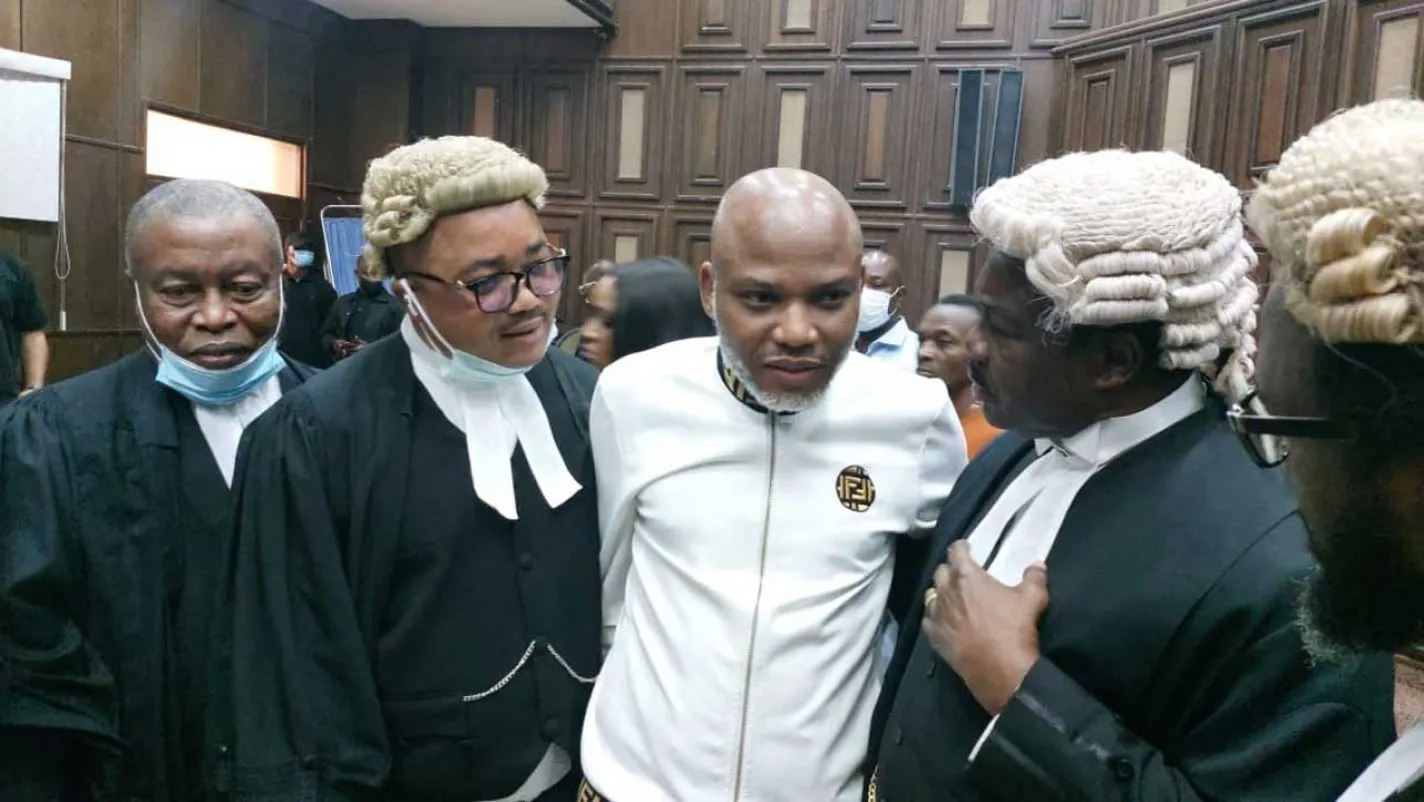
History, Drama and That Nnamdi Kanu Verdict
By Chuka Nnabuife_
I heard many say, “Ndi Igbo are on trial” during Mazi Nnamdi Kanu (MNK)’s long-drawn ordeal. The process was unnecessarily stretched, dramatic, and utterly gripping — full of suspense like a finely crafted classical drama.
Had William Shakespeare or Ola Rotimi witnessed the spectacle, a brilliant theatre script would already be in the making. Everything—thrill, twist, turns and rigmarole — played out in the Federal High Court in the FCT, Abuja. Even the side-scenes, the supporters and critics staging protests before and after each appearance, and the noisy weigh-ins of observers, would make strong supporting acts on any stage.
Join our WhatsApp ChannelWhen justice becomes theatre, the audience remembers the actors more than the truth. Encountering the MNK farce was like watching a perfectly created raw material for dramatists of the late 19th century and early 20th centuries such as Oscar Wilde, Bertolt Brecht and their likes. As Brecht and Wilde saw human tragedy as fertile ground for artistic creation, so did activists in Nigeria’s Fourth Republic, fanatics of justice and equity, commentators, politicians, Biafranists and others find meat, bone and marrow in MNK’s trial, even as Kanu’s physical and mental strain stared the world in the face. Brecht held that tragedy should expose the social forces behind suffering, compelling audiences to think.
Wilde believed art could elevate even pain into beauty. MNK’s travails offered moments that begged for artistic interpretation. Just as Brecht challenged society with tragedy, and Wilde sought meaning through aesthetic form, Rotimi, in The Gods Are Not to Blame, used Odewale’s anguish to illuminate deeper truths. MNK’s story carries a similar energy.
Kanu’s throes or shall one say, those chapters of how “Nigeria happened” to him — were spectacles of a man crushed by his own country. The trial itself is rich material for a theatrical masterpiece.
So, when Justice James Omotosho finally ended the affair on Thursday, 20 November 2025, few were surprised. Yet many wondered why the court travelled such an arduous, circling path towards a conclusion it appeared to have embraced long before proceedings began.
READ ALSO: Kanu Handed Life Imprisonment After Conviction on Seven Terrorism Charges
The verdict was straightforward: MNK was guilty as charged. The judge branded him a terrorist — an enemy of the state. Much like Shakespeare’s Coriolanus, scapegoated by Tribunes who roused the mob and cast him as a menace to Rome, Kanu was marked out by the very forces that, arguably, should have shared the dock with him.
In the same manner Coriolanus was named the “chief enemy to the people,” Kanu was presented as the enemy of the people.
Justice Omotosho declared him a danger to civic peace and the Nigerian commonwealth—an “outlaw,” reminiscent of Valentine in The Two Gentlemen of Verona, wrongfully accused and banished. Ironically, MNK himself was wrongly “submitted” to the court — abducted, renditioned, and then dramatically unveiled in the dock.
Beyond literature, the MNK saga offers sordid scenarios for any playwright. Even the moment during the judgement when the judge ordered MNK to be bundled out for “unruly behaviour” felt like theatre. One can already imagine the stage direction.
In truth, even MNK seemed to become part of the script. His decision — naive or calculated — to sack his entire legal team mid-trial remains baffling. Was it courage, confusion, arrogance, or strategy? His fiery outbursts and attempts to argue for himself added even more spectacle.
Everything about the trial smelt of deliberate content creation — even the sudden switch from years of secrecy to live global broadcast on judgement day. What did those who authorised that exposure want the world to witness? And why? To what purpose?
Indeed, the MNK–Omotosho episode mirrors Nigeria’s present confusion. The country’s ethnic, political, and religious tensions pulsed through the proceedings. The suspicions Nigerians nurse against one another surfaced plainly. Security anxieties and communication failures loomed large.
Yet for many, MNK’s trial was, symbolically, the trial of his ethnicity — the Igbo nation. Hence the frequent refrain: “Kanu’s trial is a trial of Ndi Igbo.” Evidence abounded: shop closures on his court days; every Monday sit-at-home protests across the South-East zone and even in Igbo economic hubs elsewhere; the nationwide demonstrations led by the activist and politician Omoyele Sowore; and other acts of solidarity. Clearly, Kanu has become a lightning rod for frustrations and aspirations within and far beyond Nigeria.
Still, the drama in Justice Omotosho’s court has played out. The state may claim that MNK’s case is ‘resolved,’ but what of the forces surrounding him? A state that fears its own citizens will always put the one they fail to understand on trial. Nigeria may not have chewed the MNK bone well enough before pretending to have swallowed it.
So the questions remain: What becomes of the agitations and aggregations around him? Has the tide truly ebbed for his Indigenous People of Biafra (IPOB) followers? Has the notion that “Kanu’s trial is a trial of Ndi Igbo” been dispelled? Can the world look at the FCT High Court and honestly say justice was done? What has the verdict added to Nigeria’s fight against terrorism? And what, indeed, will James Omotosho and Nnamdi Kanu expect from history and literature after this judgement?
History has no backstage. Every verdict echoes long after the curtains fall.
• Sir Nnabuife, author of the bestseller ‘Nigerian Civil War 1967–1970: Holes in Our Bubbles,’ writes from Awka, Anambra State