 Emmanuel Ochayi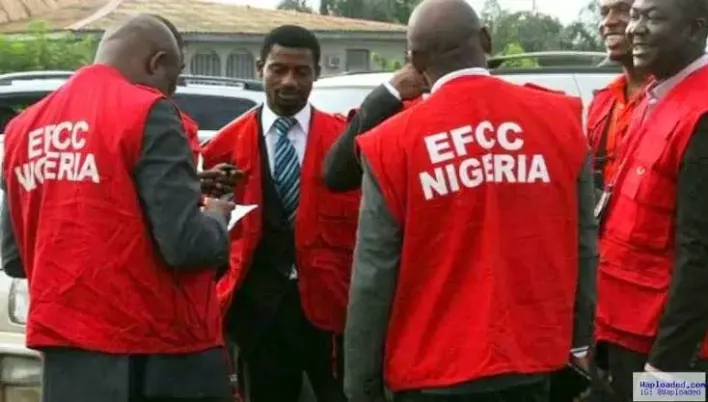
EFCC Announces Legal Action Against Bank Executives
The Economic and Financial Crimes Commission (EFCC) is gearing up to prosecute several top executives in Nigeria’s banking sector over allegations of financial crimes, including money laundering and fraudulent practices.
This revelation came from EFCC Chairman, Olanipekun Olukoyede, during the 17th Annual Banking and Finance Conference organised by the Chartered Institute of Bankers of Nigeria (CIBN) in Abuja.
Join our WhatsApp ChannelSpeaking at the event, Olukoyede stated, “We have concluded our investigations into several banks and their senior officials. You will soon see prosecutions of some banks and top officials.” He added that the EFCC has compiled all necessary documents and completed investigations into unethical financial dealings in the sector.
Prosecutions Imminent
The EFCC Chairman highlighted that these investigations would soon lead to strict penalties for those involved. “We need to do something drastic to bring everybody in line.
A system where there is no penalty for criminal infractions will never survive,” Olukoyede said, emphasizing the need for accountability in the banking sector.
He also pointed out that without penal consequences, the integrity of Nigeria’s financial system is at risk, adding, “It’s important that we impose sanctions to protect the system and align with global standards.”
READ ALSO: EFCC To DNFBPs: Don’t Allow Your Businesses To Be Used For Money Laundering
Unethical Practices Plaguing Banks
Olukoyede used the platform to discuss a range of unethical practices that are common in the banking sector. These include manipulation of foreign exchange rates, charging depositors fraudulent fees, and participating in money laundering activities.
According to the EFCC boss, financial institutions often engage in these illegal activities to boost their profits, disregarding regulations.
“Operators frequently find ways to bypass regulations, aiming for higher yields. Practices such as forex manipulation, defrauding depositors with phantom charges, and complicity in laundering illicit funds undermine the sector’s integrity and hurt the economy,” Olukoyede explained.
He also expressed concern over banks’ involvement with politically exposed persons (PEPs), noting that financial institutions play a key role in money laundering schemes that further destabilize Nigeria’s economy. “Banks must stop serving as channels for illicit activities by PEPs,” he stressed.
EFCC and Banks to Collaborate
Despite the crackdown, Olukoyede reaffirmed the EFCC’s willingness to collaborate with the banking industry to strengthen Nigeria’s financial system.
He called on banks to ensure full compliance with anti-money laundering laws and encouraged stronger regulatory oversight from institutions like the Chartered Institute of Bankers of Nigeria.
The EFCC Chairman urged, “The banking sector must adhere to ethical standards. Prioritizing profits over national interest only leads to long-term economic harm.” He warned that banks that fail to comply with regulations would face severe consequences moving forward.
CBN Steps In
In a related development, the Central Bank of Nigeria (CBN), recently announced that it will closely monitor recapitalisation efforts in the banking sector. The aim is to prevent illicit funds from infiltrating banks during the recapitalisation process.
The CBN, in collaboration with law enforcement agencies, plans to ensure that all capital raised complies with anti-money laundering regulations. Banks are now required to conduct comprehensive due diligence, including Know Your Customer (KYC) and suspicious transaction monitoring.
This move aligns with efforts from the EFCC to clean up the financial sector and ensure that banks are not used as vehicles for illegal financial activities.
By cracking down on unethical practices and prosecuting top banking officials, the EFCC hopes to restore public trust in Nigeria’s financial system. As Olukoyede concluded, “We must act decisively to secure our economic future.”

Emmanuel Ochayi is a journalist. He is a graduate of the University of Lagos, School of first choice and the nations pride. Emmanuel is keen on exploring writing angles in different areas, including Business, climate change, politics, Education, and others.
- Emmanuel Ochayi
- Emmanuel Ochayi