 Amanze Chinonye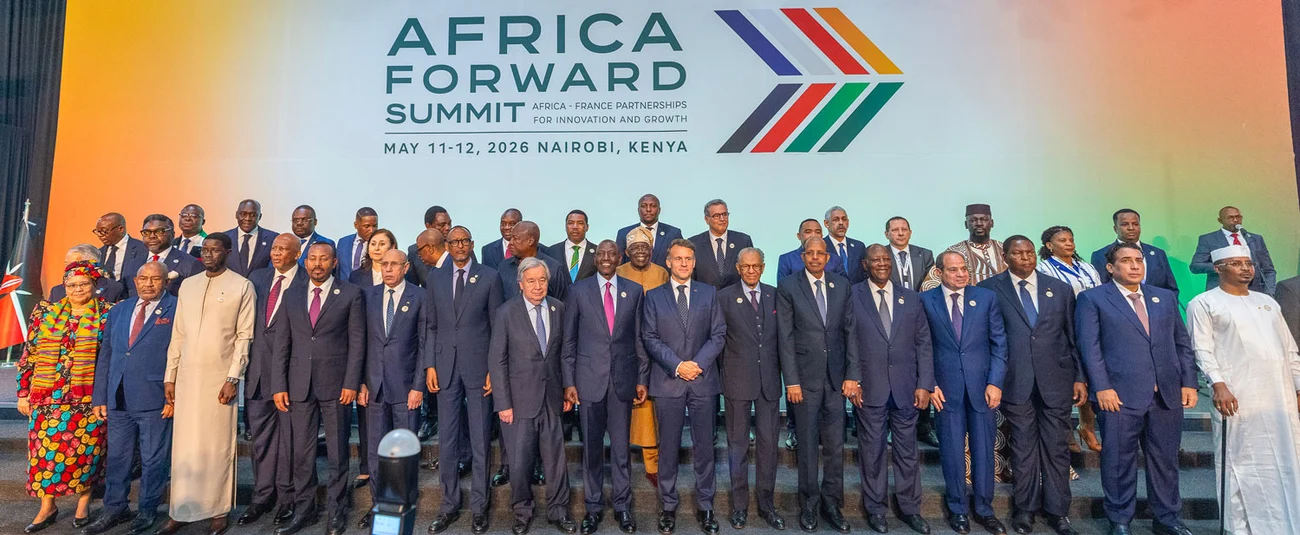
African leaders, global partners, and development finance institutions have endorsed an ambitious push to reshape how development funding is mobilised across the continent, with a renewed focus on reducing borrowing costs and unlocking large-scale private investment into infrastructure and industrial growth.
The consensus emerged at the Africa Forward Summit in Nairobi, where heads of state, international organisations, investors, and development agencies gathered to advance a new framework known as the New African Financial Architecture for Development (NAFAD).
The summit was co-hosted by Kenyan President William Ruto and French President Emmanuel Macron, and brought together an estimated 5,000 participants from across government, finance, and the private sector in what organisers described as a coordinated effort to reposition Africa within global capital markets.
Join our WhatsApp ChannelREAD ALSO :
Tinubu Sets Out on Strategic France, Kenya, Rwanda Tour for High-Level Economic Talks
At the centre of the discussions was the African Development Bank Group, which is driving the NAFAD initiative as a coordinated strategy aimed at addressing a longstanding challenge: Africa’s difficulty in converting its financial resources and savings into productive long-term investments.
The President of the African Development Bank Group, Dr Sidi Ould Tah, said the continent’s main constraint is not a shortage of money but the inability to convert perceived risk into investable opportunity at scale.
“Africa is not capital poor. Africa is risk-transformation poor,” he said, underscoring the need for stronger financial instruments capable of attracting institutional investors.
Data presented at the summit showed that Africa faces an annual infrastructure and development financing gap of more than $400 billion, despite holding close to $4 trillion in domestic savings.
However, the continent still attracts only a small fraction of global investment flows, estimated at about 1% of institutional capital and roughly 4% of foreign direct investment.
The imbalance, officials said, continues to limit job creation and industrial expansion at a time when Africa’s labour force is growing rapidly. Between 12 and 15 million young Africans enter the job market each year, while only around 3 million formal jobs are created annually, creating mounting pressure on economies across the region.
A key constraint identified at the summit was the lack of sufficient risk guarantees and insurance capacity, with participants estimating a financing protection gap of $40 billion to $50 billion annually. This gap, they said, prevents many infrastructure and industrial projects from reaching financial closure, even when funding interest exists.
READ MORE :
Abia State Commits to Co-Finance $200m Agro-Industrial Hub with AfDB
Under the emerging NAFAD framework, attention has turned to the African Trade & Investment Development Insurance (ATIDI), headquartered in Nairobi, which has been positioned as a central institution in the proposed continental guarantee system.
The plan envisions the African Development Bank leveraging its strong balance sheet to support African financial institutions in reducing investment risk and attracting global capital into key sectors such as energy, manufacturing, logistics, and digital infrastructure.
Kenyan President William Ruto described the strengthening of ATIDI as essential to Africa’s financial independence, calling it a “critical pillar” in building a system where African economies can increasingly fund their own development priorities through homegrown institutions and innovative risk-sharing tools.
French President Emmanuel Macron also voiced support for the initiative, backing the expansion of ATIDI and a broader first-loss guarantee mechanism designed to improve Africa’s attractiveness to global investors. He described the effort as part of a shift toward a “new financial paradigm” that recognises Africa’s economic potential.
United Nations Secretary-General António Guterres added that African countries must strengthen domestic resource mobilisation while continuing to push for reforms in global financial governance that better reflect the needs of developing economies.
Across discussions, there was broad agreement that Africa’s development model must evolve away from traditional aid dependence toward a more investment-driven system anchored in domestic savings, stronger capital markets, and increased private sector participation.
The NAFAD framework itself is built around coordination between African and international financial actors, guided by principles aimed at improving risk-sharing, efficiency, and capital mobilisation at scale.
Officials said the scaling of ATIDI represents the first major step in operationalising the framework, with further progress expected to align with upcoming international economic meetings, including G7-level discussions in France.
As the summit concluded, Dr Ould Tah stressed urgency in moving from planning to implementation, noting that the institutional foundations are already in place.
“The political moment is now. The institution exists. The approach is endorsed. The capital pathway is mapped,” he said, urging collective action to accelerate Africa’s financial transformation.

Amanze Chinonye is a Staff Correspondent at Prime Business Africa, a rising star in the literary world, weaving captivating stories that transport readers to the vibrant landscapes of Nigeria and the rest of Africa. With a unique voice that blends with the newspaper's tradition and style, Chinonye's writing is a masterful exploration of the human condition, delving into themes of identity, culture, and social justice. Through her words, Chinonye paints vivid portraits of everyday African life, from the bustling markets of Nigeria's Lagos to the quiet villages of South Africa's countryside . With a keen eye for detail and a deep understanding of the complexities of Nigerian society, Chinonye's writing is both a testament to the country's rich cultural heritage and a powerful call to action for a brighter future. As a writer, Chinonye is a true storyteller, using her dexterity to educate, inspire, and uplift readers around the world.