 Emmanuel Ochayi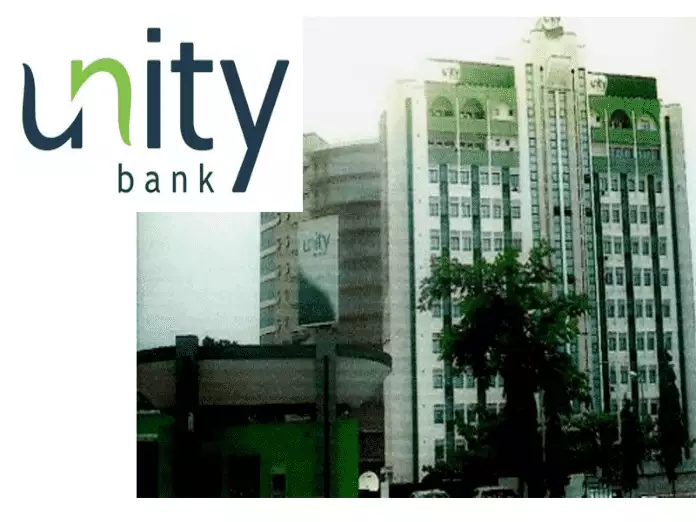
Unity Bank Plc, backed by the Asset Management Corporation of Nigeria (AMCON), has reported a staggering net loss of N38.9 billion for the first half of this year.
This comes as a stark contrast to the N1.7 billion net profit recorded just a year ago, according to the bank’s newly released financial report.
Join our WhatsApp ChannelAs Unity Bank navigates these turbulent financial waters, all eyes are on the bank’s strategy and its ability to weather the currency storm in Nigeria’s banking sector.
The financial turbulence experienced by Unity Bank is a stark departure from the ongoing banking boom in Nigeria, where a sharp depreciation of the naira by approximately 40 percent in June alone has proven to be a windfall for banks with foreign currency-denominated loans, resulting in record profits for some.
Unity Bank’s financial woes were exacerbated by a foreign exchange revaluation loss of N35.4 billion for the period, a stark contrast to the mere N16.2 million recorded a year earlier. Curiously, no detailed explanation has been provided for the considerable discrepancy.
READ ALSO: Nigeria’s Finance Minister Promises a Level Playing Field for Global Investors
Among the notable figures in Unity Bank’s financials is the revelation of N8.9 billion in long-term loans from the African Export-Import Bank, converted from US dollars.
Addressing the situation, Unity Bank’s CEO, Tomi Somefun, stated, “In the light of the prevailing FX revaluation in the financial system, what we have is a market-driven impact which is adjustable envisaged from the positive economic outcomes of the government policies in the near term.”
She continued, “The negative shareholders’ fund has improved considerably through the injection of N135 billion, which moderated the negative shareholders’ fund from (-ve) N275 billion in December 2022 financial year-end to (-ve) N178 billion as at the end of June 2023, after absorbing the FX revaluation loss suffered in Q2/2023.”
To mitigate this negative balance, the bank drew N135.2 billion from its other reserves in the form of convertible debentures, reducing the shareholders’ fund deficit by 35 percent.
While Unity Bank’s revenue for the period showed a marginal increase, with gross earnings rising from N27.6 billion to N27.8 billion, the key profitability metric, net interest income, plummeted by 23 percent to N7.9 billion.
This was primarily due to a weakened interest income and increased interest expenses. Furthermore, operating expenses surged by 16 percent to N15.3 billion, driven by a significant uptick in personnel expenses.
The bank’s balance sheet also revealed a concerning aspect, with total liabilities of N688.8 billion surpassing its total assets by 35.1 percent.
In a bid to regain stability and competitiveness, CEO Tomi Somefun hinted at Unity Bank’s plans to complete its recapitalization program soon, emphasizing that it will enable the financial institution to “do business as expected in the fast-growing markets in Nigeria.”

Emmanuel Ochayi is a journalist. He is a graduate of the University of Lagos, School of first choice and the nations pride. Emmanuel is keen on exploring writing angles in different areas, including Business, climate change, politics, Education, and others.