 MARCEL MBAMALU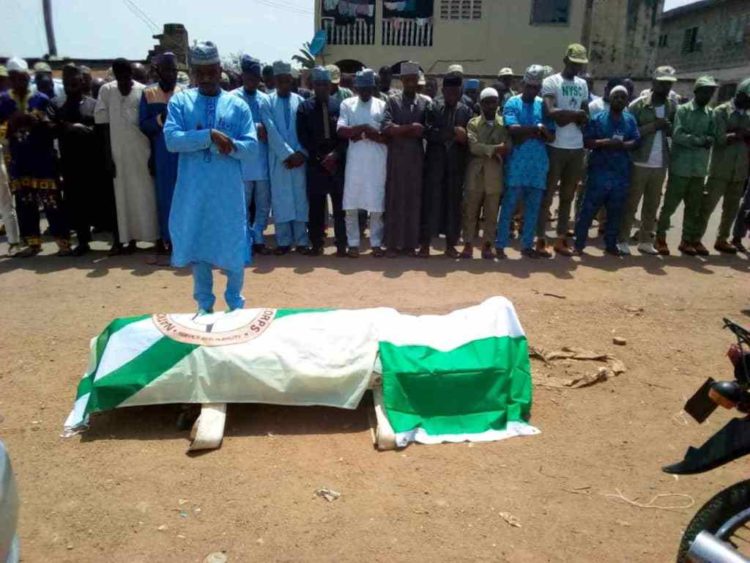
The killing of a National Youth Service Corps (NYSC) member in Abuja has again drawn attention to the recurring tensions that follow civilian deaths during military operations in Nigeria, particularly where facts remain disputed.
His death has since reopened the questions about transparency in security operations and the burden of establishing clear facts when civilians are killed in such circumstances.
Join our WhatsApp ChannelAt 24, Abdulsamad Jamiu should have been counted among the thousands of young Nigerians completing the compulsory NYSC scheme, a programme designed to symbolise unity, sacrifice, and national contribution. Instead, his death in Dei-Dei, Abuja, during a military operation has become another troubling test of Nigeria’s accountability systems.
His killing in the early hours of 25 April has produced two sharply conflicting narratives: one from the Nigerian Army, which said he was caught in crossfire during an anti-robbery operation, and another from his family, which alleged he was shot inside his home by soldiers who unlawfully entered the premises.
Between these versions lies a deeper national concern, one that extends far beyond a single tragedy: when civilians die during security operations, can the Nigerian state establish the truth quickly, transparently, and credibly enough to sustain public trust? And are military operations meant to kill innocent citizens, or are they meant to protect?
For a country already burdened by insecurity, that question is no longer theoretical.
Conflicting account
According to a statement issued on Sunday, Lieutenant Olawuyi Odunola, the Acting Assistant Director of Army Public Relations, Headquarters Guards Brigade, Abuja, said Jamiu was killed during a security incident. He said soldiers on routine patrol responded to a distress call over an armed robbery incident in Shagari Estate. The Army said troops encountered armed robbers, came under fire, and engaged in a “brief but intense” gunfight, during which Mr Jamiu was struck by stray bullets.
Yet, we were not told if any of the thieves were shot or if the thieves ran into that particular building. Why was it only that building that was affected?
The family, however, forcefully rejected that account. Relatives said soldiers scaled the fence of the family compound around 2 a.m., entered without warning, and shot through the closed door of Mr Jamiu’s room, killing him instantly. They argued that physical evidence, including bullet trajectory and the reported absence of multiple gunshots, contradicted claims of a broader exchange of fire. They also called for an independent investigation outside military structures.
These two accounts are not minor discrepancies. They are fundamentally different versions of reality. One suggests an unintended casualty during a volatile anti-crime operation.
The other implies wrongful use of lethal force against an unarmed civilian in his own residence. But was Mr Jamiu killed outdoors during a robbery response or indoors while asleep? Was there an active gun battle, or was there a single fatal shot?
Were operational protocols followed, or was force deployed recklessly? Are the military supposed to kill or capture a thief?
Without transparent answers to the aforementioned questions, official communication risks appearing less like accountability and more like damage control. This pattern has become increasingly familiar in Nigeria’s security landscape.
Military operations and civilian protection
Nigeria’s military has constitutional responsibility for national defense, but it has also increasingly been deployed in internal security roles, from counterinsurgency to anti-banditry and urban rapid response.
Such deployments are often justified by severe security threats. Yet operating in civilian communities demands strict rules of engagement, clear identification of threats, and prioritisation of civilian safety.
Urban security operations are inherently complex. Criminals may exploit populated environments. Intelligence may be imperfect. Operational pressures may be high.
But none of these realities removes the obligation to distinguish between legitimate threats and innocent civilians.
Professional security institutions are judged not only by their success against criminal actors but also by their capacity to minimize harm to the people they are sworn to protect.
A troubling national pattern
Jamiu’s killing fits into a broader pattern of civilian deaths linked to Nigerian military operations, where official accounts, eyewitness claims, and investigation outcomes often diverge. In 2020, the Lekki Toll Gate shootings during the EndSARS protests raised early concerns about the use of lethal force against civilians, with judicial findings recommending accountability that has remained contested in implementation.
In 2023, Nasarawa airstrikes reportedly killed herders mistaken for armed groups, while the Tudun Biri drone strike in Kaduna, which killed at least 85 civilians, exposed intelligence failures despite subsequent investigations and disciplinary claims.
Similar disputes followed strikes in Zamfara and Kaduna between 2024 and 2025, where civilian casualties were acknowledged in some cases, but clarity over responsibility and outcomes remained limited.
Just a few weeks back, reports from Yobe State indicated that Nigerian military aircraft struck Jilli market along the Borno-Yobe border, killing large numbers of civilians. Amnesty International reported over 100 deaths, while some local sources estimated nearly 200 casualties. The federal government defended the strike as an intelligence-led counterterrorism operation in a known insurgent corridor while simultaneously ordering an investigation. Rights groups, regional institutions, and international observers again demanded independent scrutiny.
Across these incidents, a recurring issue persists: investigations are announced, but transparency and public confidence remain inconsistent, deepening mistrust in security accountability.
This is notwithstanding that Nigeria does not lack mechanisms for military inquiry. Boards of inquiry, internal investigations, and occasional presidential directives exist. The deeper problem is public confidence in these mechanisms. Too often, investigations are announced, but findings remain opaque. In incidents such as the death of Jamiu, questions arise over whether full findings were established before public statements were issued or whether communication preceded complete verification, further deepening suspicion rather than clarity.
The Army’s statement in the case may prove accurate, incomplete, or disputed upon independent scrutiny. The family’s account equally requires forensic verification. That is precisely why independent investigation matters to find answers to what forensic examination has been conducted, whether witness statements were independently gathered, what evidence supports the Army’s robbery-response narrative, why accounts differ so sharply, what oversight mechanisms are engaged, and when will findings be publicly released?
These are not anti-military questions. They are pro-accountability questions. Abdulsamad Jamiu was a corps member serving his country. His death demands clarity, not contradiction. Where civilian deaths occur, the truth must not remain contested between official statements and grieving families.

Dr. Marcel Mbamalu is a distinguished communication scholar, journalist, and entrepreneur with three decades of experience in the media industry. He holds a Ph.D. in Mass Communication from the University of Nigeria, Nsukka, and serves as the publisher of Prime Business Africa, a renowned multimedia news platform catering to Nigeria and Africa's socio-economic needs.
Dr. Mbamalu's journalism career spans over two decades, during which he honed his skills at The Guardian Newspaper, rising to the position of senior editor. Notably, between 2018 and 2023, he collaborated with the World Health Organization (WHO) in Northeast Nigeria, training senior journalists on conflict reporting and health journalism.
Dr. Mbamalu's expertise has earned him international recognition. He was the sole African representative at the 2023 Jefferson Fellowship program, participating in a study tour of the United States and Asia (Japan and Hong Kong) on inclusion, income gaps, and migration issues.
In 2020, he was part of a global media team that covered the United States presidential election.
Dr. Mbamalu has attended prestigious media trainings, including the Bloomberg Financial Journalism Training and the Reuters/AfDB Training on "Effective Coverage of Infrastructural Development in Africa."
As a columnist for The Punch Newspaper, with insightful articles published in other prominent Nigerian dailies, including ThisDay, Leadership, The Sun, and The Guardian, Dr. Mbamalu regularly provides in-depth analysis on socio-political and economic issues.