 Amanze Chinonye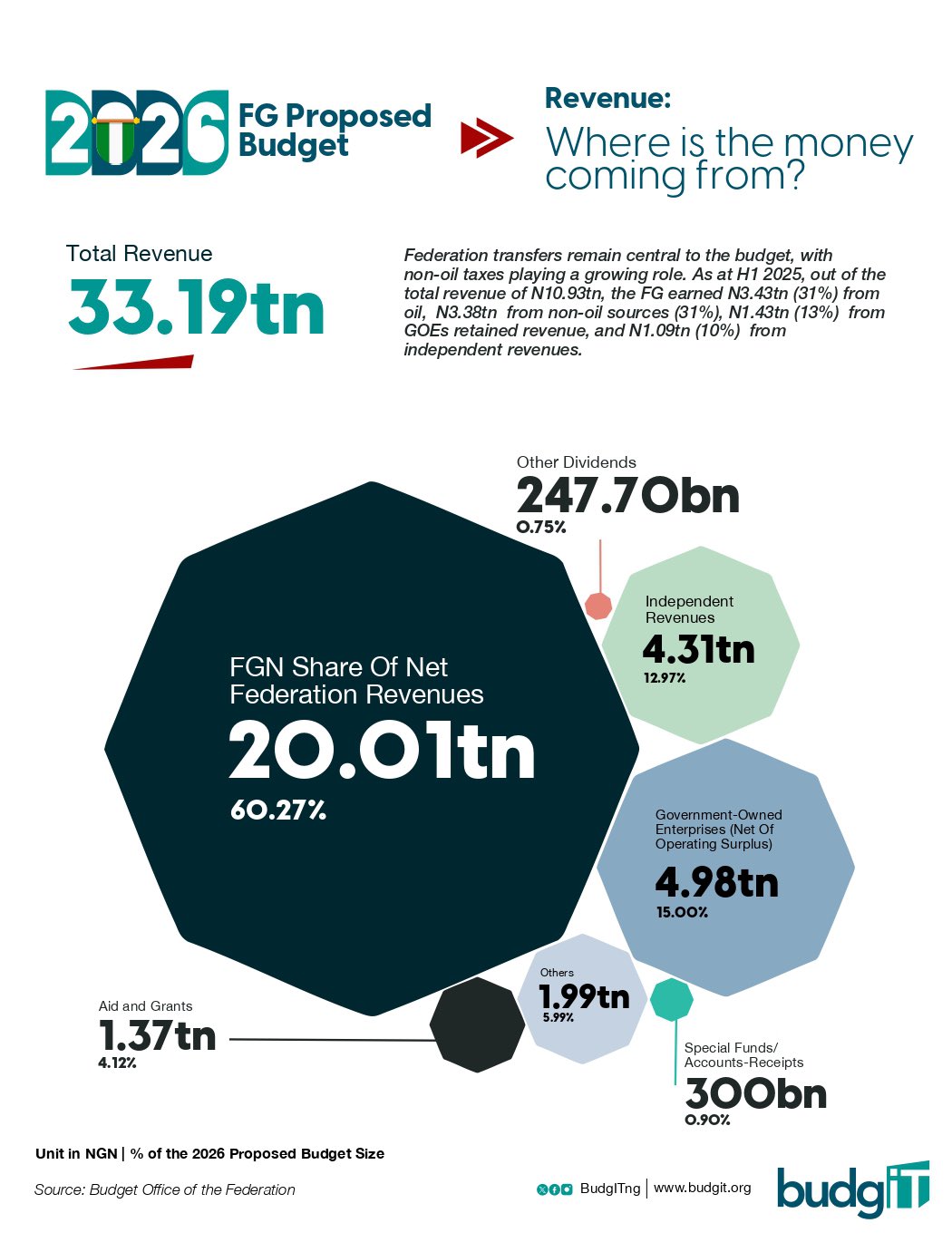
The Federal Government has projected a total revenue of N33.19 trillion in its proposed 2026 budget, with federation transfers remaining the single largest source of funding, alongside growing contributions from government-owned enterprises and independent revenues.
A breakdown of the proposal, obtained from the Budget Office of the Federation, shows that the FGN share of net federation revenues is expected to account for N20.01 trillion, representing 60.27 per cent of the total projected revenue. This reflects the continued centrality of federally shared revenues to Nigeria’s fiscal framework.
Revenues from Government-Owned Enterprises (GOEs) are projected at N4.98 trillion, making up 15 per cent of the budget, while independent revenues are estimated at N4.31 trillion, or 12.97 per cent. These figures underline the government’s reliance on agencies and parastatals to boost non-oil income.
Join our WhatsApp ChannelREAD ALSO : Federal Government Unveils 2026 MDA Budget Allocations; Finance, Defence, Works Lead Spending
Further analysis shows that aid and grants are expected to contribute N1.37 trillion (4.12 per cent), while revenues stand at N1.99 trillion, representing 5.99 per cent of the total. Special funds and account receipts are projected at N300 billion (0.90 per cent), with other dividends estimated at N247.7 billion, accounting for 0.75 per cent.
The revenue structure reflects a continuation of recent fiscal patterns, with federation revenues and non-oil income remaining the main pillars of government funding.
As of the first half of 2025, total federal revenue stood at N10.93 trillion, with oil and non-oil sources contributing almost equally. Oil revenue accounted for N3.43 trillion (31 per cent), while non-oil sources generated N3.38 trillion (31 per cent). Government-owned enterprises contributed N1.43 trillion (13 per cent), and independent revenues stood at N1.09 trillion (10 per cent).
Fiscal analysts note that while oil revenues remain significant, the 2026 projections signal a sustained push towards diversifying government income through non-oil taxes, GOEs and independent revenue streams.

Amanze Chinonye is a Staff Correspondent at Prime Business Africa, a rising star in the literary world, weaving captivating stories that transport readers to the vibrant landscapes of Nigeria and the rest of Africa. With a unique voice that blends with the newspaper's tradition and style, Chinonye's writing is a masterful exploration of the human condition, delving into themes of identity, culture, and social justice. Through her words, Chinonye paints vivid portraits of everyday African life, from the bustling markets of Nigeria's Lagos to the quiet villages of South Africa's countryside . With a keen eye for detail and a deep understanding of the complexities of Nigerian society, Chinonye's writing is both a testament to the country's rich cultural heritage and a powerful call to action for a brighter future. As a writer, Chinonye is a true storyteller, using her dexterity to educate, inspire, and uplift readers around the world.