 Amanze Chinonye
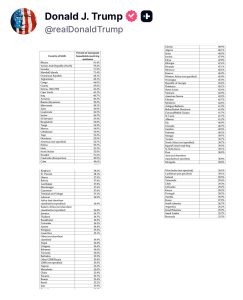
U.S. President Trump has reignited debate over immigration and public spending after posting data outlining what he described as “Immigrant Welfare Recipient Rates by Country of Origin,” with Bhutan, Yemen and Somalia emerging as the top three countries with the highest reported rates of government assistance usage among immigrant households in the United States.
According to the chart shared by the president on his Truth Social platform, the top three immigrant welfare recipient rates are:
- Bhutan: 81.4 per cent
- Yemen Arab Republic (North): 75.2 per cent
- Somalia: 71.9 per cent
President Trump argued that the figures demonstrate that the current U.S. immigration and welfare system is “unsustainable,” blaming past immigration policies for placing what he described as excessive strain on social services. He said the data supports the need for stricter immigration controls and reforms to public assistance eligibility.
Join our WhatsApp ChannelBeyond the top three, the chart lists dozens of other countries and regions with reported welfare participation rates above 50 per cent, including the Marshall Islands (71.4 per cent), Afghanistan (68.1 per cent), the Dominican Republic (68.1 per cent), Guinea (65.8 per cent), Iraq (60.7 per cent) and Burma/Myanmar (59.2 per cent).
READ ALSO : Exiled Iranian Crown Prince Praises Trump as Protests Sweep Nation
Somalia Takes Security Council Helm Amid Scrutiny of Ambassador’s Past
Mid-range figures include Liberia (48.9 per cent), Algeria (48.1 per cent), Syria (48.0 per cent), Jordan (47.8 per cent), Ethiopia (47.6 per cent) and Morocco (46.6 per cent), while lower figures on the chart feature countries such as Nigeria (33.3 per cent), China (32.9 per cent), Brazil (32.2 per cent) and Iran (31.9 per cent).
The post has triggered immediate backlash from immigration advocates, civil rights groups and policy analysts, who questioned the source, methodology and definitions used in compiling the data. The chart did not cite a specific U.S. government agency or explain which programmes were counted under the term “welfare.”
Experts note that no official federal dataset publicly confirms these exact national percentages by country of origin. They also caution that in many studies, a household is classified as receiving public assistance if any one member benefits from programmes such as Medicaid, food assistance or housing support, a method that can significantly raise reported participation rates.
Analysts further warn that country-level figures may reflect factors such as refugee resettlement patterns, family size and health needs rather than long-term dependency, and stress the importance of clear context when interpreting such statistics.
As debate continues, the data has become a focal point in the broader national conversation on immigration policy, welfare reform and the use of statistics in shaping public opinion and government action.

Amanze Chinonye is a Staff Correspondent at Prime Business Africa, a rising star in the literary world, weaving captivating stories that transport readers to the vibrant landscapes of Nigeria and the rest of Africa. With a unique voice that blends with the newspaper's tradition and style, Chinonye's writing is a masterful exploration of the human condition, delving into themes of identity, culture, and social justice. Through her words, Chinonye paints vivid portraits of everyday African life, from the bustling markets of Nigeria's Lagos to the quiet villages of South Africa's countryside . With a keen eye for detail and a deep understanding of the complexities of Nigerian society, Chinonye's writing is both a testament to the country's rich cultural heritage and a powerful call to action for a brighter future. As a writer, Chinonye is a true storyteller, using her dexterity to educate, inspire, and uplift readers around the world.