Prime Business Africa
By Miracle Chika
Nsukka, Nigeria—Two hundred and twenty-two years after a group of enslaved Igbo people chose death by water over bondage at a remote creek in Georgia, their descendant, United States Federal Commissioner Griffin Lotson, returned to their ancestral homeland in an act of powerful spiritual and academic reconciliation.
Speaking to a packed Princess Alexandra Auditorium at the University of Nigeria, Nsukka (UNN), as part of the Faculty of Arts Distinguished Guest Lecture Series in 2025, Commissioner Lotson delivered a moving lecture that affirmed: “The Igbo and the Gullah Geechee are, in essence, one people divided by time but reunited by memory.”
Join our WhatsApp ChannelThe Immortal Episode of Igbo Landing
The emotional core of Lotson’s address, titled “Africa (Nigeria) and United States of America (USA) Gullah Geechee Connections”, centred on the 1803 tragedy known as Igbo Landing on St. Simons Island, Georgia.
Lotson, who traced his lineage to the very plantations near the site in McIntosh County, recounted the historical account of Igbo captives who, upon realizing their captivity, revolted, broke free of their chains, and collectively walked into the waters of Dunbar Creek. Their chant, according to oral tradition, was a profound declaration of agency: “The water spirit brought us here; the water spirit will take us home.”
READ AlSO: The Igbo Culture of Widowship: Stopping The Stereotypes, Way Forward
This act, Lotson argued, was not merely suicide but a profound declaration of human agency and a refusal of enslavement, making the landing a metaphor for freedom.
The narrative gave rise to the enduring African diasporic myth of the Flying Africans, who spiritually transcended their physical chains.
Lotson himself stood before the audience as a “living testimony” to this history, stating that the blood running in his veins is both Gullah Geechee and Igbo.
Evolving From Preservation to Partnership
Commissioner Lotson, who has served as the longest-serving U.S. Federal Commissioner and Vice Chairman Emeritus on the Gullah Geechee Cultural Heritage Corridor Commission, detailed the institutional efforts to preserve his people’s unique culture in the American Southeast.
The Gullah Geechee Cultural Heritage Corridor, designated by an Act of the U.S. Congress in 2006, runs from North Carolina down to Florida. Its mission is to document, interpret, and preserve the living story of the Gullah Geechee people, safeguarding their unique folklore, language, crafts, and oral traditions.
Lotson’s personal mission is to expand this work by building bridges of understanding between the Gullah Geechee people and their ancestral kin, particularly the Igbo of Nigeria. He noted that due to the isolated nature of the coastal and barrier islands where they were enslaved, Gullah Geechee descendants were able to retain the essence of their ancestral identity, including a distinct Creole language.
A New Vision for Academic Synergy
The purpose of the lecture was not just to reflect on the past but to build a forward-looking partnership. Lotson’s visit signals a move to institutionalise the connection through academic collaboration.
He emphasised that the Faculty of Arts in Nigerian universities must play a crucial role in documenting, preserving, and teaching this intertwined heritage. The Igbo Landing is not the end of a story, he insisted, but “the beginning of a bridge, a bridge between continents, between histories, and between hearts.”
This transatlantic dialogue, facilitated by scholars like Professor Chris Uchenna Agbedo and Dr Anakwenze, is envisioned as:
Joint symposia and research.
Artist-in-residence programs and inter-faculty collaborations.
The use of modern technology, including Artificial Intelligence and digital communication tools, to connect classrooms and digitise archives across the Atlantic.
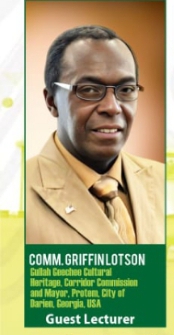
Lotson ended his address by sharing his Igbo name, Ikechukwu Chinedum, and declaring the reunion a spiritual and academic honour. He concluded with a powerful message of kinship: “May this rekindled bond… continue to grow as a living testimony that indeed, across time and tide – ‘Anyị bụ otu – We are one.”