Prime Business Africa
Within the past two business days, the U.S. stock exchange has suffered a steep 10.5% decline, resulting in a market value loss of over $5 trillion. With a total valuation of approximately $50 trillion, experts are already predicting a recession in the U.S.
The U.S. stock exchange is intricately interconnected with global finance, with numerous countries, sovereign wealth funds, and multinational corporations holding substantial investments in U.S. equities and debt instruments.
Join our WhatsApp ChannelAs of June 2023, foreign portfolio holdings of U.S. securities stood at approximately $27 trillion, accounting for more than 50% of total foreign-owned U.S. financial assets. These holdings span equities, corporate bonds, and government securities.
Countries with substantial holdings in U.S. markets include Japan, the United Kingdom, Canada, Luxembourg, Germany, China, and France. These nations manage significant portions of pension funds, insurance portfolios, and sovereign reserves through U.S.-based financial markets, making them deeply vulnerable to major fluctuations like this one.
Africa’s direct exposure to the U.S. stock market is relatively small compared to Western and Asian economies. The continent’s investments are typically routed through sovereign wealth funds, central bank reserves, and a few institutional investors.
READ ALSO: Nigeria’s Equity Market Rises By 0.79% As Investors Focus On Key Stocks
There is limited detailed public data on the continent’s aggregate holdings, but countries like South Africa, Nigeria, Egypt, and Morocco maintain some level of exposure via indirect portfolio holdings and reserve management strategies.
Nigeria’s direct investment in the U.S. stock exchange is relatively modest, and its overall exposure is limited. However, the implications of a 10.5% U.S. market decline can still be significant for Nigeria.
READ ALSO: US Stocks Rise More Than 20% For Second Year As AI Drives Big Tech Gains
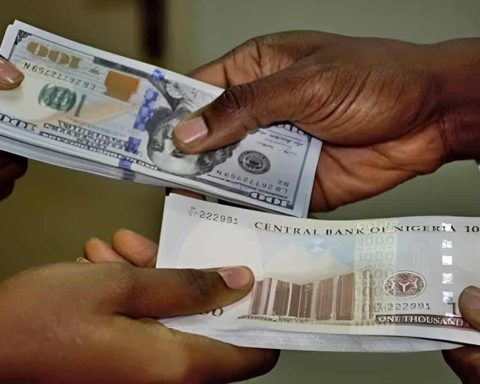
As global investors flee to safe-haven assets like the U.S. dollar, demand for the dollar surges, leading to depreciation of the naira. This has already prompted the Central Bank of Nigeria (CBN) to intervene by injecting nearly $200 million into the FX market to stabilize the local currency.
With the U.S. market in turmoil, foreign investors may reassess their risk appetite and slow down capital flows into emerging markets like Nigeria.
The U.S. is one of Nigeria’s major trading partners. A weakened U.S. economy could lower demand for Nigerian exports, especially its oil, impacting trade revenue.
Many Nigerians living in the U.S. send money home regularly. This is one of Nigeria’s sources of foreign exchange. Economic uncertainty and job losses abroad may reduce remittance volumes, affecting household incomes and local consumption.
So, while Nigeria may not hold a large stake in the U.S. market, its economic dependency on global financial flows, trade, and remittances makes it vulnerable to the aftershocks of a U.S. market crash. The situation underscores the fragile interdependence of modern global economies, where a tremor in one corner can cause quakes worldwide.
Abdulrazaq Hamzat is a multi-dimensional policy analyst.

Prime Business Africa is a business, economy and policy news platform founded in 2021 by veteran journalist and media scholar, Dr Marcel Mbamalu, after he left The Guardian as Editor.
Dr Mbamalu, who serves as Founder and Publisher, set up Prime Business Africa to deliver sharp, data-driven reporting on Nigeria’s markets, trade, investment, and governance trends for decision-makers, entrepreneurs, and policy leaders.
He also writes The Bottom Line, a backpage column for Punch Newspaper every Thursday.
Under his leadership, Prime Business Africa combines deep newsroom experience with a focus on accountability journalism, aiming to bridge information gaps between Africa’s private sector and the global economy.